
- FTSE 100 loses 57 points
- Bank of England raises interest rates to 5%
- Nasdaq nudges higher, other US indexes stay down
4.45pm: FTSE 100 breaks 7,500 mark
At the close of trading, London's key index held its head above the 7,500 mark despite dropping 57 points on the day, closing 0.8% lower at 7,502.
That marked a three-week low as investors worried about the impact of more rate hikes on the UK economy, noted IG's Chris Beauchamp.
"The losses are even more pronounced on the mid-cap FTSE 250 due to its UK exposure. A recession in the UK now seems an inevitability with the Bank of England committed to more rate hikes, and at a faster pace," Beauchamp wrote. "Everything is now subordinate to the task of getting inflation under control, with heightened recession risk accepted as a necessary evil.”
3.45pm: A few more BoE reactions
As we wind down to the market close, obviously the day’s big focus has been the Bank of England’s 50 basis point interest rate hike, so here are some more reactions:
Economists at German bank Berenberg noted: “Citing yesterday’s upside surprise to core inflation, solid gains in employment and higher wage inflation, the Bank of England (BoE) voted 7:2 to raise its bank rate by 50bp to 5% today. After 25bp moves at its previous two sessions, the BoE thus sent a strong signal that it wants to get inflation back under control. Whereas a 50bp hike had been a distinct possibility, we and most other observers had expected a 25bp increase”.
They said: “We expect two more 25bp rate hikes on 3 August and 21 September. From the new starting level of 5%, that would lift the Bank rate to 5.5% by September, above our previous call for a 5.25% peak. The more pain the BoE inflicts on mortgage holders now, the more it may have to take back later on. We now look for six instead of five BoE rate cuts next year to take the bank rate to 4% by the end of 2024.”
The Berenberg analysts added: “The risks to our call are largely balanced, in our view. If inflation surprises to the upside again in the coming months, the BoE may go further. However, if inflation moderates sufficiently and if employment and wage growth lose momentum, the BoE may not go beyond one final hike in August. As today’s 50bp hike suggests that the BoE wants to be decisive, it seems possible that the BoE will raise rates again by 50bp in August – and stop thereafter.”
Meanwhile, Jamie Dutta, market analyst, at Vantage Markets commented: “Speculation had ramped up that we may see a bigger half-point move after the fourth straight upside surprise in CPI on Wednesday. Still, consensus had forecast a smaller quarter-point increment mainly because there was no press conference or fresh, quarterly economic projections.
“But that didn’t deter policymakers in making this surprise move and the chance of a hard landing down the road. A notably tight labour market and continued hot, persistent inflation data have forced the bank to address the highest core reading in 31 years. The Bank rate has now been moved further into restrictive territory at 5% as policymakers endeavour to put the inflation genie, especially in the services sector, back in the bottle.”
He added: “Sterling’s knee-jerk reaction on the news was to spike higher but it has given back some of those gains. It seems markets are looking through the current hiking cycle and front-loading by the bank to the possible pain ahead in the UK economy.
And Julian Jessop, economics fellow at the free market (rightwing) think tank The Institute of Economic Affairs, said: “A more credible central bank might have been able to leave interest rates on hold today. Indeed, two members of the Monetary Policy Committee (MPC) voted to do just that. The full impact of previous rate increases has yet to be felt and there are still good reasons to expect inflation to fall sharply over the remainder of the year, including the rapid deceleration in the growth of money and credit.
“Unfortunately, confidence in the Bank is low after a series of policy mistakes, forecast errors and communication blunders. This MPC was forced to raise rates by an unexpected half a point to demonstrate that it is serious about getting inflation back down — along with signalling that further rate rises could be on the way.”
3.25pm: Bless you, my son
The Church of England (CofE) Pensions Board has decided to divest its holding in oil giant Shell PLC over what it said were insufficient plans to align its strategy to the goal of limiting global warming, Reuters has reported.
The CofE pensions board has around £1.35mln invested in Shell of its total £3.2bn in investments.
On Thursday, the CofE’s separate £10.3bn Church Commissioners fund said it will also divest all remaining oil and gas companies from its portfolio, including Shell, BP, Equinor and TotalEnergies, Reuters noted.
"The Church will follow not just the science, but our faith – both of which call us to work for climate justice," Justin Welby, the Archbishop of Canterbury, said in Thursday's statement.
The CofE Pensions Board said in its statement today that it would no longer prioritise engagement with the oil and gas sector on climate change and would instead refocus its efforts on reshaping the demand for oil and gas from sectors such as the auto industry.
A Shell spokesperson, quoted by Reuters, said the Church funds' decisions were "disappointing, but not surprising".
3.05pm: No Turkish delight
We shouldn't be complaining about the Bank of England's big 50 basis point rate hike today - not after the Turkish central bank's latest move.
Turkey has hiked its main interest rate from 8.5% to 15%, reversing one of re-elected President Recep Tayyip Erdogan's economic policies. Interest rates have come down from 19% two years ago to 8.5% in recent months.
Today's 6.5-point rise was far lower than economists were expecting, but it marked a major shift in policy by President Erdogan's new economic team brought in to tackle rampant inflation.
Inflation is almost 40% and Turks are in the grip of a cost-of-living crisis. In its statement, the Turkish central bank's monetary policy committee made clear that Thursday's move was the start of a gradual process, with the target of bringing inflation down to 5%.
Its members said they had "decided to begin the monetary tightening process in order to establish the disinflation course as soon as possible... and to control the deterioration in pricing behaviour".
In late afternoon trading, Shell shares were 1.3% lower at 2,334p.
2.45pm: Powell repeats
The FTSE 100 index remained weaker in mid-afternoon trading, knocked by the Bank of England’s 50 basis point rate hike, with US stocks also opening lower as Federal Reserve chairman Jerome Powell prepares to appear before the Senate Banking Committee today.
Powell’s message is expected to be the same as he delivered to the House Financial Services Committee on Wednesday, namely that US interest rates will need to rise further to get inflation back into the central bank’s target range.
Around 15 minutes after the New York open, the Dow Jones Industrial Average (DJIA) was down 80 points, or 0.2% at 33,870, while the broader S&P 500 index shed 0.2%, and the tech-laden Nasdaq Composite fell 0.1%.
On the data front, US initial jobless claims for last week signalled slower job growth despite the data being clouded by possible fraudulent claims, according to Pantheon Macroeconomics chief economist Ian Shepherdson.
Claims came in at 264,000, above the Street’s expectation of 259,000 and unchanged from the prior week's upwardly revised reading.
“Three straight readings above 260,000 are not conclusive evidence of a real shift in the trend, especially given the uncertainty over potentially large numbers of fraudulent claims, and the unreliability of the seasonals,” Shepherdson said.
“That said, the increase is consistent with the rising trend in layoff announcements, measured by both the Challenger survey and WARN notices of plant closures and mass layoffs and the year-over-year rate, which is impervious to seasonal adjustment problems, is rising rapidly too.”
He pointed out that, stepping back from the noise, the bigger picture was that the change in the financing environment for businesses, especially small firms, ought to be pushing up layoffs by now.
“We expect claims to rise further over the summer, but beware of volatility in late June and July, thanks to the difficulty of seasonally adjusting the numbers during and after the annual automakers’ retooling shutdowns,” Shepherdson said. “Focus on the trend, not the weekly numbers.”
2.20pm: Horse's mouth
You can also hear why the Bank of England hiked rates by so much direct from the Bank of England governor, Andrew Bailey's mouth in this tweet:
Andrew Bailey sets out the reasons behind today’s decision to raise interest rates. pic.twitter.com/58AqMJVMqD
— Bank of England (@bankofengland) June 22, 2023
2.10pm: BoE reactions continued ...
Yet more reaction to the Bank of England's (unlucky) 13th rate hike, with the 50 basis point interest rate increase to 5% predicted by some after Wednesday's CPI inflation number stuck at 8.7% in May.
Martin Beck, chief economic advisor to the EY ITEM Club, commented: “With inflation in both April and May well above the Bank of England’s expectations, core inflation no longer just sticky, but rising, pay growth still heated, and the jobs market tight, there was little doubt that the MPC would deliver another rise in Bank Rate in its June meeting. The question had been just how big the rise would be. With seven of the nine members voting to raise the policy rate by 50bps to 5%, Bank Rate is now at its highest level in almost 15 years. Two members voted to keep rates on hold.
“The fact that the MPC has now got ahead of market expectations (which had erred towards a 25bps rise) may give it leeway to skip what had been a widely-expected further rate rise when the committee meets next in August. With headline inflation expected to come down noticeably over the next few months, there could be further rationale for a pause. Last June saw petrol prices increase by over 9%, but pump prices are now falling, and July will see a material fall in household energy bills, reflecting the cut in the Ofgem price cap."
He added: “On the other hand, it was noticeable that the MPC didn’t use June’s policy statement to push back against current market expectations that Bank Rate will continue to increase and peak at 6% early next year. The implication is that criticism of the Bank of England's credibility may have started to have an impact. After all, as concerning as the recent inflation numbers have been, they're now in the rear-view mirror.
"Forward-looking developments have generally been positive, with pipeline price pressures in April falling to the lowest in over two years, inflation expectations among households and firms continuing to fall, energy bills likely to decline by close to 20% next month, growth in the money supply slowing to a crawl from double-digit rates in 2021, and the stronger pound expected to bear down on import prices. Moreover, the Bank of England's own estimate is that around two-thirds of the effects of past rises in interest rates are still to come."
Meanwhile, the economists at ING noted: "Consistent inflation surprises convinced the BoE to hike by 50 basis points this month, and it now seems unlikely that the committee will be content with hiking only once more in August.
"We’re tempted to say that today’s 50bp move won’t become a new trend, but two further 25bp hikes seem like the most likely route after today’s meeting."
1.30pm: A look at some top risers and fallers on the junior market
Biome Technologies PLC (AIM:BIOM) shares rose nearly 14% higher as the leading bioplastics and radio frequency technology business revealed a contract win by a subsidiary.
Longboat Energy PLC (AIM:LBE) shares jumped over 3% higher after the oil and gas company confirmed approval has been granted for its joint-venture deal with Japan Petroleum Exploration Co.
Hornby PLC (LSE:HRN), the maker of model trains, saw its shares fall 13% in the wake of its prelims.
Falcon Oil & Gas Ltd (AIM:FOG, TSX-V:FO) shares fell over a third after a new production test update informed investors that the Amungee NW-2H well, drilled in December and fracked in March, has yet to establish an "uninhibited production rate".
Robinson PLC (AIM:RBN) shares shed 13% after the custom packaging company announced at its annual general meeting today that its chief executive Dr Helene Roberts will be stepping down to pursue a new opportunity.
1.15pm: Markets weighing up BoE hike
Thoughts from the City are, as ever, still pouring in after the BoE decision.
Here's Craig Erlam, market analyst at Oanda, on the hike to 5%.
"There's every chance that those backing 50 basis points did so in the hope that doing more now may necessitate the need to do less later on and for a shorter period of time," he said.
"That's not how markets are initially perceiving it though, with the odds of Bank Rate rising above 6% increasing. It could get rather painful in inflation doesn't improve soon.
"The pound appears to be weighing up both of these considerations, as is evident in the very volatile response we've seen in the currency. Rate hikes are generally good for a currency but when they're rising to levels that could seriously threaten the economy, there's certainly an argument for the opposite to happen."
And Michael Hewson at CMC Markets: "Today’s move is tantamount to an acknowledgement that they have been materially behind the curve when it come to the rate hiking cycle and will inevitably invite criticism that the MPC in reacting now, is inviting a recession."
He adds: "While it could be argued that there is an element of panic in today’s move, we also must acknowledge that today’s move could be viewed as a bit of a free hit for the MPC given that UK gilt markets had already priced in the sort of move we’ve seen today."
Hewson says the MPC has "taken the decision to act decisively now, given that to delay might invite further criticism.
"Nonetheless, headline inflation should start to come down quite sharply towards the end of Q3, as we head towards the end of the year as the energy price cap effects continue to drop out. Reducing core prices on the other hand may be a slightly more challenging prospect."
1,00pm: Wall Street expected to join FTSE in red
US stocks are expected to open lower after Federal Reserve chairman Jerome Powell doubled down on his message that interest rates will need to rise further to get inflation back into target range.
Futures for the Dow Jones and Nasdaq 100 were both pointing to a 0.3% decline in pre-market trading, while those for the broader S&P 500 index were 0.25% lower.
Overnight, tech shares led a third day of losses on Wednesday following Powell’s semi-annual testimony to the House of Representatives on the state of US monetary policy.
Today, Powell appears before the Senate Banking Committee, where the message is expected to be the same.
“The Fed Chair appeared before the House Financial Services Committee and very much stuck to last week's script, which should come as a surprise to no one. Inflation is not under control and the vast majority at the Fed believe more rate hikes will be warranted was the message, although we got that from the dot plot," commented Craig Erlam, senior market analyst at OANDA.
"For once, markets are buying what the Fed is selling and have priced in a 70% chance of a hike in July. But that's where they believe it ends with the easing cycle then starting around the turn of the year so the Fed and the markets aren't entirely on the same page," Erlam added. "The data will likely determine whether markets remain in agreement on July as I imagine it will take less to convince investors that another hike isn't warranted than the Fed."
12.47pm: London's FTSE 250 is tumbling
While the blue-chips on the Footsie are little changed from where they were this morning, down 1.2%, the more UK-focused stocks of the FTSE 250 have plunged more dramatically since the Bank of England decision.
The UK's mid-cap index is now tumbled 235 points or 1.3% to 18,335.9 - the lowest since late March.
The biggest fallers are property developer British Land Company PLC (LSE:BLND), down 6.4%; challenger bank Virgin Money UK PLC, down 4.8%; and housebuilder Vistry Group PLC, down 4.1%.
Several other housebuilders are among the big fallers.
12.28pm: More market reaction to hike
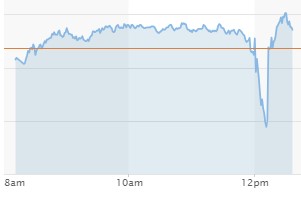
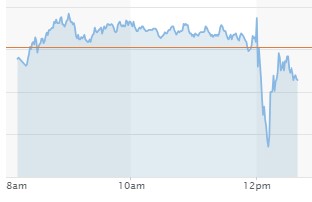
Gilt yields spiked briefly after the BoE decision was revealed, before moving lower, with the 2yr scuttling under 5% and then bouncing back, and the 10yr pummelled to 4.28% from around 4.40% earlier this morning, then bouncing to 4.37%.
Markets are pricing evens chance that BoE goes to 6.25% now, pointed out market analyst Neil Wilson at Finalto, "implying another 125bps of hikes – bank still doesn’t think it gets there but it didn’t think it would need to go to 5%."
On the gilt yields, Wilson said, the further inversion is "pointing to recession", despite bouncing a bit from the lows and trading below the morning levels.
Big bear flattening of the gilt curve since the MPC's bigger-than-expected hike...much needed after the inflation data, but mkts clear in their interpretation that it will deepen the eventual economic slowdown/contraction...not bullish GBP m/t imo...
— Michael Brown (@MrMBrown) June 22, 2023
The yield on a 2yr gilt:
...and a 10yr:
12.16pm: Pound rises then falls after BoE hike, FTSE indices differ
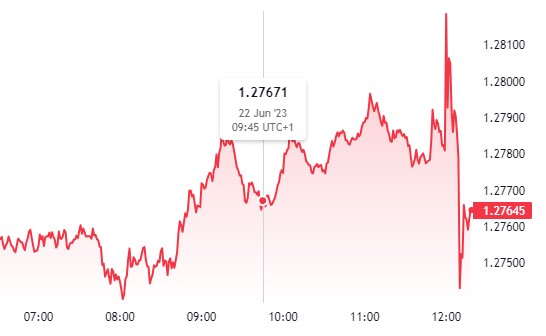
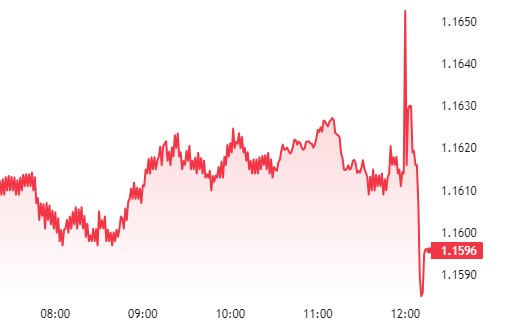
Sterling spiked after the 50bps interest rate hike but then dropped back against both the US dollar and the euro.
The pound at $1.2761 is down slightly versus USD on the day.
And it's a similar story against EUR, down 0.15% at £0.8615.
Stock investors are also working out what it means, with the more international FTSE 100 still down but not as much as it was, 75 lower on the day at 7,484. The more domestically focused FTSE 250 is heading lower though, now down 173 or 0.9% at 18,398.
12.09pm: MPC explains decision
Aftering a half-point hike, the Bank's rate setting committee still says it may need to raise rates further.
"If there were to be evidence of more persistent pressures, then further tightening in monetary policy would be required," the MPC said.
Explaining its decision, the MPC said at its previous meeting in early May the market-implied path for the base rate averaged just over 4% over the next three years.
"Since then, gilt yields have risen materially, particularly at shorter maturities, now suggesting a path for Bank Rate that averages around 5½%. Mortgage rates have also risen notably. The sterling effective exchange rate has appreciated further."
It said the committee is continuing to monitor the impact of the increases in rates so far, which have taken us from just over 0.25% at the end of 2021 to where we are now.
The MPC noted that as more people in the UK are on fixed-rate mortgages nowadays, the full impact of the increase in rate is not felt as quickly as it used to be, and will not be "for some time".
Summing up, the statement said "The MPC will continue to monitor closely indications of persistent inflationary pressures in the economy as a whole, including the tightness of labour market conditions and the behaviour of wage growth and services price inflation. If there were to be evidence of more persistent pressures, then further tightening in monetary policy would be required."
12.02pm: Bank of England hikes rates to 5%
The Bank of England's monetary policy committee (MPC) hiked interest rates half a point to 5.0%.
It was the 13th rate rise in a row as policymakers look to get a grip on inflation that has remained stubbornly high.
The MPC voted by a majority of 7–2 to increase rate to 5%, with two members preferred to maintain bank rate at 4.5%, as in the previous meeting.
It followed yesterday's inflation figures delivered unwanted surprises, with the consumer price index remaining at 8.7% and core CPI rising to a 31-year high of 7.1%.
The reaction from the FTSE 100 was to fall back towards earlier lows, down 893 points to 7476.
11.47am: MPC 'unlikely to hike to 5% today'
Economists at Standard Chartered say the BoE monetary policy committee is not likely to raise interest rates by 50 basis points today as it waits for previous hikes to filter through the economy.
The reason, the bank's chief economist Sarah Hewin told Bloomberg, "is we haven’t had any signals from the MPC members that that’s what they’re planning”.
This ties in with what several others have been saying.
Though Neil Shearing of Capital Economics is among those forecasting the MPC will hike to 5% today due to the recent rises in core inflation.
"This marks the UK out from other advanced economies, including the euro-zone and the US, where core inflation has started to fall."
With markets expecting a 50bps hike, Shearing said if the MPC does not deliver this "could cause financial conditions to loosen and the pound to weaken, which is the last thing that policymakers at the Bank need right now".
11.30am: Hornby fails to deliver, oil prices send Shell and BP lower
Across the market, things weren’t running smoothly at model train maker Hornby, whose shares fell 19% to 18.2p.
The company posted a £5.9mln loss for the 12 months ended March 31 2023 as the consumer downturn hit business.
On blue-chip news, Ocado zoomed 38% to 593p on reports that it "may" be a takeover target for Amazon.
The shares recently sank to a six-year low and are the most shorted stock in London, according to the ShortTracker website.
In the world of oil and gas, its two largest players in London, Shell and BP, were both trading lower as wholesale prices slip.
Shell was down 0.8% to 2,342p, while BP shed around 0.65% to 461p.
The share price falls come on the back of slipping oil prices, with Crude oil down 1.31% to US$71.5/bbl, while Brent lost 1.6% to US$75.8/bbl.
Crude and Brent slipped after US inventories dropped by 1.2mln barrels last week, well below market expectations of 433,000 barrels.
11am: Prominent diarists have their say on the BoE decision
Inspired by a tweet, we have asked ChatGPT to preview the Monetary Policy Committee decision.
In the style of Bridge Jones's Diary:
Dear Diary,
Crikey! The Bank of England's interest rate decision is today. With inflation stubbornly high and wage growth a bother, the tension's more palpable than an awkward dinner with Mum. Everyone's betting on a rise from 4.5% to 5.0%. Haven't seen rates that high since 2008, a proper blast from the past! As for the market, well, they're hoping for a 6% peak by winter - all a bit too "Big Coat" for my liking. If they're wrong, though, expect a strop worse than Darcy refusing to wear his Christmas jumper. Here goes!
Love, Bridget
Carrie Bradshaw on today's Bank of England interest rate decision https://t.co/gr2lh6Qktm pic.twitter.com/yxZdqcD7DA
— Conrad Quilty-Harper (@Coneee) June 22, 2023
10.46am: BoE hike odds shorten
Looking over to Threadneedle Street, markets are now pricing in close to a 50% chance that Bank of England rates will go up to 5% today, rather than the smaller 25bps increase to 4.75%.
A smaller hike is still seen as the favourite.
Most economists are predicting a 25bps raise.
After the strong inflation data and wage growth figures, Julien Lafargue, chief market strategist at Barclays Private Bank, said: “While a 50bp hike today, as partly priced in, cannot entirely be ruled out, the BoE may prefer to hike by 25bp and follow up with a very hawkish message.
“At this point, the BoE is likely to move the bank rate to 5.5% at a minimum and may need to opt for another 25bp hike should core inflation remain stubbornly high in the coming months.
“At the same time, higher mortgage rates are already significant headwinds for UK consumers and the refinancing wave that is to come will only add to the ongoing cost of living crisis. As a result, UK rates are likely to remain volatile in the short term.”
The Footsie meanwhile continues to hover in the doldrums, 61 points below the waterline.
10.20am: First rate hikes of the day
On a day of rate decisions, Switzerland and Norway's central banks have both hiked.
The surprise was from Norway’s central bank, which raised rates by 50 basis points, more than the 25bp that was expected, potentially paving the way for the Bank of England to follow suit.
"What really stands out is the new interest rate projection, which is the output of Norges Bank’s model and shows where policymakers expect rates to go over the coming months," said economists at ING.
Back in March, forecasts pointed to a peak rate of 3.5%, which implied the bank would have hiked by 25bp this month before pausing.
The Swiss National Bank increased rates 25bps, which was smaller than the 50bp hike some predicted.
"But the accompanying statement and upward revision to inflation forecasts for 2024 and 2025 strongly suggest that there will be at least one more hike in this cycle," said Andrew Kenningham at Capital Economics.
9.47am: Shares fighting back but still on the back foot
London's blue chips are fighting back from earlier lows, with most shares paring losses.
Helping things, Ocado is topping the leaderboard with a rise of over 30%.
The FTSE fell below 7460 earlier but is now back up to 7500, though that is still a fall of 60 points on the day.
9.14am: FTSE 100 in 'duldrums'
The FTSE 100 has opened sharply lower on Thursday as investors brace for the Bank of England’s interest rate decision later today following a fourth month of disappointed high inflation yesterday.
Markets are anticipating a 50-basis point hike following the worse-than-expected CPI figure, but economists predict a 25bps increase.
Among individual companies, Premier Inn owner Whitbread fell 1.2% after a positive trading update.
Pharma giant GSK fell 1.8% after US advisors recommended the company's new severe respiratory syncytial virus vaccines only be offered to over 60s.
Box maker DS Smith initially fell but has fought back to positive territory.
Overnight, Amazon was under fire from US regulators, who accused the online retail giant of selling Prime memberships to millions without consent.
Elsewhere, Twitter has made amends with Google, having now restarted making payments for the tech firm’s cloud services after several months.
And among the UK small caps, Quadrise PLC (AIM:QED) shares jumped as the energy tech firm confirmed it now had the means to resume its paused Morocco-based fuel trial.
8.55am: Ocado tops risers
Ocado Group PLC (LSE:OCDO) is top of the FTSE leaderboard again on a report that it "may" be a takeover target for Amazon.
With the shares having sunk to a six-year low recently, the Times says rumours of bid interest are circling.
The story, a market report noted that Ocado was being lifted this week by "speculation of bid interest from more than one American suitor", including "technology heavyweights such as Amazon".
Shares in the online grocery technology group are up 17% to 504p this morning, which brings them back to where they were in early May, having fallen to a low below 345p in early June.
8.48am: Blue-chip boxmaker dented
DS Smith, the FTSE 100-listed cardboard packaging maker, has seen its shares follow the wider market lower after it adopted a cautious tone alongside its final results but announced a 20% dividend hike.
Revenues were up 11%, driven by higher prices to offset a 5.8% decline in volumes as market demand was worse than expected, though underlying operating profit rose 35% to £861mln.
Trading in the new year is in line with management’s expectations, despite box volumes remaining lower than normal.
"Demand for the cardboard boxes that DS Smith makes is likely to continue to remain under pressure as consumers take stock of soaring living costs and pull back on some of their online shopping," said Matt Britzman, equity analyst at Hargreaves Lansdown.
"But pricing is the bigger driver of performance and it’s taking the reins. The benefits of price actions taken over the last couple of years are now feeding through to the bottom line, with underlying operating profit creeping above the guided range of £850-£860mln."
8.40am: Pound slips back ahead of rate decision
The pound, which bounced higher after the surprise inflation figures yesterday suggested more interest rate hikes are to come, has slipped this morning.
GBP is down 0.16% against the US dollar at 1.2748, while easing 0.14% versus the euro.
Sterling is the spotlight today due to the BoE decision later, but much is also at stake for Norway's krone (NOK), says John Hardy, head of FX strategy at Saxo Bank.
"The US dollar saw little volatility on Fed Chair Powell’s rhetoric at testimony before a House Panel yesterday.
"Sterling is more volatile after another hot UK inflation print yesterday and on anticipation ahead of today’s BoE meeting," he said, noting that it had "poked below 1.27 before bouncing as markets weigh whether BOE can address the inflation concerns".
EURGBP surged to 0.86 from 0.8525 and EURUSD surged back towards 1.10 with Hardy observing that ECB officials have been reiterating that the battle against inflation is not won.
USDJPY remains "locked in range" with Japan’s inflation numbers due tomorrow, and the NOK is also in the spotlight on a Norges Bank decision this morning, as the size of today’s hike is debated.
8.29am: Mix of shares in the red
Banks, miners, utilities and drug giants are all among the big early fallers on Thursday, with the Footsie down 93 points or 1.2% to 7,466.50 so far.
Bottom of the blue-chip list is Airtel Africa PLC (LSE:AAF), down 6% on reports that it will take a US$1.3bn hit on its revenues and US$740mln on profit due to a currency devaluation of the Nigerian naira, its largest African market.
Among the other fallers are Barclays and Standard Chartered, two banks with large markets exposure via their investment banking arms. 8.13am: FTSE plunges at the open
The FTSE 100 has plunged lower at the open, falling 74 points or 1% to 7485.10.
This takes it back to its lowest since the start of the month.
Markets are expecting the 13th interest rate hike in a row from the Bank of England at midday.
After the inflation numbers yesterday, Deutsche Bank's Jim Reid said current market pricing is suggesting there’s a 37% chance of a hike to 5.0% today.
"But looking over the June and August meetings together, we’ve got 76bps of rate hikes priced, so that implies markets are fully pricing in a larger move for one of the next two decisions," he said.
7.35am: Whitbread checks in with positive update
Premier Inn owner Whitbread has checked in with a positive first-quarter trading update, giving an optimistic full-year outlook.
Total sales in the quarter rose 19%, or 15% on a like-for-like basis, while revenue per available room rose 16%.
Accommodation sales in the UK grew by 18%, driven by strong consumer demand, especially in London.
Whitbread said it opened 348 new rooms across the UK and Ireland and expects to open up to 2,000 more by the end of the year.
"Our business is in great shape and trading well,” said chief executive Dominic Paul.
7.10am: FTSE 100 heading lower
The FTSE 100 is expected to fall sharply on Thursday, ahead of a Bank of England meeting where interest rates are predicted to be hiked again.
London's blue-chip index was heading for a decline of 45-55 points, according to different spread-betting platforms, which would extend its losses to a fourth day.
Overnight, Wall Street's main stock indices all finished in the red after Federal Reserve chief Jerome Powell suggested he was not done hiking rates.
The falls were led by tech stocks, with the Nasdaq Composite falling 1.2% to 13,502, while the S&P 500 slipped 0.5% to 4,366 and the Dow Jones closed down 0.3% at 33,951.
"This weakness in US markets looks set to translate into a lower European open," said market analyst Michael Hewson at CMC Markets, who noted that there are three central bank rate hikes expected today, with the Swiss National Bank and Norges Bank also tipped to join the BoE in further policy tightening.
After yesterday's surprising inflation figures, the decision from the BoE's monetary policy committee (MPC) was placed slightly in doubt.
An increase in the base rate from its current 4.5% to 4.75% had been widely expected, but some economists are now predicting a move to 5.0%.
"Whatever they do today it’s not expected to be a unanimous decision," said Hewson.
"In the absence of a press conference to explain their actions a 50bps rate move would be a risky strategy, as it could signal they are panicking. A more measured response would be to hike by 25bps with a commitment to go more aggressively at the next meeting if the data warrants it.
"The big problem the bank has is that they won’t get to see the July inflation numbers, when we could see a big fall in headline CPI, until after they have met in August, putting us into the end of Q3 until we know for certain that inflation is coming down."