
Financial regulators should pay serious attention to the risks around the potential confirmation of alien technology or advanced non-human intelligence on Earth, according to a former Bank of England economist, as it would spark extreme price volatility in financial markets.
Confirmation of the presence of such non-human intelligence would also be likely to lead to a crisis in the scientific industry and an upswell of government distrust, according to Helen McCaw, a former senior analyst in financial stability at the Bank of England.
In a worst-case scenario, such events would undermine the legitimacy of governments and their institutions worldwide, McCaw wrote on the Liberation Times website.
Extreme volatility in financial markets would result from investors becoming suddenly uncertain about "how to price assets using any of the familiar methods", she wrote.
Following a number of allegations from ex-military whistleblowers that the US government is in possession of a number of downed alien spacecraft, and that at least one private company is working with Washington on reverse-engineering the technology, McCaw said investors would wonder how successful these engineering programmes have been, how it changes the future for the planet and the implications for various sectors such as energy, utility, transportation, materials technologies, defence and space exploration.
Furthermore, she suggested volatility might also be sparked by suspicions that some companies have been given illegal uncompetitive advantages by governments, and that "perhaps of greatest consequence" what the confirmation of advanced non-human intelligence could do "to the ability of financial regulators to operate, or mitigate risks, in global financial markets".
The expectation about the undermining of governments and world order followed an academic journal article entitled “Sovereignty and the UFO”, drawing on philosophical work from the likes of Michel Foucault and Jacques Derrida, argued that as human beings are sovereign on Earth, if this is undermined it would be likely to undermine the current world order.
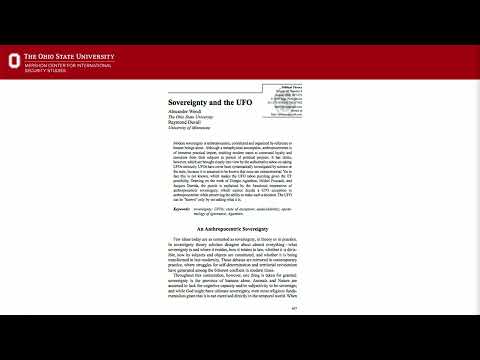
Also, speaking last year, the report's author, Dr Alexander Wendt, posited that a worst-case scenario would see “eight billion people...start wondering individually what that means for their religion, their ideology, their economic wellbeing, wondering about everything, questioning everything that we thought we knew, that we could always take for granted.”
A Bank of England spokeswoman offered no comment on whether this issue is something the Prudential Regulation Authority has addressed or plans to do so.
*** Update with BoE response ***