
Overview
Tajiri Resources (TSX-V:TAJ) Corp., a gold exploration company, is marking significant progress with its Reo Gold Project in Burkina Faso, Africa. The company has turned its focus to the K4-5 Prospect, nestled at the southern end of the extensive Reo Project. Evidence from gold-in-saprolite anomalies, extensive artisanal workings, and an intriguing poly-folded interference pattern suggest this area may yield a large gold deposit. With an expansive drilling and sampling plan, Tajiri aims to unearth the full potential of the Reo Gold Project.
In Africa's heartland
Tajiri Resources (TSX-V:TAJ) is directing its efforts toward the Reo Gold Project, situated at the convergence of the Hounde Boromo and Goren Greenstone Belts, in west-central Burkina Faso, Africa. The primary site of interest within this project is the K4-5 Prospect, lying at the southernmost region of the vast 1,200-kilometre square (km2) Reo Project.
Tracing gold through poly-folded interference patterns
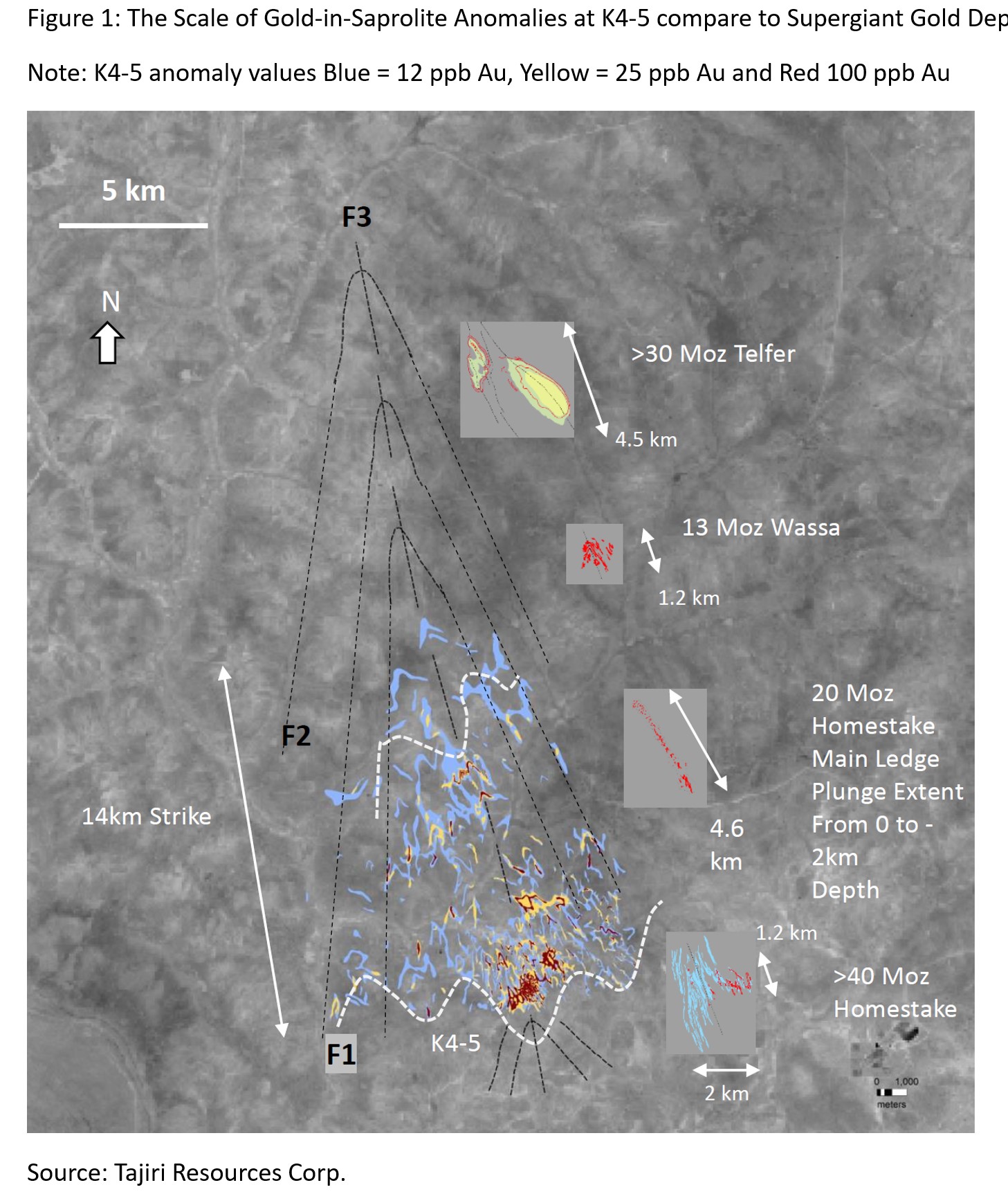
Tajiri Resources (TSX-V:TAJ) is bullish about the K4-5 gold system, characterised by an extensive poly-folded interference pattern. This understanding is based on thorough analysis of magnetic anomalies and satellite imagery. Proterozoic gold deposits worldwide, such as the Wassa Gold Mine, which has produced approximately 1.3 million ounces (Moz) of gold and holds an estimated 11.72 Moz in total resources, share a similar poly-folded structure.
Artisanal workings
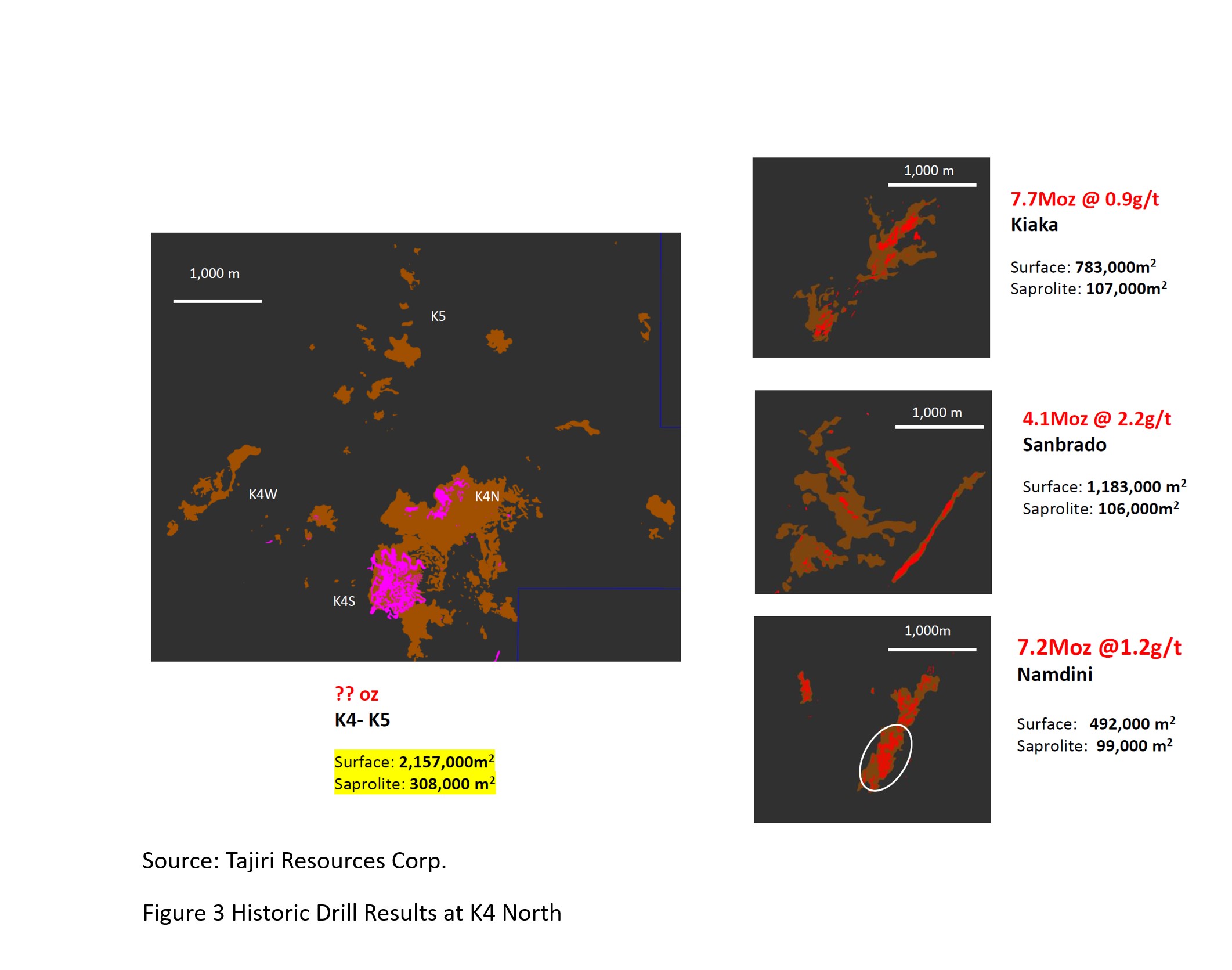
The company has identified sizable gold-in-saprolite anomalies at K4-5, which outsize those at the Wassa Mine and align with other supergiant gold deposits (Figure 1). This, along with extensive artisanal workings that cover a considerable area of 2.2km2, further suggests that K4-5 Prospect could host substantial gold deposits. Remarkably, these artisanal workings are 1.5 to 5 times larger than those found in other major West African deposits, such as West African Resources Ltd (ASX:WAF)’s 4.8 Moz Sanbrado Gold Mine and 7.7 Moz Kiaka Deposit, and Shandong Gold Mining’s 7.2 Moz Namdini Deposit (Figure 2).
Untapped riches
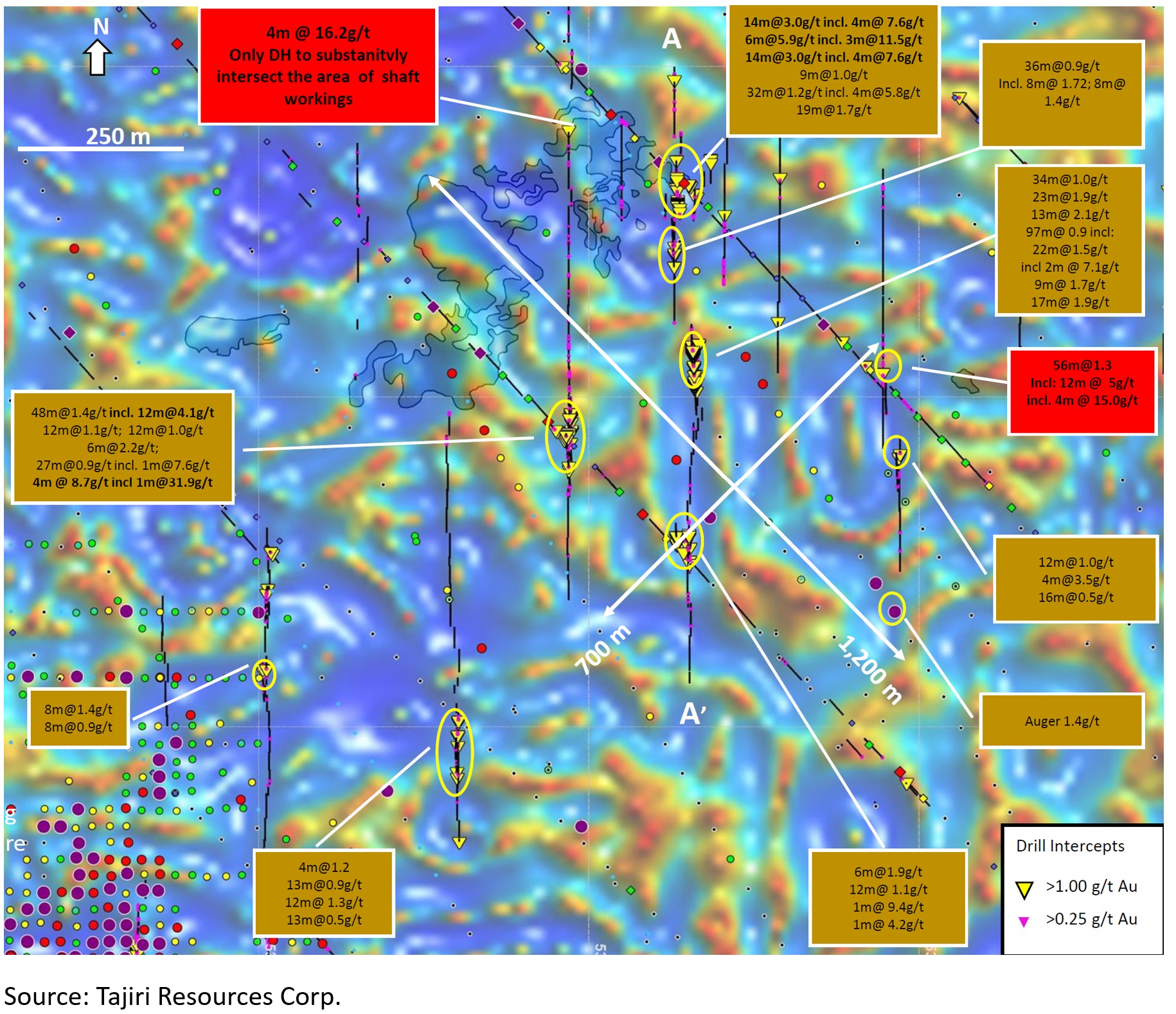
Several primary artisanal workings and high-grade in-situ auger gold anomalies are yet to be drill tested. Even so, historical drilling projects have reported robust gold grades over large intercepts(Figure 3), including:
• 56 meters (m) at an average grade of 1.3 grams per tonne (g/t) gold (Au), including 4m at an average grade of 15.0 g/t Au.
• 48 m at an average grade of 1.4 g/t Au, including 12m at an average grade of 4.1 g/t Au.
• 97 m at an average grade of 0.9 g/t Au, including 22m at an average grade of 1.5 g/t Au.
The only drill holes to intersect areas of visible artisanal workings retuned 4 m at an average grade of 16.2 g/t Au.
As part of its forward-looking strategy, Tajiri Resources (TSX-V:TAJ) Corp. has planned an extensive exploration programme this year at the K4-5 Prospect, involving close-spaced auger drilling, excavation of trenches and panel pits, and a diamond drilling program spanning approximately 3,000 to 4,000 m.
Conclusion
The Reo Gold Project, spearheaded by Tajiri Resources Corp. in Burkina Faso, harbours immense promise for uncovering supergiant gold deposits. The unique features of the K4-5 Prospect, combined with an ambitious drilling and sampling program, offer high hopes for revealing the full potential of this lucrative gold exploration project. As Tajiri continues its exploration efforts, the industry watches keenly, awaiting the potential reveal of a significant gold deposit within Africa's rich mining landscape.