
Gold has had a blistering run during the pandemic, hitting an all-time high of US$2,036.58 an ounce in July of 2020, and breaking that record with a spike to US$2,040.10 in March last year.
The precious metal broke records again last month, breaking through to the US$2,048.00 mark to set a new high before settling at the current US$1,978.00 an ounce.
The World Gold Council’s (WGC) demand trends report paints a fairly rosy picture for gold in the first quarter of this year, with total global demand edging up 1% year on year (y/y) to 1,174 tonnes despite a 13% y/y dip in over-the-counter (OTC) transactions.
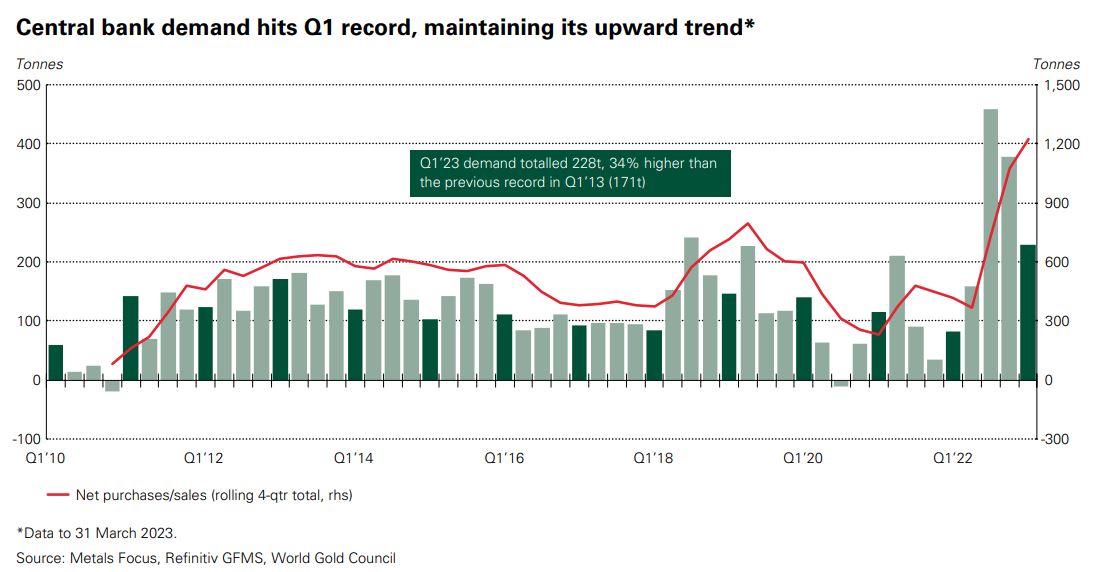
Central Banks and official sector institutions were particularly hungry for gold this quarter, squirreling away an additional 228 tonnes even as the tech sector’s demand slumped to 70 tonnes, the second lowest quarter on record going all the way back to 2000.
Higher gold prices led to an uptick in gold recycling (+5%) and mines also produced about 2% more y/y to bring total gold supply to 1,174 tonnes.
Looking specifically at Australia, Q1 2023 saw a marked downturn in gold demand y/y, as rising living costs and escalating interest rates weighed heavily on consumer spending.
Demand for gold nosedived 21% from the record highs of Q1 2022, driven primarily by a steep 27% decrease in investment demand for bars and coins, falling from 8 tonnes to a more modest 5.8 tonnes.
Let’s take a look at what’s influencing the gold market this year.
In this article
- Investment in gold
- Supply side - mining and recycling
- Demand from fabrication and central banks
- Gold takes centre stage with recession fears on horizon
Investment in gold
Exchange traded fund or ETF investment in gold is expected to overtake bar and coin demand in the near future, although that appears to be happening at a more gradual pace than initial forecasts suggested at the start of the year.
North American gold ETFs have experienced sporadic inflows, a trend which was turbocharged in March following the US banking crisis scare and has continued into April.
The report points to developing market recession conditions – which may or may not materialise – a ceiling for interest rates appearing more certain and overextended equity valuations as drivers for further ETF-driven inflows to come.
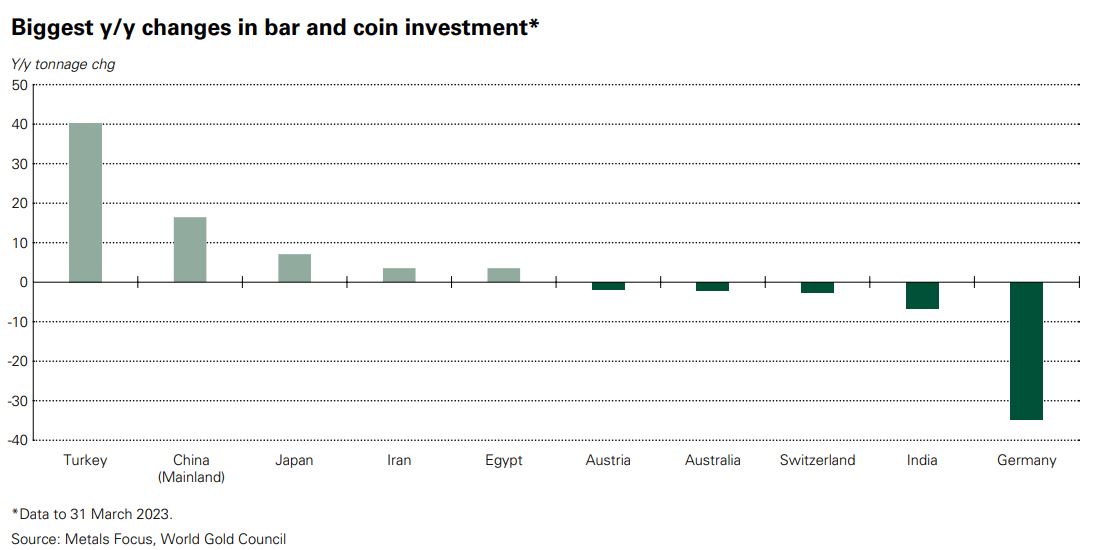
European weakness in this area appears to be offset by strengthening Chinese consumer activity – with new credit creation moving into the positive after spending the last 18 months in the red – alongside official purchase of gold.
Indian bar and coin demand was also weak, as local gold prices hit record levels. The World Gold Council believes that’s unlikely to change given both growth and inflation are expected to be moderate.
Recession fears drove bar and coin demand in the US but a return to positive real interest rates in Germany alongside a higher euro gold price put a dampener on activity from that market.
“We believe this weakness in Europe to be temporary, considering the risks ahead,” the report states.
“Given strength in the global number, and the return of OTC investment, we have modestly raised our midpoint for both full-year bar and coin demand and total investment.”
Demand from fabrication and central banks
Gold has been a hot commodity for central banks this first quarter, with demand high enough that the WGC is expecting a higher midpoint for its full-year estimate.
The institution also raised the downside range limit, although the WGC believes it won’t match 2022’s glittering performance.
“Limited information and delayed reporting mean that a broad range of outcomes are possible, both to the upside and the down,” the report read.
“But intentions have consistently been a leading indicator for buying over the last few years and our central bank surveys suggest little change to the positive trend.”
Fabrication demand is a different story – the beleaguered tech sector, which has experienced a massive sell-off in the last few months, offered weak demand for gold, dropping 15% y/y.
Trade restrictions, supply chain disruptions and declining consumer purchases all pushed down tech gold demand – last year, computer shipments dropped 28% y/y during the fourth quarter, and smartphone shipments slid 17% in the same period.
By the same token, Samsung, one of the largest chip manufacturers globally, reported a 96% drop in Q1 profits, and stated they were “…lowering the production of memory chips by a meaningful level, especially of products with supply secured”.
“Although China’s reopening is a welcome development for chip manufacturing, it is likely that end-user demand will slow and sanctions will remain in place while China and the US continue their economic skirmish,” the WGC commented.
Jewellery gold demand in China was strong and is predicted to become stronger as the year progresses, although other discretionary spending may cut into gold’s gains.
The western countries remained consistent in demand this quarter, although India’s headwinds also effected jewellery demand.
Supply side – mining and recycling
Resource miners aren’t the type to pass up an opportunity – sky-high gold prices have led to record gold production, up 2% y/y, and increased gold recycling volumes by 5% to boot.
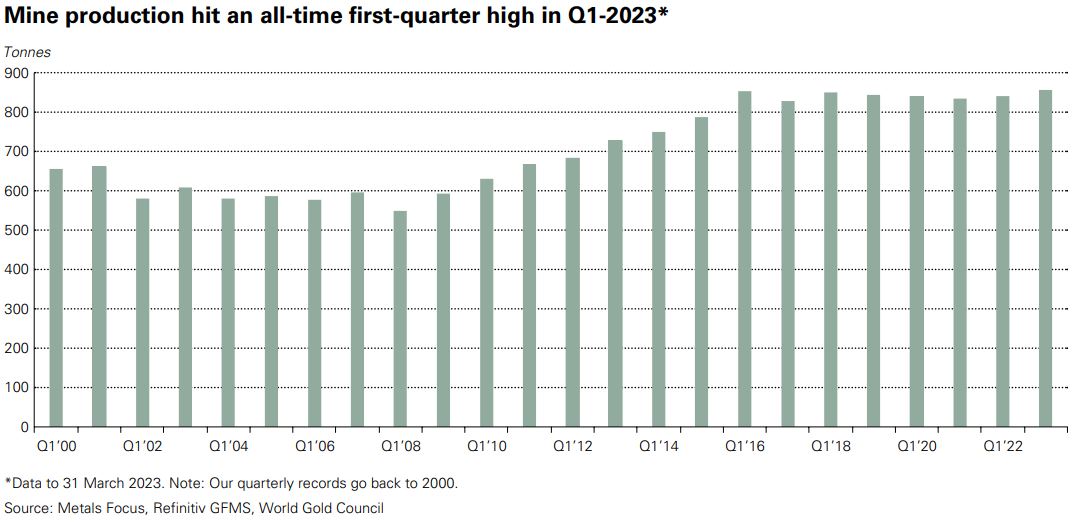
The extra production accounts for an additional 856 tonnes of gold, although quarter-on-quarter (q/q) production has fallen some 10%, mostly due to seasonal variations effecting mining, according to the WGC.
Of particular note was a massive increase in gold mining in Mongolia, up a whopping 118% y/y as the vast Oyu Tolgoi copper-gold mine began production.
Brazil achieved a 13% y/y uptick due to a ramp-up at the Salobo mine, South Africa raised production 8% y/y despite continuing power disruptions, and China managed a 3% y/y increase due to ongoing consolidation of the mining industry and better operational practices.
Not all countries were as fortunate:
- Production fell 19% y/y in Indonesia due to flooding and falling grades at the Grasberg copper-gold mine.
- Senegal’s output slipped 8% y/y for similar grade-related reasons.
- Suriname production fell by 7% y/y on sequencing, harder ore and additional stripping.
- Mexico’s gold output fell 6% y/y for the same reasons.
Gold recycling, understandably, rose in line with the gold spot price.
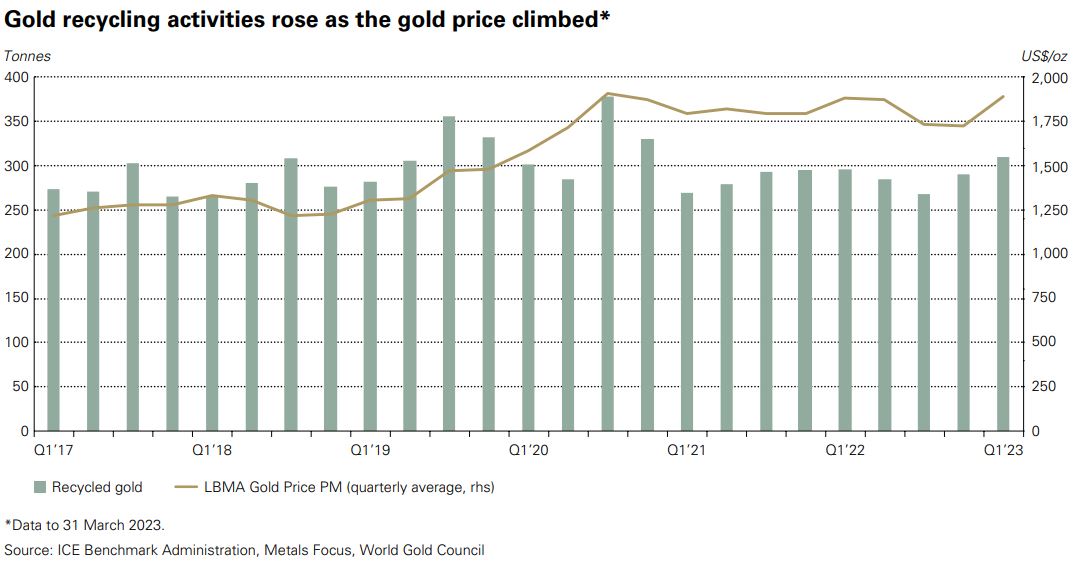
Recycling was up 7% quarter on quarter, which the WGC believes is a more important comparison than a 5% y/y increase.
“This is the second consecutive quarterly increase in recycling supply and mirrors the increase in the gold price over this period,” the report read.
Despite the overall increase in gold recycling, the absolute volume of recycled supplies fell, mostly due to lower sales from western and Middle Eastern markets.
“Barring a sharp rise in the gold price in 2023 we believe recycling supply could rise modestly over the year,” the WGC concluded.
Gold takes centre stage with recession fears on horizon
With inflation still threatening, and a recession seeming more likely, gold is once again shining as a safe – and ancient – store of value in uncertain times.
World Gold Council senior market analyst Louise Street explains.
“Against the backdrop of turmoil in the banking sector, ongoing geopolitical tensions and a challenging economic environment, gold’s role as a safe haven asset has come to the fore,” Street wrote in a WGC press release.
“In this landscape, it is likely that investment demand will grow this year, especially with waning headwinds from the strong US dollar and interest rate hikes.
“Positive demand for gold ETFs has continued in Q2 so far, and the looming threat of developed market recession may be the trigger for inflows to accelerate later in the year.
“Central bank buying is likely to remain strong and will be a cornerstone of demand throughout 2023 – even if at lower levels than the record highs seen last year.
“As some economies teeter on the brink of recession, gold’s role as a long-term, strategic asset could take centre stage as it has a history of delivering positive returns in the last five out of seven recessions.”