
- FTSE 100 closes 19 points higher
- Diageo leaves Dublin
- Tesco firms after top-end results
4.45pm: FTSE 100 finishes higher
At the closing bell, the FTSE 100 had finished the day in positive territory at 7,843 points for a gain of 0.2% on the day.
Inflation weakness prompted renewed gains in stocks, according to IG's Chris Beauchamp.
“The afternoon has seen stocks bolstered by weaker PPI figures in the US, along with a rise in jobless claims," Beauchamp noted. "This means that the market is once again back to hoping that more bad news will tilt the Fed further towards a pause beyond the next meeting, though hopes for a ‘no change’ at the upcoming get-together remain dim.”
3.50pm: FTSE 100 looks set to close the day in the green
London’s blue-chip index was up 15 points to 7,840, shy of the intraday high of 7,851 it reached at 2pm.
Miners, housebuilders, and gambling operators dominated the top of the index, experiencing positive read across from news in their respective sectors.
Fresnillo, Antofagasta and Endeavour all traded higher on the back of a Trafigura prediction that copper will reach a record high this year.
Berkeley, Barratt and Taylor Wimpey shrugged off the gloomy outlook for the housing market in a RICS report with the help of an upbeat HSBC note which said much of the downturn was already priced in.
Flutter and Entain also remained unphased by the voluntary agreement from Premier League clubs to no longer have betting operators as their main shirt sponsors.
On the flip side, Imperial Brands and British American Tobacco were weighing on the index after the former’s results suggested tough times ahead in the US for its vape rollout.
3.01pm: Network International confirms takeover approach
Network International, the payments solutions company, surged 25% to 304.8p after it confirmed it received a conditional proposal from CVC Capital Partners and Francisco Partners Funds.
People with knowledge of the matter said the Middle-Eastern-focused company has reportedly been speaking with advisers after attracting takeover interest from CVC.
The company currently has a market value of £1.6bn and is quoted on the FTSE 250.
London’s blue-chip index was up four points to 7,829 while the FTSE 250 gained 44 points, or 0.2%, to 19,045.
2.30pm: US markets in the green
US markets opened in positive territory as investors digested producer price and unemployment figures.
The Dow Jones gained 0.13% in the bell, while the S&P 500 was up 0.62%.
The tech-laden Nasdaq gained 0.67%.
1.54pm: US producer prices fall
In other news across the pond, US core producer prices, which exclude the cost of food and energy, fell for the first time since 2020 in March.
Core producer prices were down 0.1% month-over-month in comparison to a forecast of a 0.3% increase.
Producer prices for final demand, which are inclusive of food and energy, fell by over 0.5% in March, the biggest decline in two years.
Two-thirds of the decline has been attributed to a 1% decrease in prices for final demand goods, that is those sold for personal consumption, namely gasoline, which fell by 11.7%.
The indices for diesel fuel, residential natural gas, jet fuel, electric power and fresh and dry vegetables also fell.
Over in London, the FTSE 100 seems to have reacted positively to falling producer prices, with the index shooting up.
FTSE 100 is trading 19 points higher at 8,444, its highest level today.
1.41pm: US unemployment claims jump
US unemployment claims rose more than expected in the week ending 8 April.
The number of Americans filing for unemployment benefits rose by 11,000 to 239,000, overshooting Wall Street expectations of 232,000 claims.
Figures were in line with labour market data for March that pointed towards a softening of the US labour market.
1.27pm: Here’s a look at a few of the top risers and fallers on the junior market today
Corero Network Security PLC (AIM:CNS) jumped 13%% higher to 6.50p after the cyber defence solutions firm revealed a string of “significant” new orders in the first quarter of 2023.
Science in Sport PLC (AIM:SIS) added 2.3% after the company reassured of a “high level of confidence" in its business model and growth plan after a hit in April last year.
Foresight Group Holdings Ltd (LSE:FSG), the investment trust and VCT manager, rose 8% to 410p after upping its underlying profit guidance for the year to end-March as revenue is expected to be "significantly up" on the prior year ahead of latest consensus forecasts.
Kodal Minerals PLC (AIM:KOD) added 16% to 0.68p after providing an update on the funding package with Hainan Mining Co., which has informed Kodal that it has received all necessary approvals from the Chinese Government authorities to allow it to complete its funding and investment as set out in the agreement.
Steppe Cement (AIM:STCM) Ltd fell 25% to 33.11p after releasing its first-quarter earnings report which suggested its market share decreased to 12.7% in the first quarter of 2023 from 13.7% in the first quarter of 2022.
Wall Street to open flat
Wall Street is likely to open flat to moderately higher as investors look to weekly jobless claims and March’s producer inflation data, out today, as well as quarterly earnings from some of the US’s largest banks for further direction.
Futures for the Dow Jones Industrial Average were steady in Thursday pre-market trading while those for the broader S&P 500 index gained 0.1% and contracts for the Nasdaq-100 added 0.2%.
The Dow snapped a four-session winning streak on Wednesday, following the other benchmarks lower, as minutes from the Federal Reserve’s March policy meeting seemed to drive recession fears.
That followed consumer inflation data that showed core inflation remains sticky while headline inflation surprised to the downside.
The DJIA closed 0.1% down at 33,647, the Nasdaq Composite fell 0.9% to 11,929 and the S&P 500 dipped 0.4% to 4,092.
“Last night’s Fed minutes didn’t tell us much more than what we already knew from the post-meeting statement and (Chair Jerome) Powell’s press conference, with European markets finishing the day higher, while US markets slipped back,” commented CMC Markets’ Michael Hewson.
“The recent banking turmoil appears to have tempered the reaction function of many Fed officials in terms of how many more hikes are needed to keep a lid on prices, while the risks of a modest recession have increased, according to Fed staffers.
The primary focus for now still remains on inflation which is still too high and sticky, and a labour market that is proving increasingly resilient," he added.
With no data of note on the docket for today aside from weekly jobless claims and PPI, TickMill Group market analyst Patrick Munnelly noted that investors will look towards the start of first-quarter earnings season, with many of the tier-one banking franchises set to announce earnings in the coming days.
The Producer Price Index (PPI) is expected to show a flat month-over-month reading for March, implying an annual headline rate of 3%, while core inflation is expected to show a 0.3% monthly rise, taking the annual rate to 3.4% from 4.4% in February.
“Tomorrow sees the major banking marquees of JPMorgan, Citi and Wells Fargo set to announce performance for the quarter,” Munnelly said.
“Given the Fed's focus on credit conditions, banking earnings will give timely insights into the credit landscape."
"Investors will also be keen to track the regional banks' earnings given the recent turbulence amongst their peers, especially given Bank of South Carolina’s recent announcement around margin erosion as the bank highlighted a significant increase in deposit costs given the surge in competition with larger banks, brokerages and the US Treasury,” he added.
12.41pm: Premier League bans gambling sponsors
In the world of sports, the Premier League has agreed to ban gambling sponsors on the front of their shirts from the start of the 2026-2027 season.
Sponsorships will still be available in other areas, including sleeves and pitchside hoardings.
The decision has been taken voluntarily in order to reduce gambling advertising.
Sports gambling has been dominating recent headlines, with a White Paper into a review of the UK Gambling Act 2005 ready to be published in the coming weeks.
Measures being touted in the media include a limit on online slot machines of between £2 and £5, moving it in line with limits on physical machines seen in pubs and high street gambling shops.
A statutory levy on operators to fund addiction research is said to be suggested. At 1%, the levy would replace the current voluntary contributions made by firms.
The paper is also said to include affordability checks for customers losing between £500 and £100 a month, at which point they would be required to provide bank statements.
Share prices of operators however responded positively to the news.
Paddy Power owner Flutter gained 1%, while Entain, which owns Ladbrokes, was up 1.1%.
The smaller 888Holdings was up 2.3%.
12.13pm: UK mortgage availability turns positive
UK mortgage availability turned positive for the first time in over a year in the past quarter, the latest Bank of England survey showed.
But amid recent banking sector wobbles, lenders plan a tighter supply of new mortgages in the second quarter.
The survey was carried out in the first two and a half weeks last month, amid the collapse of Silicon Valley Bank and the fall of Credit Suisse, with lenders asked about conditions from December to February.
Recent mortgage approval data for February showed the first improvement since last summer but remained more than a third below their levels from a year ago as high borrowing costs squeeze household spending.
The quarterly BoE credit conditions survey showed rising default rates across mortgages, consumer credit and loans to both large and mid-sized businesses, with banks expecting defaults to increase further in the current quarter.
Also, losses given default on mortgages increased and were expected to increase further this quarter.
Shares in listed banks were mixed on Thursday, with Lloyds down 2.62%, but Natwest and Barclays rising 0.8%, HSBC, Standard Chartered, OSB and Virgin Money all hovering between 0.3% to 0.4% higher.
11.39am: Copper could reach all-time highs
Copper prices reached their highest level in a month at US$4.1/lbs amid a weak dollar, expectations of elevated demand and concerns surrounding low supplies.
Data from the London Metal Exchange highlighted inventories fell to 56,000 tonnes, the lowest since 2005, which has sparked concerns over reserves.
To add to woes, Chile, the world’s largest copper producer, said its state-owned Codelco expects output in 2023 to shrink by 7%, adding to a 10.6% decline in 2022.
Such low levels of supplies sparked commodity trader Trafigura to forecast copper prices at record highs later this year, breaking the peak in March 2022 of US$4.75/lbs.
Shares in Glencore were up 1% to 488p, while Antofagasta gained 1.4% to 1,602p.
The broader FTSE 100 market was flat at 7,824 points.
11.19am: Guinness supplier dumps Dublin
Diageo has seemingly bucked the trend of companies fleeing London after it decided to ditch its listings on Euronext Paris and Euronext Dublin.
The Guinness producer leaving Dublin may spark some controversy in Ireland, especially as US President Joe Biden is set for a press opportunity outside the Guinness Storehouse.
A London Stock Exchange release said the decision was taken following a review of the trading volumes, costs, and administrative requirements related to its listings in Paris and Dublin.
Delistings are expected to take place at the end of May.
Diageo’s London shares were little changed on the news, changing hands at 3,675p, while the broader FTSE 100 market was trading flat at 7,824p.
10.56am: Burberry welcomes LVMH results
Shares in Burberry welcomed news in Europe from luxury fashion brand LVMH after the company reported a 17% rise in global sales in the first quarter of 2023.
Ran by the world's richest man Bernard Arnault, the company behind brands including Moët and Louis Vuitton recorded revenues of £18.5bn.
First quarter results, boosted by a “significant rebound” in China, showed luxury brands remain steadfast in the face of the cost-of-living crisis.
Burberry was the fifth largest riser on the FTSE 100, with shares up 2% to 2,551p, while Rolex seller Watches of Switzerland was unchanged, up 0.3% to 760p.
LVMH was up 4.5% to 874p.
10.18am: Market rundown
Here is a quick run-down on some of the stories making today's headlines.
FTSE 100 remains little changed, down three points to 7,882 as the latest GDP figures from the Office of National Statistics showed the UK economy ground to a halt in February.
Tesco said it expects full-year revenue and operating profit at the top of the end of City forecasts. The supermarket urged caution for the year ahead, however, warning of flat profits.
Elsewhere among London’s blue chips, Imperial Brands said it is on track to achieve full-year profit and revenue growth. The tobacco-focused company added it has completed more than half of its £1bn buyback.
Healthcare and consumer goods company PZ Cussons (LSE:PZC) reported a 6.2% uptick in third-quarter revenue. Performance was boosted by growth in sales of its Imperial Leather and Cussons Creations portfolio.
Among the small caps, Pennant International said acquired the rail services company Track Access Productions. The group said the move will “significantly” enhance its own rail offering.
9.20am: FTSE hovers around opening levels
The FTSE 100 has edged into positive territory with gains housebuilders leading the way. Barratt Developments, Taylor Wimpey and Berkeley Group are all prominent risers as is property website Rightmove PLC (LSE:RMV).
Persimmon bucked the trend in the sector falling 2.2% as it went ex-dividend.
Burberry advanced 1.9% after well received numbers from French luxury conglomerate LVMH which rose 4.5% in Paris while Tesco also holds firm, up 1.9% after its top-end full-year results.
Victoria Scholar at interactive investor noted: "Investors are weighing up an improving picture for US inflation with the latest data falling to 5%, a two-year low versus fears of a recession stateside after minutes from the Fed’s latest meeting indicated that US central bank policymakers are concerned about the negative economic fallout from the recent turmoil in the banking sector."
The market also received a lift by news that German inflation continued to soften last month due to falling energy costs, with consumer prices rising by 7.4% on an annual basis, but lower than the 8.7% rate recorded in the first two months of the year.
Prices of energy products increased 3.5% on year, a sharp decline from the 19.1% rise seen in February. Food prices continued to place pressure on consumers, rising 22.3% on an annualised basis and up from the 21.8% recorded in February.
In the FTSE 250, Oxford Instruments was a star performer, up 4.8%. The scientific and industry product and services provider said it expects adjusted operating profit to be ahead of its previous expectations for the year to March 31.
It also named TT Electronics Chief Executive Richard Tyson as its new CEO, succeeding Ian Barkshire who will retire after seven years in the role and more than 25 years with the company.
But Imperial Brands fell 1.6% after its trading update despite saying it is on track to meet full-year guidance for revenue and operating profit growth.
Jefferies felt all in all it was a "slightly disappointing print." The broker noted first half sales are down, while the commentary on market share trends slowing, next generation products (NGP) trends in the US, and guidance on profit for tobacco and NGP trends for the full-year being down will all "likely concern."
8.47am: Housebuilders soar, lifted by HSBC upgrades
Shares in housebuilders rose strongly following an upbeat research note from HSBC which believes the downturn in the housing market is more than priced-in to share prices.
Barratt Developments PLC (LSE:BDEV), Taylor Wimpey PLC (LSE:TW.) and Berkeley Group PLC fill the top three positions in the FTSE 100 risers up 3%, 2.7% and 2% respectively.
In the FTSE 250, Redrow PLC (LSE:RDW) is 4.3% to the good while Crest Nicholson PLC (LSE:CRST) and Bellway PLC (LSE:BWY) are up 3.7% and 3.4% as well.
HSBC has upgraded ratings on six volume housebuilders to buy from hold, reiterated partnerships play Vistry at buy and upgraded London regeneration specialist Berkeley to hold from reduce.
The six companies put on the buy list are Barratt, Bellway, Crest Nicholson, Persimmon, Redrow and Taylor Wimpey.
“We now have greater visibility about the shape of the current housing market downturn for the housebuilders’ profits and cash flows and their recovery from it, which we believe to be more than priced-in to share prices,” analysts at the bank said.
On average target prices have been increased by 29%, implying the most upside for Redrow at 45% and Vistry at just under 40%, whilst targets for Bellway, Crest Nicholson and national volume builders Barratt, Persimmon and Taylor Wimpey, imply 23-30% upside.
The target for Barratt rises to 570p from 390p, for Bellway to 2,700p from 2,030p, for Berkeley to 4,000p from 3,000p, for Crest Nicholson to 270p from 230p, for Persimmon to 1,550p from 1,410p, for Redrow to 670p from 500p, for Taylor Wimpey to 150p from 105p and for Vistry to 1,060p from 900p.
HSBC noted the share prices of the eight housebuilders covered above are on average almost 50% lower than their pre pandemic February 2020 highs.
The bank pointed out that after recovering strongly for much of 2021, almost all this decline occurred in the first few months of 2022 when the UK government tapped the sector to pay for fire safety remediation and the market discounted a downturn against the backdrop of the rising cost of money.
HSBC continues to forecast a c20% downturn in most housebuilders’ completions in 2024 versus 2022 and a 5% fall in UK new build house prices.
8.15am: FTSE edges lower at the open
The FTSE 100 was as flat as the UK economy at the open with blue chips little changed in early changes although Tesco pushed ahead after top-end full year results.
At 8.15am London’s lead index was down 10.59 points, or 0.14%, at 7,814.25 while the FTSE 250 firmed a touch, up 32 points, or 0.2%, to 19,035.06.
Latest figures from the Office for National Statistics showed the UK economy ground to a halt in February with monthly real gross domestic product estimated to have shown no growth.
Falls in services and production were offset by growth in construction, the ONS said.
This follows growth of 0.4% in January, revised up from growth of 0.3% before. Economists had forecast a rise of 0.1%.
Tom Hopkins, Portfolio Manager at BRI Wealth Management said: “Despite the government’s optimism on the UK avoiding a recession this year, the UK economy has been stagnating for some time, we think a mild recession is imminent.”
Samuel Tombs at Pantheon Macroeconomics expects the economy to show little growth in the first half of 2023 predicting a rise of 0.1% in quarter one and to flat line in quarter two.
In company news, Tesco PLC (LSE:TSCO) rose 1.3% after reporting top-end revenue and operating profit figures in full-year results.
The food retailer expects operating profit to stabilise in the coming year after falling to £2.63bn in the 52 weeks to February 25, down from £2.83bn in the comparative period. On a statutory basis pre-tax profit halved.
Chief Executive Ken Murphy said: "We will continue to prioritise investment in our customer offer whilst doing everything we can to offset the impact of ongoing elevated cost inflation."
Zoe Gillespie, investment manager at RBC Brewin Dolphin, said: “Tesco is continuing to cement its position as the UK’s top supermarket. Profits may be down, but that was to be expected from the pressures of the cost-of-living crisis and post-pandemic normalisation in shopping habits.”
“While profits are expected to be flat for the year ahead, the continuation of its share buyback scheme and strong execution of its strategy mean Tesco remains in good shape” she felt.
PZ Cussons (LSE:PZC) was little moved by its trading update with quarter three revenue up 6.2%.
7.55am: PZ Cussons (LSE:PZC) reports solid growth in thirs quarter
PZ Cussons (LSE:PZC) PLC reported 6.2% growth in third quarter revenue boosted by strong growth in sales of St Tropez US and the combined Imperial Leather and Cussons Creations portfolio.
The personal healthcare products and consumer goods manufacturer said revenue rose to £166mln in the period and that it expects adjusted profit before tax to be at least in line with current market estimates.
In a trading update for its third quarter, ended March 4, the company noted the Europe & the Americas region returned back to strong revenue growth and with significantly improved margin although Carex revenue declined in the period reflecting the reduction in the UK Hand Hygiene category more broadly.
Childs Farm is performing as expected and is on track for double-digit revenue growth in the year, on a pro-forma basis, the company said.
Asia Pacific performance has been driven by strong growth in Australia, reflecting continued successful revenue growth management activity and sustained share gains across our major brands while Africa trading was in line with expectations, with all Must Win Brands in good growth.
In Asia, Cussons Baby revenue declined slightly, in line with the overall category, reflecting increased pressure on consumer spending in recent months as well as some retailer de-stocking.
7.35am: Tesco sees flat profit in the year ahead
Tesco PLC (LSE:TSCO) (Tesco PLC (LSE:TSCO)) reported full-year revenue and operating profit at the top end of City forecasts but predicted flat profits in the year ahead.
The food retailer reported revenue in the 52 weeks to February 25 of £65.72bn up 7.2% from £61.34bn a year before while adjusted operating profit totalled £2.63bn down from £2.83bn in the comparative period.
Analysts had forecast revenue of £65.72bn and operating profit of £2.61bn.
On a statutory basis pre-tax profit halved to £1.00bn from £2.03bn while adjusted EPS was flat at 21.85p. The full year dividend was unchanged at 10.9p.
The grocer said like-for-like (LFL) retail sales rose 5.1% as volumes held up well despite the cost of living pressures with UK LFL sales up 3.3%, ROI up 3.3%, Booker up 12.0% and Central Europe LFL sales up 10.4%.
UK & ROI adjusted operating profit of £2.31bn was down 7% driven by the impact of lower year-on-year volumes and ongoing investment in its customer offer, with Save to Invest largely offsetting significant operating cost inflation.
Chief Executive Ken Murphy said he was pleased with the performance and “confident that we have the right strategy,” but he predicted flat profits in the year ahead.
“We expect to be able to deliver a broadly flat level of retail adjusted operating profit in 2023/24 and retail free cash flow within our target range of £1.4bn to £1.8bn, he said.
"We will continue to prioritise investment in our customer offer whilst doing everything we can to offset the impact of ongoing elevated cost inflation," he added.
Tesco Bank profit is seen between £130mln and £160mln.
The grocer also announced plans for a further £750mln share buyback.
7.05am: UK economy grinds to a halt in February
The UK economy ground to a halt in February with monthly real gross domestic product (GDP) estimated to have shown no growth.
Falls in services and production were offset by growth in construction, figures from the Office for National Statistics showed.
This follows growth of 0.4% in January, revised up from growth of 0.3% before. Economists had forecast a rise of 0.1%.
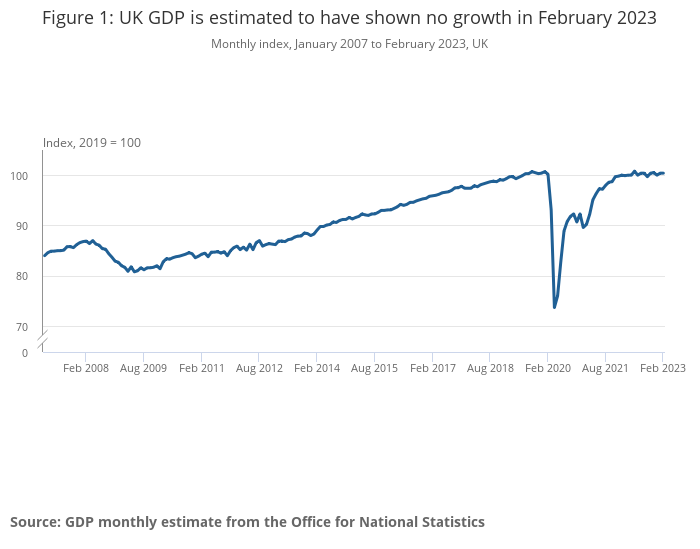
Looking at the broader picture, GDP grew by 0.1% in the three months to February.
The services sector fell by 0.1% in February, after growing by 0.7% in January, revised up from 0.5% in the previous publication.
The largest contributions to the fall in services output in February came from education and public administration and defence; compulsory social security, industrial action took place in both of these industries in February.
Output in consumer-facing services grew by 0.4% in February, this follows growth of 0.3% in January with the largest contributor to this growth came from retail trade, except for motor vehicles and motorcycles.
Production output fell by 0.2% in February, following a fall of 0.5% in January, revised from a fall of 0.3% before.
The construction sector grew by 2.4% in February, after falling by 1.7% in January.
7.00am: FTSE seen lower after US slip back after FOMC minutes
The FTSE 100 is expected to dip at the open after US markets fell from earlier highs as the minutes of the latest Federal Reserve meeting showed officials fear the recent banking turmoil could tip the US into recession.
Spread betting companies are calling London’s lead index down by 16 points.
US stocks closed lower on Wednesday after earlier taking heart from cooler than expected consumer price inflation figures which boosted hopes that pricing pressures were easing and interest rates were close to peaking.
The Dow Jones Industrial Average closed down 38.29 points, or 0.1%, at 33,646.50. The S&P 500 fell 16.99 points, or 0.4%, to 4,091.95, while the Nasdaq Composite slipped 102.54 points, or 0.9%, at 11,929.34.
Minutes from the FOMC March 21-22 meeting showed several officials considered holding interest rates steady "to assess the financial and economic effects of recent banking-sector developments and of the cumulative tightening of monetary policy."
But after judging that actions by the Fed in coordination with other government agencies had helped calm conditions in the banking sector they decided to press ahead with the 25 basis point increase with reducing inflation the priority.
In Asia, the Nikkei 225 index was up 0.3%, in China, the Shanghai Composite was down 0.3%, while the Hang Seng index in Hong Kong was down 0.7%.
Back in London and the early focus will be results from food retailer Tesco and a GDP reading for February.