
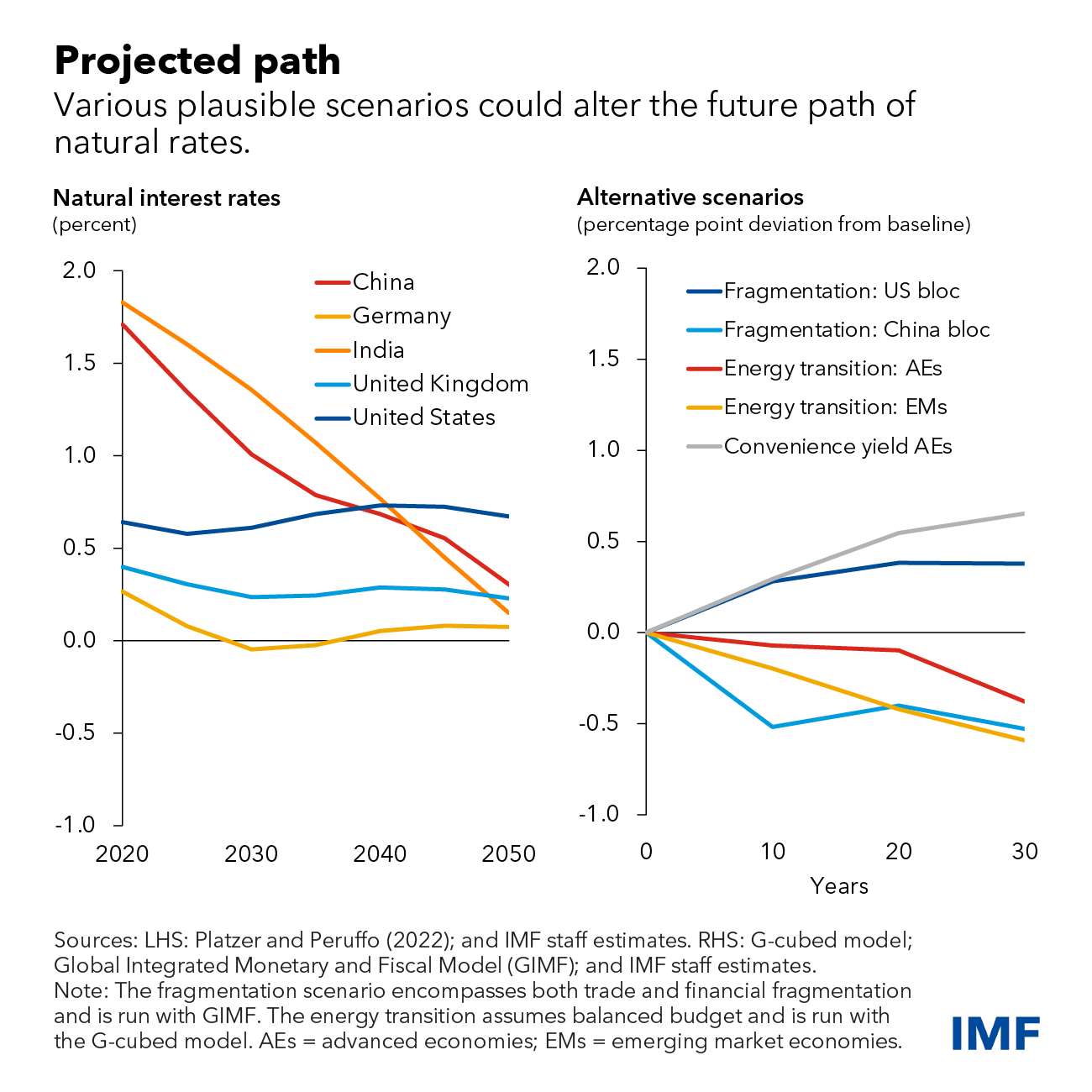
Interest rates in the UK are projected to head back to pre-pandemic levels and remain at this 'natural' level for the coming decades, according to the International Monetary Fund (IMF), but first the global economy needs to emerge from a "perilous phase" of low economic growth and high financial risk.
Interest rates were hiked by the Bank of England from zero up to the current 4.25% over the past year and a quarter to try and rein in soaring inflation, which reached multi-decade highs, with central banks in the US, Europe and elsewhere doing similar.
But the IMF said, according to its baseline scenario, that the rises in interest rates are "likely to be temporary" as price rises would quickly ease back and allow rates to return to their ultra-low level seen since the global financial crisis.
An analysis by the Washington-based organisation suggested the UK's natural rate of interest is around 0.5% above inflation, which would mean a nominal interest rate of 2.5% if the BoE is able to return inflation to its 2% target.
Global headline inflation is set to fall from 8.7% in 2022 to 7% in 2023 on the back of lower commodity prices, although underlying core inflation is proving to be stickier.
"When inflation is brought back under control, advanced economies’ central banks are likely to ease monetary policy and bring real interest rates back towards pre-pandemic levels," said the World Economic Outlook report, which conceded that there are various possible outcomes that could disrupt this baseline scenario.
The IMF thinking about interest rates heading back towards pre-pandemic levels is in line with the market's current thinking, said Laith Khalaf, head of investment analysis at AJ Bell.
US interest rates are currently being priced by the market to end the year around 0.5% lower, while for the UK, markets are projecting some extra tightening in the coming months, but are still forecasting interest rates to fall back in the longer term, Khalaf noted
“It’s important to recognise that the IMF is suggesting interest rates will head back towards pre-pandemic levels, not that there will be a wholesale return to zero interest rate policy," he said.
Moreover, the IMF has conceded that not only is there a considerable range of possible outcomes around this baseline scenario, but the thousands of economic projections that make up the overall model could also themselves be wide of the mark.
“In other words, the IMF’s findings have a wide margin of error and should be treated with caution.“
Khalaf said it was “difficult to see how interest rates could be cut when CPI still stands at around 10%", though inflation is forecast to recede rapidly over the next year, with the latest BoE report pointing to CPI falling to 1% in 2025, and just 0.4% in 2026.
Perilous phase
The IMF's World Economic Outlook also included an updated baseline forecast for global output growth, 0.1 percentage point lower than predicted in January, but was otherwise mostly unchanged from its first-quarter report.
Global output growth is projected to fall from 3.4% last year to 2.8% in 2023, before rising to 3% in 2024.
“The world economy is still recovering from the unprecedented upheavals of the last three years, and the recent banking turmoil has increased uncertainties," said Pierre-Olivier Gourinchas, the IMF’s chief economist, predicting advanced economies will see an especially pronounced growth slowdown from 2.7% in 2022 to 1.3% in 2023.
“Importantly, this outlook assumes that recent financial stresses remain contained,” he said.
He noted that recession concerns have gained prominence lately, while worries about stubbornly high inflation persist.
Risks are "heavily tilted to the downside" and have risen with the recent financial turmoil, Gourinchas said, adding that recent banking strife could result in a "sharper and more persistent tightening" of financial conditions, with rate hikes in various countries potentially having "more contractionary effects than expected, especially as debt levels are at historical highs".
If inflation remains stickier than expected, it could also precipitate more monetary tightening, he acknowledged.