
House prices across the UK rose for the third month in a row in March, while the annual rate slowed to the lowest in three and a half years.
This suggests that the market is stable, although a further slowdown throughout this year looks likely as mortgage costs have risen, said mortgage lender Halifax.
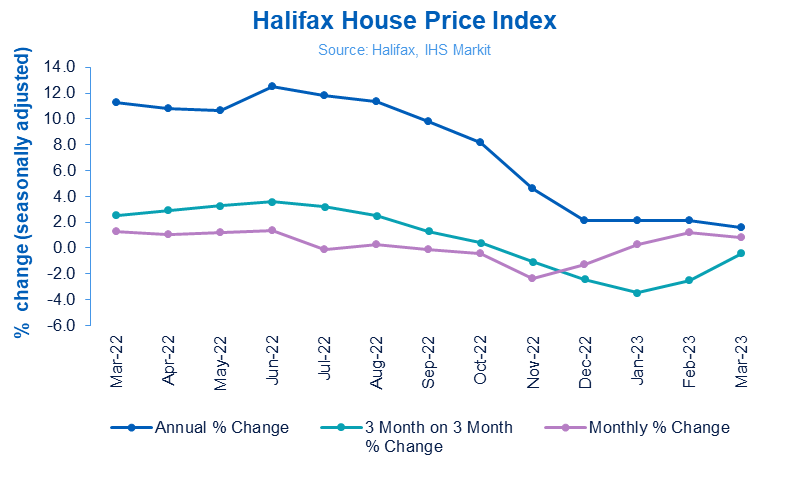
A typical UK property now costs £287,880 (compared to £285,660 in February), according to the monthly house price index from Halifax.
Prices rose 0.8% in March from the month before following February’s 1.2% gain, and were up 1.6% on a year earlier, the slowest annual pace since October 2019.
House prices rose in all UK nations and regions last month, though the annual rate of growth continued to slow in most areas. Mortgage costs have risen as the Bank of England has raised interest rates 11 times to 4.25% to fight double-digit inflation (at 10.4% in February).
Kim Kinnaird, director of Halifax Mortgages, said: “The UK housing market continues to show resilience following the sharp downturn at the end of 2022, with average property prices rising again in March.”
But while the data is resilient it can’t hide the fact that a “slowdown in the housing market is at play”.
That was the view of Myron Jobson at interactive investor, who noted prices were holding up despite “a double whammy of rampant inflation and rising interest rates”.
“The recent fall in mortgage rates, with lenders seemingly engaged in a mortgage price war, and a strong labour market, with unemployment at a near record low, has helped keep prices elevated,” he explained.
“But there is mounting evidence that the housing market is seemingly in a pendulum moment — swinging back in a buyer’s market direction,” he cautioned.
He said the crucial spring-buying season could give us a clear indication of the state of the property market.
“In spring, home prices tend to rise due to increased seasonal demand, but current indicators do not signal that the season will be a robust one,” he pointed out.
The EY ITEM Club said taking the Halifax measure in isolation, “it offers another sign that the economy is holding up against headwinds from high inflation and rising interest rates much better than many expected”.
They noted mortgage approvals and survey evidence of housing transactions both appear to have bottomed out while there are signs of green shoots in the economy.
“However, prices still look very stretched on most affordability measures,” they added.
The EY ITEM Club’s chief economic advisor Martin Beck said: “On balance, the EY ITEM Club sticks with its view that prices will decline by around 10% peak-to-trough.”