
- FTSE 100 ends 67 points lower at 7,500
- Wall Street rallies after Fed rate hike falls on Wednesday
- Bank of England MPC votes 7-2 to raise rates to 4.25%
4.45pm: No support from sterling
The FTSE 100 finished the day off its lows but still 0.9% down at 7,500 as it failed to take direction from a more upbeat US trading session. The Bank of England's 25 basis point rate hike also lent some support to the pound.
“A slew of ex-dividends and gains for sterling have meant the FTSE 100 hasn’t joined in the more optimistic afternoon session. However, this is likely to be a temporary development – the outlook for the global economy has improved even from where it was on Monday," commented IG's Chris Beauchamp. This should see some renewed strength for banks and miners in the medium term, making the FTSE 100 an interest play on global growth.”
By the UK close, the Dow Jones Industrial Average was 1.1% up at 32,367, the S&P 500 had gained 1.3% to 3,988 and the Nasdaq had jumped 1.9% to 11,897.
3.55pm: No alarms and no surprises
With just over 30 minutes of trading to go in London, the FTSE 100 index remained weaker, but off lows after the latest Bank of England interest rate decision, with the 25 basis point hike to 4.25% as expected given yesterday's surprise rise in UK inflation and an easing in the recent banking crisis.
Commenting on the BoE move, Toby Sturgeon, Global Head of Fiduciary Investment Services at wealth planning firm ZEDRA, said: “The Bank of England increased interest rates by 25 basis points to 4.25%, the highest level since 2008, with the Monetary Policy Committee (MPC) voting 7-2. This marked the 11th increase in a row following Wednesday’s surprise jump in inflation to 10.4%.
“Today’s increase was widely expected despite the recent global banking turmoil. The Bank’s Financial Policy Committee briefed the MPC on the UK’s banking system, judging that it remains resilient with 'robust capital and strong liquidity positions' with a clear feeling that contagion in the banking sector was unlikely.
“The Bank is still expecting inflation to fall significantly in 2023 Q2, despite the surprise inflation figure yesterday, partly due to the fall in wholesale energy prices as well as the extension of the energy price guarantee at the current level announced in the Spring Budget.”
3.40pm: Data mined
Rio Tinto PLC shares slipped after the giant miner revealed its has been subject to a cyber attack with personal data potentially stolen according to a staff memo.
The mining giant's memo said information on former and current staff dating back to January was stolen by a crypto criminal group using managed file transfer software GoAnywhere, according to Reuters.
"Investigations now indicate a possibility that Rio Tinto data may be impacted," it said to staff.
Though none of the information has been released, a yet-to-be-named group had threatened to publish data on the dark web, including staff payslips and payroll information, it explained.
"To date, none of the records described above have been released, and we still do not know if the cybercriminal group holds these records or not," the memo said, Reuters reported.
3.15pm: Pru looks oversold
Prudential PLC shares were weaker, in line with the market trend, even as analysts at JP Morgan raised their price target for the FTSE 100-listed life and pensions group to 1,850p, up from 1,750p, reflecting an improved outlook for the company's new business growth prospects.
The US bank's analysts also made minor adjustments to its estimates based on the firm's recent full-year results and reiterated an 'overweight' rating on the stock which they feel were 'oversold' following its lower-than-consensus new business profit for the 12 months just gone.
The analysts praised Prudential's new CEO, Anil Wadhwani, describing him as a strong addition to the management team with a clear vision for the company.
Wadhwani's priorities include agent activation, focusing on diversifying distribution and product mix, gaining group-wide synergies by moving away from running Prudential like a financial holding company and drawing greater investor attention to the wider ASEAN growth franchise.
The JP Morgan analysts said they believe that these factors will contribute to a stronger performance for Prudential in the coming years, with the potential for its shares to be re-rated in comparison to its peers. This bullish outlook for the insurance giant may encourage investors to consider the stock as it seeks to capitalize on new opportunities and expand its presence in the growing ASEAN market, they said.
2.50pm: Tik Tocked out
Staying with politics, the UK parliament will block TikTok on all parliamentary devices and the wider parliamentary network, citing the need for cybersecurity, Reuters reported quoting a spokesperson.
Last week, use of the Chinese-owned video app was banned on government phones.
"Following the government's decision to ban TikTok from government devices, the commissions of both the House of Commons and Lords have decided that TikTok will be blocked from all parliamentary devices and the wider parliamentary network," the spokesperson said.
"Cyber security is a top priority for parliament," the spokesperson added, Reuters said.
2.35pm: Johnson out
With Boris Johnson’s political career hanging in the balance, bookmaker William Hill is offering odds of 4/6 that the former Prime Minister doesn’t win a seat at the next general election.
Johnson, who is facing formal reprimand for allegedly misleading parliament, is now 11/10 to retain his Uxbridge constituency when the next general election takes place.
In a statement, William Hill spokesperson, Lee Phelps, said: “Boris Johnson’s fate is set to be decided by the Privileges Committee, but regardless of their decision the public may be less forgiving, and we are 4/6 that he won’t win a seat at the next general election.
“While the situation may look dire for Boris at the moment, we understand he still has significant support in his constituency, and he is 11/10 to secure a seat at the next vote.”
2.20pm: Wall Street rallies
The FTSE 100 index stayed weak with investors still assessing the Bank of England's 25 basis point interest rate hike, even as Wall Street make a positive start to trading, rallying from falls recorded after the US Federal Reserve made the same move on Wednesday.
Around 50 minutes after the New York opening bell, the Dow Jones Industrials Average was up 253 points, or 0.8% to 32,511, while the S&P 500 index added 1.1%, and the Nasdaq Composite jumped 1.8%.
The market is showing signs of recovery after closing well into the red Wednesday following the Fed's decision to increase interest rates by 25 basis points. What's more, investors are also weighing jobless claims, which came in below expectations this morning.
“US initial jobless claims came in slightly lower than expected at 191,000 vs expected 197,000," said Ryan Brandham, head of global capital markets, North America at Validus Risk Management. "At the margin, this reinforces the current market theme of resilient US labour markets and sticky inflation. This further highlights the challenge facing the FOMC: can they provide enough liquidity to promote stability in the financial system and still get inflation down towards the 2% target? It will not be easy for them. The 4-week average is certainly not rising, underlining this strength in US labour markets”.
In London, around 2.20pm, the FTSE 100 index was down 55 points, or 0.7% at 7,511, well below the early session peak of 7,566.84.
1.32pm: Some of the biggest risers and fallers on the junior market today
SRT Marine Systems PLC (LSE:SRT) saw its shares leap 14% higher to 43.50p after the company released a trading update and announced a “milestone” systems contract.
PureTech Health (LSE:PRTC, NASDAQ:PRTC, OTC:PTCHF) plc shares jumped 10% higher after it agreed on a US$500mln royalty deal, US$100mln of which will be paid upfront.
Eco Animal Health Group PLC (AIM:EAH) rose nearly 15% after hinting it would outdo market expectations this year after stronger-than-expected demand for its Aivlosin drug in Asia.
Safestyle UK PLC (AIM:SFE) fell over 16% to 24.22p after the double glazing specialist issued a profit warning for the current year and swung from profit to loss last year.
Inchcape PLC (LSE:INCH) shares fell almost 8% to 801p despite its full-year revenue being better than expectations and profits in line with forecasts.
Analysts at Jefferies noted that guidance had been raised throughout last year, but estimates "landed in line with consensus".
Osirium Technologies PLC (AIM:OSI) shares fell 16% after the British cyber security firm reported a slightly wider loss and an increase in deferred revenue for 2022.
1.03pm: Bank keeping its options open - ING
More reaction to the Bank's interest rate call.
ING Economics thinks the Bank is keeping its options open regarding future policy.
Like last month, it has indicated it could hike again if inflation is continuing to show signs of “persistence”.
"Our read of that phrasing is that officials are less beholden to month-to-month swings in the data than perhaps the Federal Reserve/European Central Bank and are trying to take a more top-level look at pricing-setting behaviour," economists at ING said.
"It’s this that will determine whether the Bank hikes again in May - and for now we think it won’t, though another 25bp move is possible if the inflation data turns more hawkish."
Capital Economics thinks the Bank of England may not yet be finished in its battle with inflation.
"We continue to forecast that the Bank will hike rates once more in May, to 4.50%, before cutting rates in 2024 further and faster than is currently discounted in the markets," analysts at the economics bureau said.
"It is the data on the persistence of inflation that will determine whether or not rates rise further," they suggested.
"We are sticking with our view that the rates will be raised once more to a peak of 4.50%, most probably in May."
"And with the banking turmoil likely to accelerate the coming economic weakness, we are becoming a bit more confident in our view that in 2024 rates will be cut to 3.00%. That’s more cuts than investors currently anticipate," they pointed out.
Laith Khalaf, head of investment analysis at AJ Bell said: "Stubbornly sticky inflation has prompted the Bank of England to raise rates again, but from here on in monetary policy is likely to be become more tentative while the bank surveys the economic impact of the breath-taking rise in the cost of money."
"In other words, the end of the rate-hiking cycle is nigh."
"It’s been a hell of a journey, and there have been casualties along the way. Bond funds, LDI pension funds, mortgage holders, and more recently the banking sector, have all suffered as a result of higher interest rates."
"Given the tectonic shift we have seen in monetary policy in such a short space of time it’s surprising there haven’t been more breakages, and we may not yet be out of the woods on that score."
He thinks we may get one more increase, noting "we now have to wait almost another two months for the next interest rate decision, which allows for a lot of water to flow under the bridge."
Victoria Scholar, head of investment, interactive investor noted this was "eleventh rate increase since December 2021 as the central bank approaches the peak of its rate hiking cycle."
She highlighted the rise in the pound. "The upswing for cable (GBPUSD) has been exacerbated by recent weakness for the greenback, under pressure after the Fed carried out a dovish hike on Wednesday," she explained.
12.32pm: Rise in inflation forced Bank's hand
Jeremy Batstone-Carr, European Strategist at Raymond James (NYSE:RJF) Investment Services thinks yesterday’s surprising inflation data all but forced the Bank of England to increase rates.
The timing of this hike is inconvenient, to say the least, given the current uncertainties in the banking sector, he felt, and because the Bank would ideally be nearing the end of its tightening cycle by now.
“Instead, with the worst inflation in the G7 and uncertainty over the current trend, the Bank may still be some distance away from pausing its rate hikes, unlike its American peer who signaled this week that the end of monetary tightening is on the horizon,” he commented.
Samuel Tombs at Pantheon Macroeconomics said the MPC has taken the edge off the 25bp hike in Bank Rate by downplaying the significance of the unexpected increase in CPI inflation in February and maintaining its guidance from last month that further tightening will be required only if there is evidence of more persistent inflation pressures than it expected.
He sees a strong case for expecting 4.25% to be the peak for Bank Rate. "A plethora of indicators point to an imminent sharp fall in inflation, and the recent pick-up in the growth rate of the workforce looks likely to endure, supported by government policies and cost of living pressures," he noted.
In addition, banks likely will raise lending interest rates modestly over the coming months in response to the recent increase in their funding costs.
Susannah Streeter, head of money and markets, Hargreaves Lansdown noted: "A banking curve ball has been thrown into the Bank of England’s already tricky juggling act, but for now the eye of policymakers is still firmly trained on catching inflation and bringing it under control."
"The hotter than expected temperature of consumer prices in February, and the tight labour market are cause for concern, amid worries inflation could still become embedded in the economy."
She pointed out the knock-on effects of the banking scare are still hard to determine, and with lending criteria expected to be tightened and loans set to be harder to come by, a forecast deterioration in financial conditions is likely to be the equivalent to further interest rate rises in the months to come.
As a result, she thinks in May policymakers will press pause on rate hikes, as the lag effect of tightening across the economy comes into play.’’
Garry White, Chief Investment Commentator at Charles Stanley (LSE:CAY), agreed that the sharp rise in inflation drove the increase. He thinks there may be at least one more rate rise ahead, but we are probably close to the top of the cycle.
12.15pm: Pound gains after rate rise, equities stable
Equities have taken the widely expected rate increase in their stride. The FTSE 100 is now down 68 points little changed from before the decision but the pound has strengthened against the US dollar. Sterling is now up 0.4% at US$1.2324.
Gilt yields moved marginally higher, with the interest rate sensitive two-year yield rising by 0.02 percentage points to 3.38%.
12.05pm: Bank votes 7-2 to lift rates by 25 basis points
The Bank's Monetary Policy Committee voted by a majority of 7–2 to increase Bank Rate by 0.25 percentage points, to 4.25%. Two members preferred to maintain Bank Rate at 4%.
Seven members (governor Andrew Bailey, plus Ben Broadbent, Jon Cunliffe, Jonathan Haskel, Catherine Mann, Huw Pill and Dave Ramsden) voted in favour of raising Bank Rate by a quarter-point, to 4.25%.
But two members, Swati Dhingra and Silvana Tenreyro, voted against the proposition, preferring to maintain Bank Rate at 4%. They are the two most dovish members of the committee.
In a statement the Bank said global growth is expected to be stronger than projected in the February Monetary Policy Report, and core consumer price inflation in advanced economies has remained elevated. Wholesale gas futures and oil prices have fallen materially.
The Bank of England’s Financial Policy Committee (FPC) said it briefed the MPC about recent global banking sector developments. The FPC judges that the UK banking system maintains robust capital and strong liquidity positions, and is well placed to continue supporting the economy in a wide range of economic scenarios, including in a period of higher interest rates. The FPC’s assessment is that the UK banking system remains resilient.
The Bank painted a brighter picture of the UK economy. While GDP is still likely to have been broadly flat around the turn of the year, it is now expected to increase slightly in the second quarter, compared with the 0.4% decline anticipated in the February Report.
It estimated additional fiscal support announced in the Spring Budget would increase the level of GDP by around 0.3% over coming years.
CPI inflation is still expected to fall significantly in 2023 Q2, to a lower rate than anticipated in the February Report. This lower-than-expected rate is largely due to the near-term news in the Budget including on the energy price guarante, alongside the falls in wholesale energy prices.
Services CPI inflation is expected to remain broadly unchanged in the near term, but wage growth is likely to fall back somewhat more quickly than projected in the February Report.
12.00pm: Bank of England lifts rates by 25 basis points
The Bank of England has increased the Base Rate by 25 basis points taking UK interest rates to 4.25%.
It is the 11th interest rate increase in a row, extending a tightening cycle which began in December 2021.
Despite speculation that market volatility following the collapse of SVB and events at Credit Suisse could see rate increases being put on hold the Bank has remained steadfast as it continues to fight inflation.
11.44am: Wall Street expected to rally after heavy falls
Not long until the Bank of England's rate call.
Ahead of the decision by the Bank of England the FTSE 100 is down 66.80 points hovering around 7,500, down 0.88% while the FTSE 250 is down 75 points at 18,682.50. Sterling is trading at US$1.2289 against the US dollar while the yield on the United Kingdom’s 10-year and 2-year gilts are 3.42% and 3.36% respectively.
A rise of 25 basis points is expected, we will find out very shortly if that is the case.
Wall Street is expected to open higher as investors continue to digest the Fed’s dovish 25 basis point increase as well as Treasury Secretary Janet Yellen’s simultaneous comments that a blanket guarantee of bank deposits has not been discussed or considered.
Futures for the Dow Jones Industrial Average rose 0.3% in Thursday pre-market trading while those for the broader S&P 500 index gained 0.6% and contracts for the Nasdaq-100 added 1%.
After initially rising on the news of the Fed’s interest rate hike, US stocks changed course and were deep in the red at the close on Wednesday. The S&P 500 fell 1.7% to 3,937 points, the DJIA lost 1.6% to 32,030 points, and the Nasdaq was down 1.6% at 11,670 points at the closing bell.
The losses came as markets sought to make sense of the "duelling narrative” from Yellen and Fed chair Jerome Powell at the end of the two-day Federal Open Market Committee (FOMC) meeting, commented TickMill Group market analyst Patrick Munnelly.
“On the one hand FOMC chair Powell pretty much stuck to the script, raising rates by the expected 25bps while reducing near-term expectations for further imminent raises,” Munnelly said. “Powell pushed back against the market pricing rate cuts, stating that this wasn't a baseline expectation for 2023 and that the Committee was prepared to do more on rates if needed.”
“The fly in the ointment and the catalyst for the sharp reversal in gains seen during Powell’s press conference came from Treasury Secretary Yellen's testimony, as she stated that the Treasury is not considering insuring all uninsured bank deposits, flip-flopping on initial posturing that a backstop for all deposits was in the offing," Munnelly added. "This led to investors dumping risk exposure into the close of trading.”
11.27am: Bank expected to rise rates by 25bp
The Bank of England is expected to increase interest rates by 25 basis points at midday to 4.25% despite the recent turmoil in the banking sector.
It would be the 11th interest rate increase in a row, extending a tightening cycle which began in December 2021.
There had been speculation that market volatility following the collapse of SVB and events at Credit Suisse would see rate increases being put on hold.
But stronger than expected UK inflation figures on Wednesday are expected to see the Bank’s Monetary Policy Committee confirm a rate hike as it continues its battle to tame pricing pressures.
Susannah Streeter, head of money and markets, Hargreaves Lansdown said: “Like the Fed, Bank of England policymakers are expected to keep their hands off the pause button for now.”
“There had been hopes that inflation could have retreated from its double-digit heights, but the lurch upwards of consumer prices in February to 10.4% is likely to refocus minds on the need to dampen down demand further and rein in the price spiral.”
Neil Wilson at markets.com thinks a 25bp rise is a done deal. “The dissipation of the market turmoil of the last fortnight combined with the inflation surprise yesterday make this an easy call – though it had been much tighter at the height of the banking stress on Monday.”
"The ECB and Fed rate hikes mean that the chances of the Bank of England following suit with a 25bp move today are quite high, even more so following the surprisingly high inflation readings published yesterday," said Francesco Pesole at ING.
The UK consumer price index rose by 10.4% in February from a year before, accelerating from a 10.1% annual rise in January. Market consensus had expected UK inflation to cool to 9.8% in February, according to FXStreet.
ING's Pesole said: "The division within the BoE's Monetary Policy Committee may be nothing but exacerbated by the recent market turmoil, the risk is that markets may receive very little guidance on future policy paths. Ultimately, the pound may rapidly default to being driven by external factors: primarily the banking situation and global risk sentiment."
11.07am: Could commercial property be next?
British Land continued to wallow following yesterday’s downgrade by Goldman Sachs (NYSE:GS) to sell. Shares have fallen a further 2.3%.
Commercial real estate (CRE) is seen by some as another potential sector to come under pressure following the volatility in financial markets.
Analysts at the US investment bank reckon given the current macro volatility and tightening financial conditions that transaction markets will remain mostly subdued and forecasts 9% additional value decline over 2023.
“We believe private CRE markets may be more exposed to refinancing issues than listed landlords, which could lead to pressure (and opportunities) gradually building up in the overall space.”
It forecasts a “growing divide between the City, where vacancy is building, new supply increasing and demand decreasing, vs better trends in the West End, negatively impacting rent growth, property valuations and LTVs.”
As a result it downgraded British Land to sell from neutral. It views it as being most exposed to the City with around 50% office portfolio exposure. Goldman also has a sell rating on Hammerson.
Separately, a report in the Financial Times highlighted that the turmoil in financial markets is adding to the stresses on UK commercial property.
The report noted credit dries up particularly quickly in the real estate sector. The side effect of bank collapses in the US and Switzerland comes when rising rates and shaky office occupancy are already causing problems.
Goldman analysts noted its banking team and economists expect further tightening of financial conditions, which could have a knock-on impact on the growth outlook, notwithstanding high inflation, and ultimately on the availability of credit for European real estate.
The FT highlighted that visits to the office have fallen 30% in the UK since January 2020, according to real estate analysts Green Street while demand for CRE space has dwindled just as interest rates have surged.
UK base rates have climbed to 4%, up from a 0.5%. Interest cover from rental yields has increased less. Prime office yields in London were some 4.5% in February, according to Savills, compared with 3.75% a year earlier.
During January, a commercial property index from Investment Property Databank fell 17%, with warehousing down most at 22%.
Transaction volumes were only a third of figures a year ago. If banks and other lenders, including insurers such as Legal & General, require borrowers to hold LTV ratios below 60% that could trigger forced sales, the report warned.
Goldman highlighted that according to Bloomberg, PGIM Real Estate expects European banks to withdraw as much as €125bn from property lending, just as c.€200bn in debt matures this year and next.
10.50am: L&G investment chief warns of more banking failures
Legal & General’s chief investment officer warned more banks will fail as interest rates continue to rise as the Bank of England is expected to announce another increase to fight rising inflation.
Referring to the banking turmoil, Sonja Laud from L&G told BBC Radio 4's Today programme: "Over 70 years and every hiking cycle we have seen in that period, we have never seen a hiking cycle that has not led either to a recession - which is 80% of the cases - or a financial crisis, or both.”
"The question always has been why should this time be different?”
"If you slam on the brakes, the chances are something will break and it is always the weakest links that are flushed to the surface first” she explained.
"These were unique business cases and challenged business models that we have seen first.
"We have to expect more will break simply because we are trying to slow down the economy in order to arrest inflationary pressures" she warned.
The Bank's Monetary Policy Committee is widely expected to increase interest rates by 25 basis points to 4.25% at midday.
It comes after inflation unexpectedly increased to 10.4% last month, driven by food prices rising at their highest rate in 45 years.
However, the Bank of England faces a difficult balancing act with the banking sector still in a delicate position following the collapse of Silicon Valley Bank and rescue of Credit Suisse.
9.55am: ARM set to increase prices ahead of IPO
Arm Holdings is seeking to raise prices for its chip designs as the SoftBank-owned group aims to boost revenues ahead of a hotly anticipated initial public offering in New York this year.
A report in the Financial Times, said the UK-based group, which designs blueprints for semiconductors found in more than 95% of all smartphones, has recently told a number of its biggest customers of a radical shift to its business model.
Citing several industry executives and former employees the FT said Arm planned to stop charging chipmakers royalties for using its designs based on a chip’s value and instead charge device makers based on the value of the device.
This should mean the company earns several times more for each design it sells, as the average smartphone is vastly more expensive than a chip.
The changes represent one of the biggest shake-ups to Arm’s business strategy in decades, at a time when SoftBank chief executive Masayoshi Son is seeking to drive up Arm’s profits and attract investors to its impending return to the public markets.
9.31am: Rate rises in Switzerland and Norway
Over in Europe and we have two interest rate increases to report.
The Swiss National Bank’s policy rate has been lifted by 50 basis points to 1.5% from 1% to counter “the renewed increase in inflationary pressure”.
The SNB said it cannot rule additional rises in the SNB policy rate will be necessary to ensure price stability over the medium term.
It’s been an eventful week in Switzerland following the takeover of Credit Suisse by UBS.
The SNB commented: “The measures announced at the weekend by the federal government, FINMA and the SNB have put a halt to the crisis.”
In Norway, the Norges Bank’s Monetary Policy and Financial Stability Committee has increased the Norwegian policy rate from 2.75% to 3%, as it battles inflation.
Growth in the Norwegian economy is slowing, but economic activity remains high, the labour market is tight, and wage growth is on the rise, the Norges Bank says.
Governor Ida Wolden Bache suggested another hike could be on its way in May: “There is considerable uncertainty about future economic developments, but if developments turn out as we now expect, the policy rate will be raised further in May.”
9.20am: Citi cuts FTSE 100 target
The Footsie remains on the back foot after the heavy falls in the US overnight as investors now await the monetary policy call by the Bank of England at midday.
Susannah Streeter at Hargreaves Lansdown noted: “With the banking sector not out of the woods and central bank and US treasury officials still on edge, uneasy about what may lie ahead, a sense of nervousness is still hanging over the markets.”
She highlighted that away from the Fed’s move to increase interest rates, Janet Yellen, US Treasury Secretary, made it clear in her testimony to Congress that the US government was not considering a “blanket insurance” for bank deposits without legislative approval.
The comments sent US bank shares lower and weighed on banking names in London. HSBC fell 1.3%, Standard Chartered slipped 0.9% while Lloyds Banking Group PLC (LSE:LLOY) was 0.5% lower. But NatWest bucked the weaker trend up 0.9%.
The more volatile environment was one reason behind Citi’s move to lower its target for the FTSE 100 to 7,600 from 8,000. Still above the current level of 7,515 but hardly suggesting a year of bullish gains.
The broker said the past week has reminded “us of the consequences of monetary tightening.”
“We think investors’ attention will start shifting from higher rates to lower GDP and deteriorating fundamentals.”
As a result Citi’s sector strategy has taken a more defensive tilt, downgrading banks and upgrading tech.
9.03am: FTSE 100 trails European markets, markets gear up for BoE rate decision
The FTSE 100 blue-chip index struggled to make ground this Thursday morning, having carved out half a percent to fall to 7,532 as of 9.00am.
Leading the risers were mining blue chips Endeavour and Angofasta, which rose 2% and 1.5% respectively, the former enjoying sustained bullish support following a price target raise by Canaccord Genuity (TSX:CF, LSE:CF).
On the flip side, Schroders PLC (LSE:SDR) was the worst performer in the FTSE 100, dipping 3.7% to 445.6p.
The British asset-management multinational has been under pressure since reporting a 14% profit slump in recent weeks.
Today’s big talking point is obviously the Bank of England interest rate decision, due at midday, with the market broadly expecting 25bps interest rate hike to 4.25%.
Despite yesterday’s higher-than-expected inflation read, financial sector turmoil will weight heavily on the MPC decision.
On the continent, Frankfurt and Paris are outperforming the FTSE 100, dipping 0.12% and 0.15% respectively.
On broader company news, Wickes penned an 11% fall in annual pre-tax profits to £75.4mln in the year to December, following what it called a challenging year. Revenue hit a record though, rising 1.8% to £1.56bn.
Insurance broker Lloyds of London saw red this morning meanwhile, recording a pre-tax loss of £769mln last year, down from a £2.28bn profit in 2021.
Manchester United’s potential buyers have had their deadlines to submit bids for the club extended from yesterday’s 9pm cut-off, with offers set to exceed £5bn.
However, fans may just be worried over rumours the Glazer family could be sticking around.
Among the small caps, AFC Energy rose 3.5% after announcing the launch of its ammonia cracking system, designed to convert the gas to hydrogen for use in transport.
8.40am: Endeavour Mining PLC (LSE:EDV, TSX:EDV, OTCQX:EDVMF) and Angofasta plc lead the blue chips
Two premier mining groups, Endeavour Mining PLC (LSE:EDV, TSX:EDV, OTCQX:EDVMF) and Angofasta plc, are top of the FTSE 100 list this morning.
Endeavour added 2% in early trades, evidently still buoyed by a price target raise and repeated ‘buy’ rating from Canaccord Genuity (TSX:CF, LSE:CF) following the group’s 2022 year-end update.
Positive sentiment among the mining set filterest through to Angofasta, which outperformed the FTSE 100 by rising 1.4%.
In the volatile banking sector, NatWest Group PLC (LSE:NWG) has had a good start to the day, adding around 1.3%, though Barclays PLC (LSE:BARC) and Lloyds Banking Group PLC (LSE:LLOY) have remained essentially flat.
The FTSE 100 index as a whole is currently down 0.47% to 7,531.
8.08am: London brokerage mainstays finnCap and Cenkos agree to merge
Corporate brokers finnCap Group plc and Cenkos Securities PLC (AIM:CNKS) have agreed on a £42mln all-share merger that will have a combined 210 clients and 230 staff once the deal goes through and will be run by joint chief executives John Farrugia and Julian Morse.
The recommended offer follows an abortive takeover play for finnCap by Bob Diamond’s Panmure Gordon last year.
It likely also reflects the tough market for companies such as finnCap and Cenkos tasked with raising funds for growth companies amid a dearth of IPOs.
Cenkos’ share price has tumbled 50% in the last year, and is down around two-thirds from its 2018 high.
finnCap’s stock, meanwhile, has tumbled 59% in the last 12 months and is off 75% from its 2021 high.
finnCap chair Lisa Gordon, who will take the same role at the combined company, characterised the transaction as a “proactive and mutually-beneficial merger” that creates a “champion for growth and investment companies”.
“The two firms' cultures are very similar, and our client lists and capabilities are complementary. This is good for our clients, our employees, our investors and the UK capital markets as a whole," she added.
7.37am: Markets await BoE rate decision, Cable rallies
The market is betting on a 25 basis point interest rate hike when the Bank of England convenes at midday, in line with yesterday’s US Federal Reserve announcement.
Meeting these expectations would cement the interest rate at 4.25%, though there remains a chance of a heftier 50bps hike given yesterday’s higher-than-expected inflation read.
Headline inflation unexpectedly shot above 10% mark, with food prices rising a painful 18% in the last month, in stark contrast to Bank of England governor Andrew Bailey’s comments in February of “powerful downward forces on inflation”.
However, market turmoil in the financial sector still looms large, which will likely put the more dovish constituents of the BoE in the driving seat.
Cable is on a rally in anticipation of another BoE rate hike, adding over 50 pips to a seven-week high of 1.233.
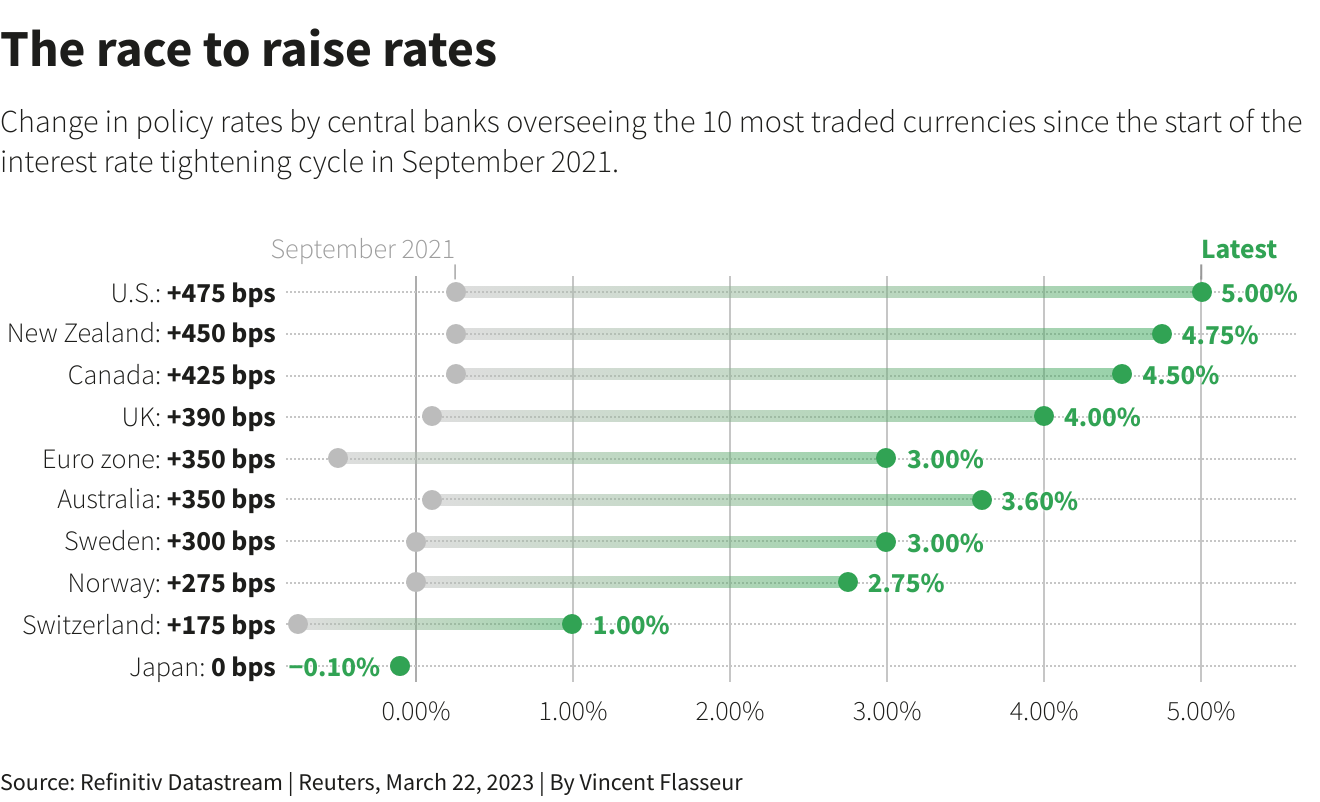
Here’s a graph of the current state of interest rate hikes among the 10 largest currencies on the forex markets:
7.00am: FTSE to open lower
FTSE 100 is expected to open lower after US stocks tumbled following mixed messages from US officials after the Federal Reserve opted to increase interest rates despite turmoil in the banking sector.
Spread betting companies are calling London’s lead index down by 26 points.
On Wall Street, the Dow Jones Industrial Average closed down 530.49 points, or 1.6%, at 32,030.11. The S&P 500 slumped 65.90 points, or 1.7%, at 3,939.97 and the Nasdaq Composite declined 190.15 points, or 1.6%, at 11,669.96.
The Federal Reserve increased interest rates by 25 basis points, resisting the urge to pause hikes in the face of banking sector uncertainty, taking the federal funds rate range to 4.75% to 5.00%. The vote was unanimous.
But in a signal that the US central bank is nearly done with the most aggressive streak of rate rises in decades, members of its policy-setting committee removed the oft-repeated warning that "ongoing increases" would be necessary to bring soaring inflation under control.
Rather, the committee said "some additional policy firming may be appropriate" to bring inflation back to the bank’s 2% target.
Federal Reserve Chair Jerome Powell also moved to calm banking sector fears in the wake insisting that depositor funds were "safe" in the US banking system.
Powell said the measures taken in response to the failures, including a guarantee for all deposits held at the two lenders and a new Fed lending facility, "demonstrate that all depositors’ savings are safe".
But as Powell spoke, shares in US banks slipped after Treasury secretary Janet Yellen said that the Biden administration was not considering a broad expansion of bank deposit insurance or “blanket” guarantees for savers.
The KBW Nasdaq Bank index fell 4.7%. Shares in First Republic, the hardest hit among regional banks that have been suffering massive outflows of deposits, fell 15%. Larger banks also came under pressure, Wells Fargo and Bank of America declined 3.3%, while investment banks JPMorgan Chase and Morgan Stanley (NYSE:MS) fell 2.6% and 1.4% respectively.
I truly do not understand what Treasury Secretary Yellen was thinking today. We had a real opportunity to work our way through this one before she explicitly said that there's no big plan to help depositors. A simple: "we have the power to do what's necessary" was called for
— Jim Cramer (@jimcramer) March 23, 2023
Back in London and monetary policy will take centre stage in the UK with the Bank of England set to make its call at 1200 GMT. A rise of 25bp in line with the Fed and ECB is expected.
Otherwise the early focus in London will be results automotive distributor Inchcape PLC (LSE:INCH) and building materials firm Wickes Group PLC (LSE:WIX).