
Just how significant is Credit Suisse? The embattled Swiss lender is one of just 30 global financial institutions designated as being systemically important by the international Financial Stability Board.
But as shares fell to an all-time low yesterday the bank’s valuation was less than Crocs, a manufacturer of rubber clogs and would have placed it between Admiral and Kingfisher in the FTSE 100. Its market value has dropped by Swiss franc 100bn over the past 15 years.
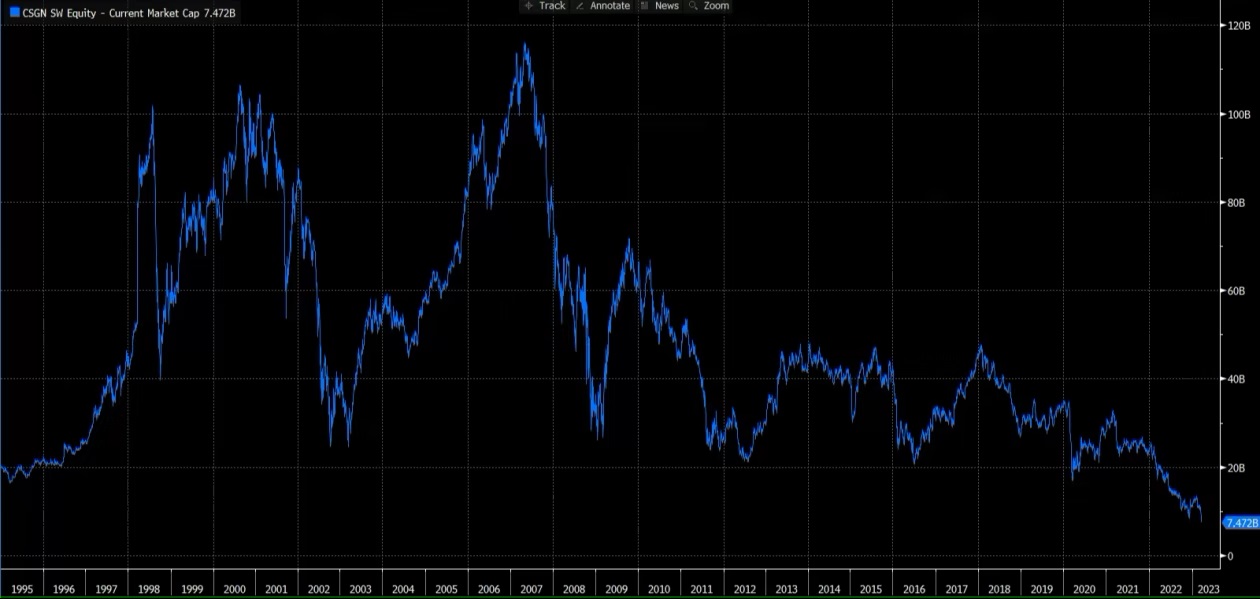
While this is a slightly flippant approach it shows how far the bank’s fall from grace has been.
In 2007, Credit Suisse was the world’s eighth-biggest publicly owned bank by market capitalisation. At yesterday’s low it ranked 155th, between Shanghai Commercial and Savings Bank and Webster Financial (NYSE:WBS) of Stamford, Connecticut.
However, it remains a household name in financial markets and had total assets of US$574bn at the end of 2022, down 37% from US$912bn at the end of 2020. Its asset-management arm supervises another US$1.7 trillion in assets, dwarfing anything seen at Silicon Valley Bank, which had total assets of US$212bn.
As Rob Burgeman, senior investment manager at wealth manager RBC Brewin Dolphin pointed out: "Messy as it looks, it is almost inconceivable that the bank would be allowed to collapse à la Lehman Brothers – the potential fallout would be catastrophic."
"I certainly wouldn’t want to be a shareholder or bondholder, but we think that the latest falls are more to do with sentiment towards the banking sector, in general, and the weaker banks, in particular.”
The company is a significant employer in the US and the UK. According to its website the firm has 7,020 employees in the US, with offices in Boston, Chicago, Houston, Los Angeles, New York and San Francisco. In the UK the number is put at 5,500, primarily at its Canary Wharf base.
The bank has been involved in a number of notable M&A deals including advising Express Scripts (NASDAQ:ESRX) on its acquisition of Medco Health Solutions (NYSE:MHS) for US$34.1bn, Genzyme (NASDAQ:GENZ) on it sale to Sanofi Aventis for US$20.1bn and Energy Transfer Equity on its acquisition Southern Union for US$9.4bn.
Recent equity assignments include Cargill’s US$7.5bn monetization of shares of Mosaic, the US Treasury’s US$6bn monetization of AIG shares, and the US$3.4bn equity & equity-linked acquisition financings for PPL.
It describes itself as a proven leader in debt underwriting and corporate lending, demonstrated through its role in many of the most recognizable US bond issues.
“We helped the following leading companies tap the debt markets: Fannie Mae, Conoco, PanAmSat, Ford Motor Credit and GE Capital, to name a few,” the bank said.
So despite its share price fall the Swiss bank remains a big player. But as Guy Foster, chief strategist at RBC Brewin Dolphin noted: "The reassuring thing from a financial stability perspective is that if that trust can't be maintained regulators will have options to combine Credit Suisse with another entity, force a more significant restructuring, or rescue the bank without subjecting taxpayers or prospective white knights to unacceptable financial risk.”