
OpenAI launched ChatGPT-4 on Tuesday, the latest version of its artificial intelligence chatbot, and its first multimodal model – able to process images as well as text.
Training for GPT-4 finished in August, though OpenAI then spent six months “iteratively aligning” the programme, prompting it to react better to instructions, be “more truthful” and “less toxic”.
A key feature of GPT-4 is OpenAI’s claim it is “40% more likely to produce factual responses” than its predecessor GPT-3.5.
OpenAI has done this through a technique called ‘reinforcement learning from human feedback,’ a three-step process where people demonstrate responses to, and then rate the chatbot’s own answers to prompts.
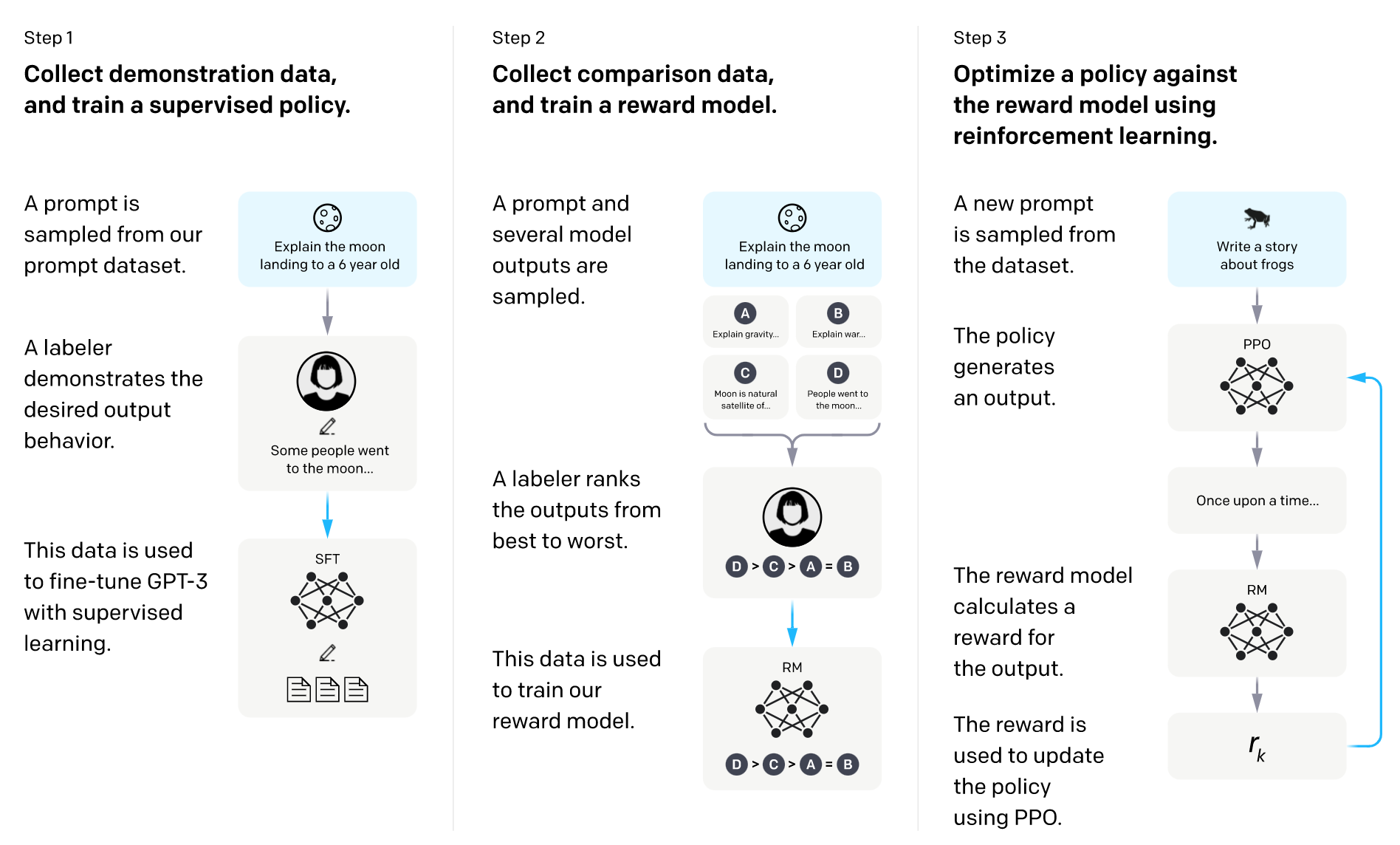
Reinforcement learning from human feedback method - OpenAI
Despite this, OpenAI explains the difference between ChatGPT 3.5 and 4 will be “subtle” when users stick to casual conversation and only offer simple tasks.
The difference comes, the tech firm adds, when its tasks reach a “sufficient” complexity, such as giving it the US bar exam, which it passed, scoring within the top 10% of test takers.
OpenAI also said it would be “updating and improving” GPT-4 based on public use, preventing unsafe outputs by making it refuse “certain instructions”.
“More work is needed to study how these models perform on broader groups of users,” the company said, especially when humans disagree with it.
Another key step in GPT's journey is its ability to register and process photographs, a feature able to help partially sighted and blind people, according to OpenAI, though this is yet to be made public.