
- FTSE 100 closes 293 points lower
- US stocks drop as banking worries return
- Credit Suisse shares under pressure after earlier halt
4.50pm: FTSE 100 drops nearly 300 points
The UK's blue-chip index closed a day to forget down 3.8% at 7,344 points.
4.00pm: Footsie lowest level since December 2022
With half an hour of trading to go in London, the FTSE 100 index was heading back towards session lows below 7,400, which was the lowest level off the year.
Walid Koudmani, chief market analyst at XTB noted: "While the pound didn't show many signs of reaction to today's budget announcement by Chancellor Hunt, UK stocks took a further dive with the FTSE 100 reaching the lowest level since December 2022. Some of this negative sentiment is certainly tied to the prospect of a crisis in the banking sector sparked by the collapse of several high-profile US banks but many are now asking themselves how this new budget by the UK government will impact economic prospects moving forward. Furthermore, expectations of inflation have been lowered further from previous estimates to 2.9% which may prompt a modified reaction by the Bank of England as we head to the end of the year."
He added: "The pound continues to hover around the 1.205 region against the US dollar after the greenback seemed unimpressed with US retail sales and PPI data, but any major news may lead to a significant reaction across asset classes. In conclusion, many of the measures announced today were somewhat expected and certainly were perceived better than the 'mini-budget' announcement by the Truss cabinet, which now famously caused a crash in the pound. It remains to be seen how much of it will be able to be implemented as businesses and consumers continue to struggle with cost of living and economic uncertainty."
3.45pm: First John Lewis Group CEO named
The owner of John Lewis and Waitrose has appointed its first group chief executive, with Nish Kankiwala, a former Hovis and Burger King executive who is currently a non-executive director of the John Lewis Partnership, to take up this new role from 27 March.
The boss of the partnership's department store chain, Pippa Wicks, left unexpectedly last month to be replaced by the retail director, Naomi Simcock, while the boss of Waitrose, James Bailey, is under pressure after a sales slide at the supermarket chain during the cost of living crisis.
Simcock and Bailey, who until now have reported directly to the partnership’s chair, Sharon White, will now report to Kankiwala, as will five other directors including the finance director, Bérangère Michel, and Zaka Mian, who joined as transformation and technology officer in November.
The appointment comes as the staff-owned partnership is set to announce its second-ever full-year loss, with workers expected to miss out on their annual bonus for the second time in three years.
3.35pm: Gold makes sterling record
Gold hit a new record price in sterling terms close to £1,600 per ounce as investors took fright at the slumping share prices of some of Europe's leading banks.
In pound terms, the metal's price was up from just over £1,530 a week ago and £1,500 a year ago.
Five years ago, the sterling gold price was less than £1,000 an ounce.
Proactive's Alastair Ford noted that inflation has been on the move for more than a year, US banks are wobbling, the fabled Swiss banking system is under more scrutiny than it’s ever been before, and every single significant central bank in the world has been printing money hand over fist ever since 2008.
And so, with the collapse of SVB, a new round of bailouts in the offing, Credit Suisse sinking at last down to the depths it should have been consigned to long ago, the gold price hit a new all-time record in sterling terms.
3.15pm: Mid caps not so badly off
With global markets under severe pressure again and the FTSE 100 index dropping by over 3% to a session low below 7,400, the more UK-centric FTSE 250 index managed to limit its losses to - just - 2% helped by some bright spots from the UK Budget for a few players.
Danni Hewson, head of financial analysis at AJ Bell noted: “On a miserable day for stock markets amid concerns about the banking sector, UK Chancellor Jeremy Hunt managed to pluck enough rabbits out of the hat to halt the decline in the FTSE 250 share index and trigger a small recovery.
“The FTSE 250 is typically seen as a better benchmark for the UK economy than the FTSE 100 because it has a greater number of domestic companies in its index. Before the Budget got underway, the mid-cap index had fallen from 19,129 from 18,552, but it managed to recover to 18,602 by the time Hunt’s speech had finished.
“Helping to drive a turnaround was news that the OBR no longer forecasts the UK will be in technical recession this year and the Chancellor’s plans to drive economic growth through a series of measures.
“The Chancellor gave the message that UK was pro-nuclear and launched a competition for small modular reactors, a key area of focus for Rolls-Royce.
“Other key bits of interest to investors include the news that the government will announce plans in the autumn to make London a more attractive place to list their shares for companies.”
Around 3.15pm, the FTSE 250 index was still down 393 points, or 2.1% at 18,736.
2.45pm: Energy security support
UK government measures to support energy security will be announced later in March, a budget document has said without mention of any fresh incentives for oil and gas or renewable energy producer, Reuters reported.
Oil and gas producers had called for floor prices to be applied to a windfall tax imposed last year and renewable power companies wanted better investment incentives, but finance minister Jeremy Hunt's spring budget included no such actions.
"In addition to the measures in the spring budget, the government will set out further action later this month to ensure energy security in the UK and meet our net zero commitments," the government said in the budget document, the newswire said.
Both the oil and gas and renewables industries will watch out for any updates to how the Energy Profits Levy (EPL) tax applied to the former and the Electricity Generator Levy (EGL) applied to the latter might change.
The Chancellor Jeremy Hunt's first Budget did include some incentives for nuclear power and carbon capture and storage projects.
2.30pm: Boring, boring
The Chancellor, Jeremy Hunt delivered his first Budget today and the highlight was that he said the UK will not enter a technical recession this year.
However, the economy will still shrink by 0.2% in 2023 versus November’s forecast for a decline of 1.4%, while inflation is estimated to fall to 2.9% by the final quarter of 2023, but unemployment will rise to 4.4%.
Victoria Scholar, Head of Investment, Interactive Investor commented: "Hunt wanted today’s Budget to be boring, but markets are anything but that. Today’s sell-off across equities with sharp declines in the banking sector have overshadowed the impact from the Treasury’s fiscal plans for spending and taxation."
She added: "Despite attempts by the Chancellor to paint a rosy picture with improved figures on growth and inflation, the strain in the financial sector is yet another headwind to contend with. The market turmoil and the economic fallout are paving the way for a much smaller chance of a rate hike from the Bank of England this month. Interest rate futures are now pricing in a 60% chance the central bank opts for no change at its next monetary policy committee meeting.
"The Budget has done little to budge the pound which is down against the US dollar but higher against the euro. Fear of a financial crisis is weighing on the euro zone currency which has slumped more than 1.7% against the greenback."
2.10pm: Woe all round
The FTSE 100 index hovered not far above hefty session lows as Wall Street joined in the sharp drops by global markets as worries over contagion in the banking sector engulfed Swiss banking giant Credit Suisse.
Around 40 minutes after the opening bell, the Dow Jones Industrials Average was down 450 points, 1.4%, to 31,704, the S&P 500 also fell 1.4%, and the Nasdaq Composite lost 1.1%.
The collapse of both Silicon Valley Bank and Signature Bank earlier this week has brought significant turmoil to the banking sector and the market as a whole. Shares of Credit Suisse were suspended after the bank's stock hit a record low and the bank's biggest investor, Saudi National Bank, said it could no longer provide the Swiss bank with further financial credit, according to a report by Reuters.
In London, around 2.10pm, the FTSE 100 index was down 207 points, or 2.7% at 7,429, easing off the session low of 7,391.25
1.55pm: Credit Suisse's road to potential ruin
The Saudi National Bank (SNB) which is Credit Suisse’s biggest backer sparked the freefall in the Swiss bank's shares.
Comments that it remains confident in the troubled bank and that it didn’t need extra money were interpreted as meaning there is no more cash forthcoming from SNB.
Ammar Al Khudairy, SNB’s chairman, said: "We are happy with the transformation plan that Credit Suisse has put forward. It is a very strong bank.
“I don’t think they will need extra money; if you look at the bank’s ratios it's fine.”
Al Khudairy added that SNB could not inject funds into the bank even if it wanted to, citing regulation prohibits stakes in the lender from going above 10%.
SNB currently have a 9.88% holding in Credit Suisse, according to Refinitiv data.
The journey to Credit Suisse’s share low has been led by multiple scandals dirtying the reputation of Switzerland’s second-largest bank.
In October 2019, its chief operating officer was fired after it was found the bank had hired private investigators to follow a senior executive across Zurich.
Six months later in March 2021, the bank was hit financially when clients Greensill, a stock lender, and asset manager Archegos collapsed.
That month the two failures cost the bank upwards of US$15bln.
Over a year later and the scandals continued after the Swiss bank was found guilty of failing to prevent money laundering by Bulgarian cocaine traffickers.
Over the last six months, the bank has also:
- Reported its worst annual loss since the financial crisis of 2008.
- Had data stolen by a former staff employee.
- Faced a social media storm that sunk the share price.
- Had a market manipulation investigation opened into comments made by its chairman Axel Lehmann.
Since the issues began in 2021 the share price has shed more than 80% of its value , with constant record lows being reached and an increasing number of client withdrawals.
1.36pm: Banks continue to tumble
Here’s a quick recap on where we are with the UK-listed banks after Credit Suisse's shares were temporarily suspended this morning.
FTSE 100 bank Barclays shed 8% to 139p, while Standard Chartered slipped 8% to 639p.
NatWest’s losses weren’t as deep, losing 5.7% to 261p, while HSBC and Lloyds both lost 5% to 547p and 45p respectively.
Credit Suisse hasn’t been able to stop the rot after shares resumed trading again, down 27% to 1.62 Swiss francs.
1.24pm: Budget provides little respite
Today's Budget provided little respite for FTSE 100 which continued to fall, with the index down 241 points, more than 3%, to 7,395.
Hunt did provide some relief for pubs, however, freezing the alcohol duty rate, while also deciding not to increase the energy price cap to £3,000, welcome news for households.
Corporation tax, however, will rise to 25% from 19% as of 1 April.
1.15pm: BlackRock warns of 'slow rolling crisis'
BlackRock chief Larry Fink said the collapse of SVB could be followed by a “slow-rolling crisis” in the US financial system.
In his annual CEO letter, the likened the bank’s collapse to the savings and loans crisis from 1986 to 1995.
“We’ve seen inflation move sharply higher to levels not seen since the 1980s. To fight this inflation, the Federal Reserve in the past year has raised rates nearly 500 basis points. This is one price we’re already paying for years of easy money – and was the first domino to drop,” the letter said.
“Prior tightening cycles have often led to spectacular financial flameouts – whether it was the Savings and Loan Crisis that unfolded throughout the eighties and early nineties or the bankruptcy of Orange County, California, in 1994. In the case of the S&L Crisis, it was a “slow rolling crisis” – one that just kept going. It ultimately lasted about a decade and more than a thousand thrifts went under.”
"We don’t know yet whether the consequences of easy money and regulatory changes will cascade throughout the US regional banking sector (akin to the S&L Crisis) with more seizures and shutdowns coming.”
1.00pm: US preview
Wall Street is expected to open lower, giving back Tuesday’s strong gains on lingering fears of banking contagion following the collapse of Silicon Valley Bank (SVP), with investors now looking to US retail sales for further direction.
Futures for the Dow Jones Industrial Average fell 1.7% in Wednesday pre-market trading, while those for the broader S&P 500 index also declined 1.7% and contracts for the Nasdaq-100 shed 1.5%.
Sentiment took a knock as Credit Suisse’s shares were suspended after tumbling to a record low after its largest investor, Saudi National Bank, said it could no longer provide the Swiss Bank with further financial credit, according to a report by Reuters.
"Sentiment just seems to have evaporated, with big moves in fixed income markets and banking shares again, probably on a further slide in Credit Suisse shares and rise in its CDS," commented Neil Wilson, chief market analyst at Markets.com.
"European equity markets led by banking shares and US futures are tumbling. If CS were to run into serious existential trouble, we are in a whole other world of pain."
The Nasdaq Composite led Tuesday’s gains, rallying 2.1% to 11,428, supported by news that Meta Platforms plans to axe another 10,000 jobs this year as part of the tech giant’s cost-cutting measures.
February inflation data that was largely in line with expectations helped push the DJIA 1.1% higher to 32,155, while the S&P 500 gained 1.7% to 3,919. The small-cap Russell 2000 index added 1.9% to 1,777.
“Wall Street made solid gains on Tuesday, helped not only by the post-SVB relief rally but also thanks to some slightly softer than expected inflation data,” commented James Hughes, chief market analyst at Scope Markets.
“This is making life that little bit harder for the policy hawks at the Federal Reserve and although the market continues to price in a 25 basis point hike next week, the accompanying press conference will be under close scrutiny for clues as to what happens next.”
Today, the focus moves to US February retail sales as the next key input to monitor, noted TickMill Group’s Market Analyst James Harte.
“As with CPI, retail sales spiked higher in January, adding to the sense of hawkishness at the time. However, looking at today’s data, the market is expecting headline retail sales to fall 0.3%, down from 3% prior with core retail sales expected to fall 0.1%, down from 2.3% prior," Harte said.
"Indeed, in light of yesterday’s weaker US CPI reading, market pricing now reflects a roughly 20% chance that the Fed keeps rates on hold this month.”
12.56pm: Credit Suisse a 'Lehman moment'
Nouriel Roubini, ominously known as Dr Doom, said that the collapse of Credit Suisse would a “Lehman Moment.”
The high-profile economist is referring to the collapse of the US investment bank Lehman Brothers in August 2007 at the start of the global financial crisis.
As I pointed out in my Bloomberg TV interview this morning the Credit Suisse crisis is a “Lehman moment” for European and global markets. “Too big to fail and too big to be saved”. It is not even clear what their various unrealized losses on securities and other assets are.
— Nouriel Roubini (@Nouriel) March 15, 2023
12.45pm: Pub stocks get boost but FTSE 100 tanks
FTSE 100 is down nearly 3%, or 225 points, to 7,411.
Pub stocks received a small bounce after Jeremy Hunt confirmed alcohol duty would be frozen.
JD Wetherspoons moved from to 580p from 570p at the start of the announcement at 12.30pm, while Mitchell & Butlers moved to 158p from 154p.
12.37pm: Inflation to fall
Jeremy Hunt said inflation is expected to fall to 2.9% by the end of 2023, compared to 10.7% at the end of 2022.
12.35pm: Rate hikes or not?
Following the volatility in the banking sector, central banks may be deterred from raising interest rates higher.
CME’s FedWatch Tool have the cut the chances of a quarter-point rise in US interest rates next to around 50%.
Game off! Following more banking sector volatility, markets are again seeing a decreased probability of a Fed hike next week: {data from WIRP<Go>} https://t.co/b5lKlYZkWB pic.twitter.com/wwne5gO7k6
— Michael McDonough (@M_McDonough) March 15, 2023
12.15pm: FTSE 100 wipes 2023 gains
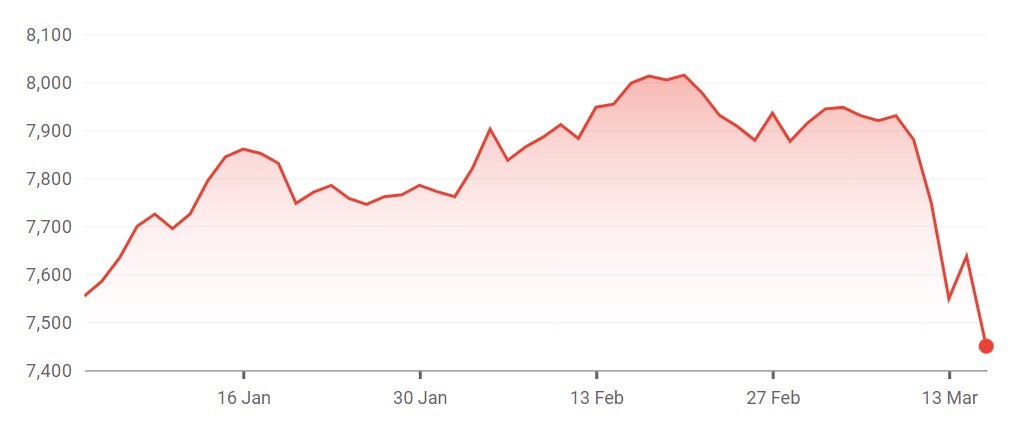
The recent stock market turmoil has seen FTSE 100 erase all of its gains made this year.
London’s blue-chip index ended the year at 7,451 points, and after breaking past and closing higher than 8,000 for the first ever on 15 February, the index is currently trading at 7,452 points.
12.10pm: Gold peaks
Gold has peaked and reached a record high of £1,596.19 per ounce, up 1.81% as investors flock to the haven asset following the Credit Suisse crisis.
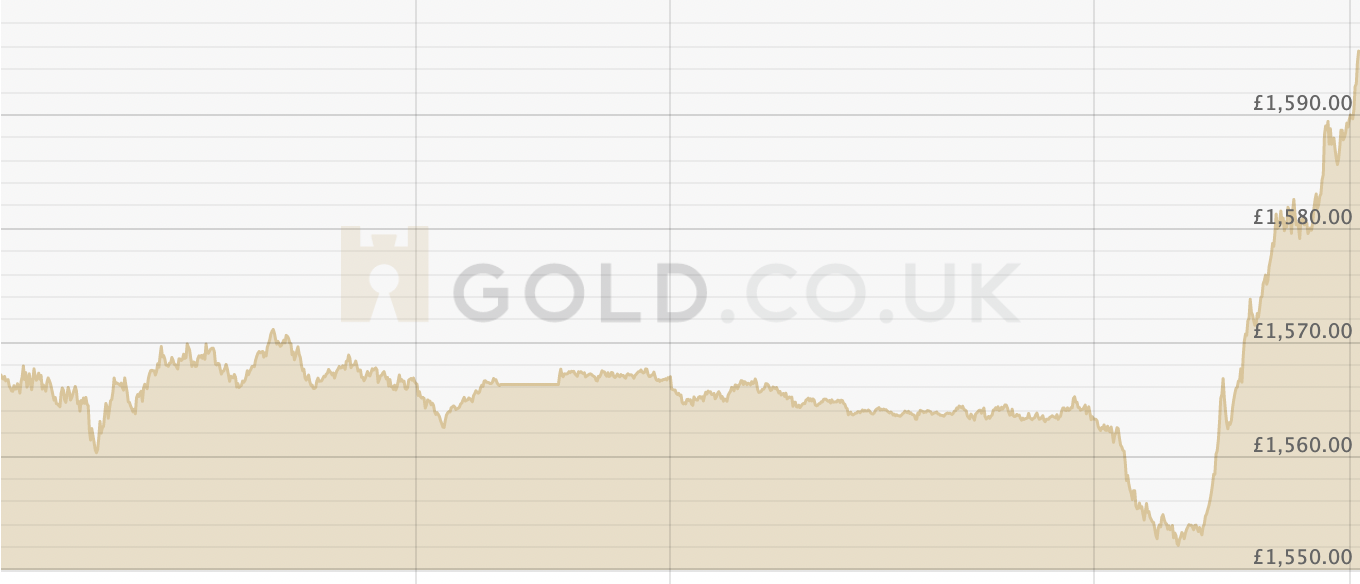
Image credit: Gold.co.uk
12.07pm: Financial crisis fears intensify
Credit Suisse’s share slump, which fell as much as 24%, has intensified fears of a 2008 financial style crisis, according to Fawad Razaqzada, a market analyst at City Index and FOREX.com
“An index of European bank stocks fell 5%, while the Euro Stoxx 50 volatility hit its highest since October. You get the picture: investors were panicking,” said Razaqzada.
“Bloodbath, if you will. This comes fresh on the heels of a broader industry selloff following the collapse of Silicon Valley Bank. Concerns over another 2008-style financial crises have intensified.”
11.58am: European banks take a beating
France’s finance minister refused to comment on drops in the share prices of the country’s top banks following the slump in Credit Suisse, where trading was temporarily halted this morning as shares tumbled 24%.
BNP Paribas and Societe Generale were both suspended from trading, with shares currently down about 10%.
Credit Agricole is also down about 6%.
Elsewhere in Italy, shares in UniCredit were down 7%, with Monte dei Paschi down 6.4%.
Germany’s Commerzbank was also down around about 10%, while the larger Deutsche Bank shed 8%.
The European Central Bank may yet add fuel to the fire, with it likely to power ahead with interest rate hikes despite the current banking mini-crisis.
11.46am: Trading resumes at Credit Suisse
Credit Suisse shares seem to be back up and trading, bouncing from earlier lows but still down 20% to 1.79CHF (161p).
11.38am: Banking crisis takes 'ominous' twist
The banking route has “taken on another ominous twist” according to Susannah Streeter, head of money and markets at Hargreaves Lansdown.
Credit Suisse’s shares were halted from trading after falling by more than a fifth after its largest investor, Saudi National Bank, said it could no longer provide financial credit.
“The fresh banking sell-off has taken hold as fears rise to the surface about the robustness of the sector with the shadow of the SVB collapse still looming large,” Streeter added.
“With the US banking sector downgraded to negative by Moody’s nervousness is super-high and that’s spilt over into a hot mess in Europe.”
The calm before the storm that the Fed may have paused on rate hikes to restore financial stability has quickly evaporated.
Instead, investors are worried that the European Central Bank may still opt for a large rate hike, despite the problems hard and fast monetary policy tightening has had on bond prices.
“The worry is that banks sitting on large unrealised losses in their bond portfolios might not have sufficient buffers if there is a fast withdrawal of deposits.”
“Although the biggest players are judged not to be at risk, thanks to the chunky layer of capital they are sitting on and the stable nature of their deposits, the nervousness is palpable," said Streeter.
11.29: SVB asks customers to return
As the banking crisis deepens, SVB opened its doors to customers.
The technology-focused lender’s collapse last week seems to have started the current storm which is encapsulating the banking sector, with Credit Suisse’s shares halted from trading after nosediving 22%.
SVB’s new CEO Tim Mayopoulos, begged customers to return to the bank, adding it is once again issuing accounts and making new loans.
FTSE 100 is down 2.3% to 7,457.
11.15 am: UK banking stocks down
Bank stocks are tanking on the bank of Credit Suisse’s shares being suspended from trading.
Lloyds is down 4% to 46p, and HSBC is down 4% to 554p.
Elsewhere, Barclays is down 6% and NatWest is down 4.9%.
11.03am: Credit Suisse shares halted
Credit Suisse shares hit another all-time low for a second consecutive session, falling 21%, before shares were halted from trading.
The group’s largest investor, Saudi National Bank, said it could no longer provide the Swiss Bank with further financial credit, according to a report by Reuters.
“We cannot because we would go above 10%. It’s a regulatory issue,” said Saudi National Bank chairman Ammar Al Khudairy.
10.46am: Credit Suisse chair speaks in Saudi Arabia
Credit Suisse’s chairman Axel Lehmann said that government assistance for the bank “isn’t a topic” after the lender moved to reassure investors, clients and regulators.
Yesterday, the bank admitted weaknesses in its financial controls and confirmed Lehmann would be taking a pay cut.
The Swiss bank in its annual report told the market “management did not design and maintain an effective risk assessment process to identify and analyse the risk of material misstatements in its financial statements”.
Speaking at the Financial Sector Conference in Saudi Arabia on Wednesday, Lehmann said it wouldn’t be accurate to compare the bank’s problems to the collapse of SVB.
Lehmann echoes remarks made by the group’s CEO Ulrich Koerner who asked for patience with its three-year plan to return to profitability.
10.26am: Pound falls
The Pound has fallen sharply ahead of Jeremy Hunt’s Budget.
Pound falls sharply against the dollar ahead of Jeremy Hunt's Budget
Markets Today: https://t.co/FJv1HLfOOx pic.twitter.com/8rAaLHxq2v
— Bloomberg UK (@BloombergUK) March 15, 2023
FTSE 100 is down 146 points, nearly 2% to 7,491.
10.12am: Goldman Sachs (NYSE:GS) bought SVB's portfolio
SVB said that Goldman Sachs (NYSE:GS) purchased the bond portfolio on which it booked a US$1.8bn loss, a transaction that put the wheels in motion for the failure of SVB.
The technology-focused lender attempted a US$2.25bn stock sale last week, using Sachs as its adviser.
Ultimately, the capital raise was thwarted as depositors fled and investors fretted that SVB would need more capital.
The collapse last week sent shockwaves through the markets, with London’s blue-chip index down 5% since last Thursday to 7,501.
9.29am: FTSE 100 on the back foot
The FTSE 100 started the day lower as speculation builds ahead of today’s Spring Budget, which Zaye Capital Markets analysts predict will aim to incentivise people back into the workforce.
Among companies, Balfour Beatty reported a 42% rise in annual profits to £279mln, prompting a dividend hike and its third consecutive buyback, worth £150mln.
Insurer Prudential pointed to China’s reopening for a boost to its early 2023 sales, also recording an 8% rise in operating profit during last year to US$3.38bn.
Keywords Studios also said trading had started well this year as it hiked its dividend 10%, bringing the total to 2.37p for 2022, up from 2.15p, also reporting a 35% rise in revenue to €690.7mln.
Transport ticketing platform Trainline fell short of expectations though, reporting net sales of £4.3bn, up 16% but short of a targeted 18-27%, as rail strikes gripped the business and cost up to £6mln each day.
And with the small caps, Mosman Oil and Gas Ltd (AIM:MSMN) was over 5% higher this morning, after it confirmed a significant increase in reserves at its Texas Cinnabar project.
8.26am: Energy price guarantee in focus
The energy price guarantee is expected to remain at £2,500 in today's Budget, shelving previous plans to raise the cap to £3,000.
Falling wholesale prices meant energy prices were 50% lower than had been forecast in October.
This in turn cut the borrowing needed to fund energy support from April to June by two-thirds to £4bn.
“This will come as an enormous relief for the millions of people who are already struggling to pay their bills, and were facing the threat of price rises with abject horror," said Sarah Coles, head of personal finance at Hargreaves Lansdown.
8.16am: Prudential welcomes China re-opening
Prudential said the reopening of China has boosted sales at the start of 2023 as it reported a rise in annual operating profit.
The Asia-focused insurer saw adjusted operating profit improve by 8% in the 12 months to December 31, 2022, to US$3.38bn, beating expectations of around US$3.34bn from a company-compiled forecast.
A second interim dividend of 13.04 cents per share was declared lifting the total dividend to 18.78 cents per share, up 9%.
Prudential chief Executive Anil Wadhwani commented: “The removal of the bulk of COVID-19-related restrictions across the region and the progressive opening up of the Chinese mainland economy has meant that 2023 has started well with encouraging progress in year-on-year sales, with group-wide annual premium equivalent (APE) sales for the two months ended February 2023 up 15% over the prior year.”
8.12am: FTSE 100 opens lower
FTSE 100 opened sharply lower, losing 36 points to 7,601.
Naeem Aslam, chief investment officer at Zaye Capital Markets believes today's Budget announcement will be focused on alleviating "self-inflicted" wounds, such as Brexit and labour scarcity.
"Therefore the emphasis will be on childcare support, which might draw part of the labour force back into the market, while he is also anticipated to talk about pension changes, which should encourage skilled employees to return," Aslam added.
8.03am: Balfour provides bumper dividend
Balfour Beatty has reported a strong rise in annual profit, a large dividend increase and confirmed a £150mln buyback for the third consecutive year.
The FTSE 250-listed firm saw underlying operating profit for the 12 months to December 31, 2023, rose by 42% to £279mln from £197mln in 2021, underlying earnings per share improved to 47.5p from 29.7p and the total dividend was increased by 17% to 10.5p from 9p a year ago.
Balfour Beatty chief executive Leo Quinn said: “The diversified portfolio, both geographically in the UK, US and Hong Kong, and operationally across Construction Services, Support Services and Infrastructure Investments, plus the strength of our balance sheet and cash management, have provided the resilience for the group to deliver ahead of expectations and grow our order book through the global instability seen in 2022.
8.00am: All eyes on Budget
FTSE 100 and global markets have been subdued by the expectations that central banks, especially the US Federal Reserve, will pause or slow down interest rate hikes in the wake of the banking turmoil.
Wall Street stocks and markets across Asia were lifted sharply, while banks hit by the SVB fall-out were making a chunk of the losses.
Oil prices have crept up, with WTI Crude up 0.79% to US$72.23.
Today, however, is all about the Budget in the UK.
"With a keen eye on trying to maintain financial stability particularly the close shave this week given SVB’s collapse, he looks set to focus on highly targeted policies, rather than tax cuts to propel growth," said Susannah Streeter, head of money and markets and Hargreaves Lansdown.
"He has more wiggle room as public sector borrowing, still high by historical standards is set to undershoot forecasts made by the Office of Budget Responsibility."
"Labour shortages mean high inflation is stubborn and he’ll be trying to coax people back to work with a combination of sweets and a naughty step approach, with a widening of sanctions expected for those who don’t look for work."
7.00am: Markets expected to open subdued
FTSE 100 is expected to open little changed as investors look ahead to Jeremy Hunt’s Spring Budget.
Spread betting companies are calling the lead index down 3 points.
The chancellor is expected to pledge to tackle labour shortages and get people back to work alongside announcements on energy bill support, benefits reform and pensions allowances.
On Wall Street, the Dow Jones Industrial Average closed up 336.26 points, or 1.1%, at 32,155.40. The S&P 500 surged 64.80 points, or 1.7%, at 3,920.56 and the Nasdaq Composite advanced 239.31 points, or 2.1%, at 11,428.15.
In Asia, the Nikkei 225 ended 7 points to the good, while in China, the Shanghai Composite was up 0.6% in afternoon trade. In Hong Kong, the Hang Seng index advanced 1.5%.
Back in London and results from Prudential and Marshalls will provide an early focus with US PPI figures due later.