
An independent study has found that the graphite by-product of planned rutile production at Sovereign Metals Limited (ASX:SVM, OTC:SVMLF, AIM:SVML)’s Kasiya Project in Malawi should have the lowest global warming potential (GWP) compared to other currently known and planned future natural graphite projects.
The cradle-to-gate life cycle assessment (LCA) by UK-based consultancy Minviro Ltd outlines that the GWP of producing one tonne of flake graphite concentrate at Kasiya is estimated to be 0.2 tonnes of CO2 equivalent emissions.
Lower than others
This is up to 60% lower than the currently reported GWP of graphite producers and developers, including suppliers to Tesla Inc (NASDAQ:TSLA).
It is also three times less polluting than proposed Tanzanian natural graphite production from hard rock sources and six times less than current Chinese natural graphite production which accounts for up to 80% of current global graphite supply.
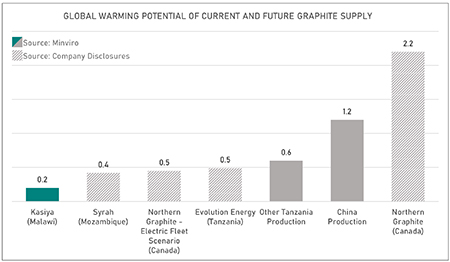
Global Warming Potential per tonne of graphite product (CO2e/t).
The benchmarking shows that Kasiya’s total GWP is significantly lower than the total GWP per tonne produced in Heilongjiang Province, China (1.2 tonnes CO2e) and the total GWP per tonne produced in Tanzania (0.6 tonnes CO2e).
Producers “taking note”
Sovereign’s managing director Dr Julian Stephens said: “It is remarkable that our graphite co-product from planned rutile production at Kasiya will not only be potentially one of the lowest cost flake graphite projects in the world but now can also be considered to have one of the lowest global warming potentials of current and future graphite mines.
"Producers and users of lithium-ion batteries are already taking note of the carbon footprint associated with the raw materials that feed into battery technology - so to be developing Kasiya at this time is truly exciting.”
Despite graphite being only a co-product to future potential rutile production, Kasiya is still one of the largest and potentially lowest production cost flake graphite resources in the world as it is hosted in soft and friable saprolite material instead of hard rock.
Based on scoping study
The GWP for Kasiya’s flake graphite product was based on information in the Kasiya Scoping Study from December 2021. This was followed up with an Expanded Scoping Study in June 2022.
Minviro’s LCA has previously shown the potential for Sovereign’s primary product of natural rutile to significantly reduce the carbon footprint of the titanium pigment industry.
Each tonne of natural rutile produced at Kasiya is expected to have a GWP of only 0.1 tonnes CO2 equivalent, equating to a 95% to 97% reduction in total greenhouse gas emissions compared to the production of titania slag and synthetic rutile respectively – both of which are alternative titanium feedstocks produced by upgrading ilmenite via energy and carbon-intensive processes.
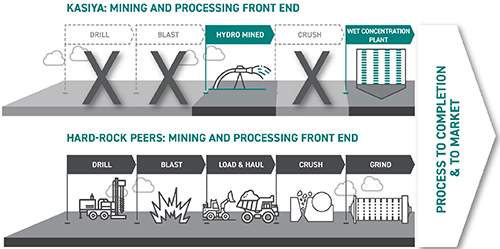
Kasiya’s co-product graphite mining and processing front end compared to hard-rock peers.
Why the low GWP?
Along with the host material, the lower GWP for Kasiya graphite has been attributed to the proposed hydro method of mining with high-pressure water monitors powered almost 100% by renewable energy sources - hydropower from the Malawi grid and on-site solar power.
This contrasts with the production in Heilongjiang Province, China, where hard-rock ore requires drilling, blasting, excavation, trucking, crushing and grinding – overall high CO2e activities.
About Kasiya
Kasiya in central Malawi is the largest natural rutile deposit and one of the largest flake graphite deposits in the world.
The lithium-ion battery sector is the main emerging market for flake graphite. Greater capacity batteries, such as those required for electric vehicles, are expected to drive significant demand for graphite over the coming years. It is forecast the battery sector will become the largest graphite market segment by 2028.
Kasiya will be a simple and conventional operation using traditional and well-developed processes used across the globe on numerous mineral sands and graphite operations.
The proposed large-scale operation will process soft, friable mineralisation that occurs from surface in an area with excellent access and water availability.
The project has high-quality surrounding infrastructure including hydro-sourced grid power, bitumen roads and recently upgraded rail lines connecting to the deep water of ports of Nacala and Beira on the Indian Ocean.