
The collapse of Silicon Valley Bank has triggered unwelcome memories of the 2008 global financial crisis where contagion spread throughout the banking sector like wildfire pushing a number of high profile names to the wall.
It's certainly caused chaos in banking share prices across Europe with Credit Suisse down 12%, Deutsche Bank AG (NYSE:DB) down 5.8%, Banco Santander SA down 7.6% and Standard Chartered down 6.6%.
So could the latest failure of a little known US bank – until last week at least - lead to a full-blown tsunami in the financial world?
Let’s start with how and why did SVB fail
The fall from grace was quick. The Financial Times reported that in early March, 40 chief financial officers from various technology groups gathered in the Utah ski resort of Deer Valley for an annual “snow summit” hosted by the bank, which was seen as a crucial financial institution for tech start-ups.
Barely a week later, the bank was bust. Customers had initiated withdrawals of US$42bn in a single day, a quarter of the bank’s total deposits, and it was unable to meet the requests.
The bank had seen deposits triple since the fourth quarter of 2019 to US$189bn at the end of 2021 which compared to industry growth of 37% over the same period, according to Autonomous Research.
It also had an unusually high reliance on corporate and VC funding. Around 95% of its deposits were uninsured at the end of last year compared with one-third at a sample of major US banks.
Crucially, and fatally as it turned out, the bank had made a large unhedged bet on longer-term bonds at peak prices. As its deposit base was rapidly eroding last week, SVB was forced to sell bond holdings to raise cash. In the process it crystalised losses, estimated at US$16bn, as the value of its fixed-rate bond holdings had suffered due to rising interest rates. An attempt to raise additional capital from elsewhere failed.
As ING pointed out: “Unusually, SVB employed far more of its deposit base in long-dated bonds than in writing loans. This meant it was more susceptible than most banks to the performance of its bond portfolio.”
“Moreover, SVB's bond portfolio had a large longer-dated fixed-income component. As rates rise, the value of this portfolio fell. This would damage the running yield on such a portfolio, pressuring the implied interest rate margin down. Under pressure, liquidation of the bond portfolio crystallised losses, necessitating the subsequent need to raise capital.“
Regulators asleep at the wheel?
So how was SVB allowed to take these financial positions?
In theory regulation changes imposed in 2010 under the Dodd-Frank Act should have prevented this. This legislation was aimed at preventing excessive risk-taking that led to the financial crisis in 2008. But despite being the 16th-largest US bank, SVB was not subject to Fed stress tests, nor the international Basel banking rules on liquidity.
Why? Well, in 2018 part of the Dodd-Frank Act was rolled back, exempting some banks with assets of up to US$250bn from the Fed’s toughest supervisory measures.
This left SVB immune from certain stress tests as well as capital and liquidity requirements.
The legislation was a cornerstone of Donald Trump’s presidency, but critics warned – wisely as it turned out - it would weaken a regulatory apparatus that had been built to avoid future crises.
There is also the issue with the US’s “dual banking system”, in which state-chartered banks are subject to both federal and state oversight – while the Federal Reserve was its primary overseer SVB was also subject to the rules of California’s state regulator.
Could contagion spread?
Never say never in the banking world where confidence is key. But there are good reasons to believe things will be different this time.
As Rupert Thompson, chief economist at Kingswood said: “This time it really should be different, even if these are the most dangerous words to utter in finance.”
“The clue here is in the name. Silicon Valley Bank was very much focused on tech start-ups and ran into problems as the rise in interest rates had led to deposit withdrawals and was forcing it to sell its government bond holdings at a loss.”
“The problems SVB faced are not applicable to the large banks which do not face a run on their deposits and generally benefit, rather than suffer, from higher interest rates.”
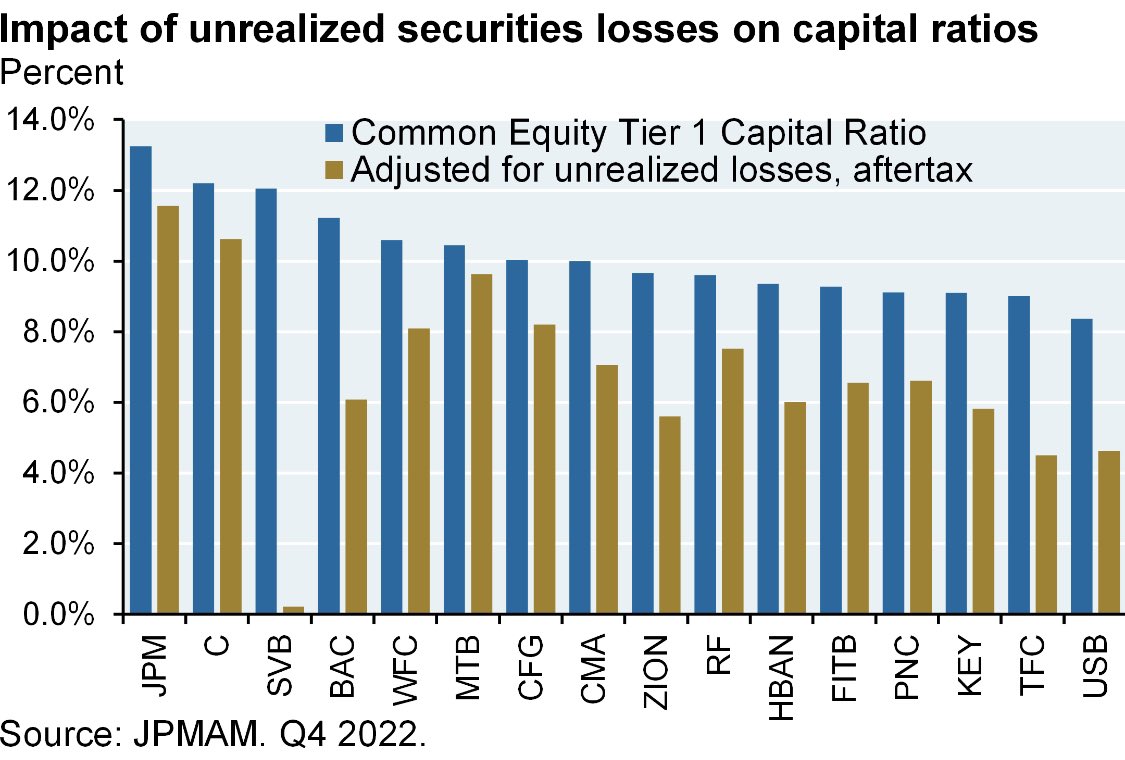
But what would happen to equity capital ratios of various major banks if all the unrealised losses on their portfolios were crystallised. Helpfully, JP Morgan's Michael Cembalest has run the numbers. He showed that realising the losses would take a big bite out of some banks’ equity, but all the banks would still have a solid equity cushion if this happened.
The analysis showed that even SVB (as of the end of last year) would have been solvent, and it had the highest ratio of securities to total assets of any US bank.
There is also no reason to think that any of them, even under extreme circumstances, would have to sell all their securities as per SVB.
Regulation, regulation, regulation
Things have also changed since 2008. Just take a look at the UK. A Bank of England report showed capital requirements on the UK’s large banks are ten times higher than before the crisis and banks have raised more than US$1.5 trillion of capital.
Banks are now disciplined by a leverage ratio which protects the system from risks and uncertainties that are hard to measure through risk weights and models.
They are also less dependent on each other - interbank lending has fallen by two thirds since the crisis while large global banks are taking fewer risks trading in financial markets; trading assets have halved.
The Bank noted as a result the average ratio of capital to risk weighted assets has increased from 4.5% to 14.3%.To see how much capital ratios have increased take a look at Lloyds Banking Group PLC (LSE:LLOY). In 2008 it reported a Tier 1 capital ratio of 6.4% which by 2022 had risen to 17.1% (it was even higher in 2021).
So banks are better capitalised and more risk averse than in 2008.
A local difficulty
Another reason for cautious optimism is that many of SVB’s issues appear company specific.
Very few banks have such a high concentration of business in one sector in the way SVB did, no other banks have such a magnitude of unrealised losses on their held-to-maturity-only securities portfolio and as mentioned above it was less tightly regulated than other US banks of its size.
So while markets are likely to remain volatile in the short-term the 'big' banks are better capitalised, better regulated and better placed to deal with any liquidity issues. That is not to say other smaller players may not follow SVB to the wall but it should mean no repeat of 2008.