
Renewable sources of energy produced enough power for all of the UK’s homes this winter, cutting gas demand by a third and reducing the need for imports.
Renewables produced 46TWh between October and February, slightly more than the 45TWh from gas and 27TWh from nuclear and other sources, according to data from the Energy & Climate Intelligence Unit (ECIU).
That’s enough to stave off 107 tankers carrying liquified natural gas, which is up to ten times more harmful for the environment than if it comes through pipes, and power 16mln homes for the entire year, and heat 10mln for the winter.
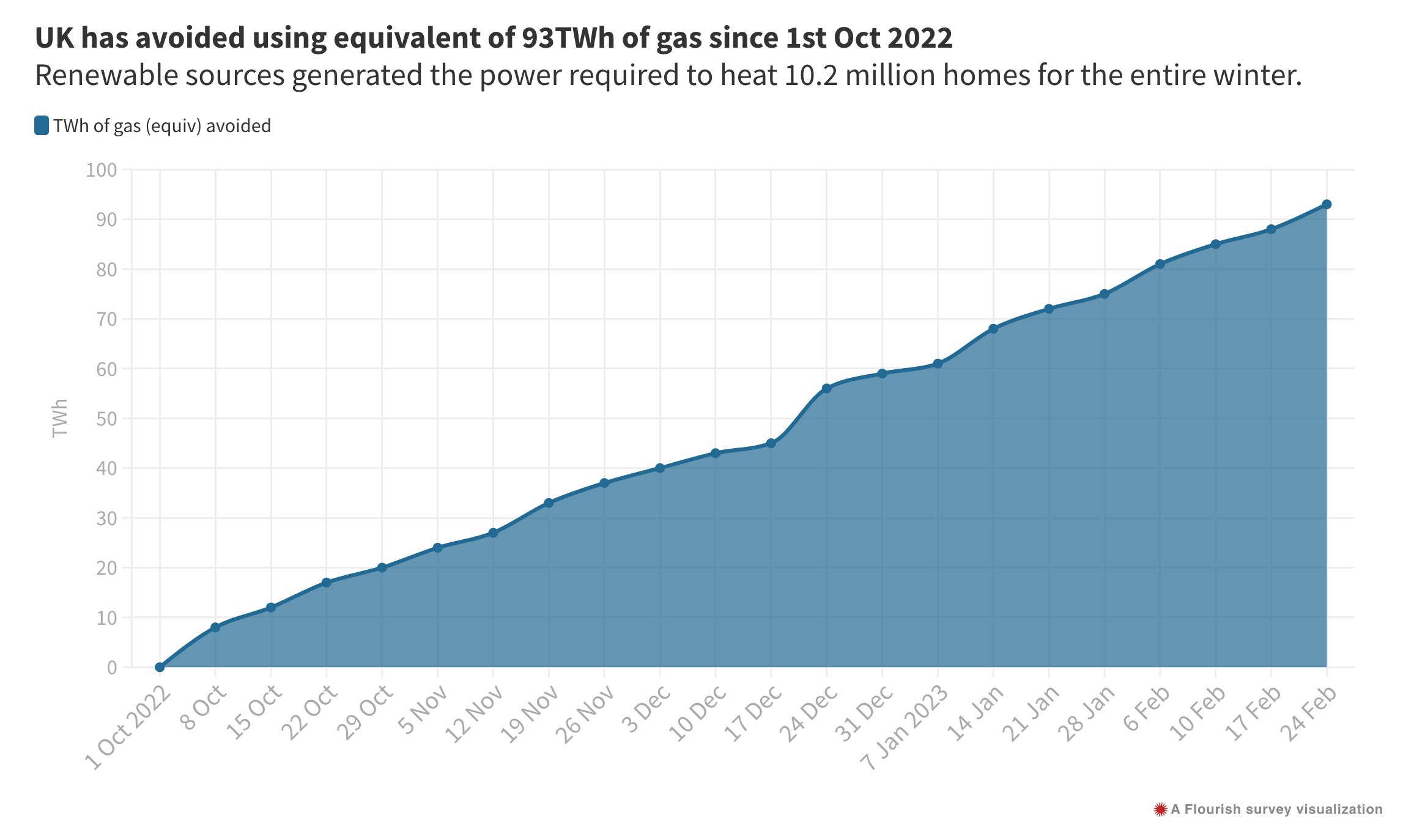
UK has avoided using equivalent of 93TWh of gas since 1st Oct 2022 - Energy & Climate Intelligence Unit
“We’re seeing the old electricity system give way to the new, with renewables becoming the backbone and displacing more and more gas,” the group’s energy head Jess Ralston said.
Britain relies on gas for 40% of its electricity production and for heating 85% of homes, which are the least efficient in western Europe, according to the International Monetary Fund.
As a result, it has been the worst hit among counterparts by higher gas prices, lifted by the war in Ukraine.
Ralston suggested new emphasis on renewables in the US and EU, as each looks to boost energy security, puts pressure on the UK to remain attractive for new investment from energy firms.
“Eyes are on the Government, the Chancellor and the Budget to decide on how the UK stays an attractive market for the investments that will ultimately bring down bills,” she said.
Despite the higher production, renewable sources, like wind, solar and hydro, can be unpredictable and often over or undershoot the needs of the grid.
Wind turbines, for example, require wind speeds above 8mph, according to the European Wind Energy Association, while solar, obviously, only works when it is light.
Surplus power is often sent across the channel to Europe because of this, with the UK becoming a net exporter for the first time in 12 years in 2022, the ECIU wrote.
It can also be stored in batteries or other technologies, like pumped hydro and compressed air, although the prevalence of these is not yet enough to stop the UK using fossil fuels.