
Australia's economy continued to grow during the December quarter, recording 0.5% growth, supported by a strong increase in household and government spending, according to the latest report released by the Australian Bureau of Statistics (ABS).
The country’s GDP grew by 2.7% through the year, marking the fifth consecutive quarterly rise in GDP.
Consumer spending and government expenditure were the driving forces behind the 0.4% increase in overall consumption, with the retail, hospitality and transportation industries seeing the most significant gains.
Meanwhile, the export sector experienced 1.1% growth, mainly thanks to a surge in demand for travel services and the continued interest from foreign markets in Australia's coal and mineral ores.
The country’s GDP growth has been sluggish in the last two quarters, signalling potential concerns for the future.
Economic activity increased 0.5% in December quarterhttps://t.co/0S5YbmEoZY pic.twitter.com/mUUVVm2NFY
— Australian Bureau of Statistics (@ABSStats) March 1, 2023
Major drivers: “Final consumption and net trade”
According to ABS head of National Accounts Katherine Keenan: “Final consumption and net trade were the major drivers of GDP growth.
"The 0.4% rise in total consumption and 1.1% rise in exports were the primary contributors to GDP growth in the December quarter.
“Continued growth in household and government spending drove the rise in consumption, while increased exports of travel services and continued overseas demand for coal and mineral ores drove exports," she said.
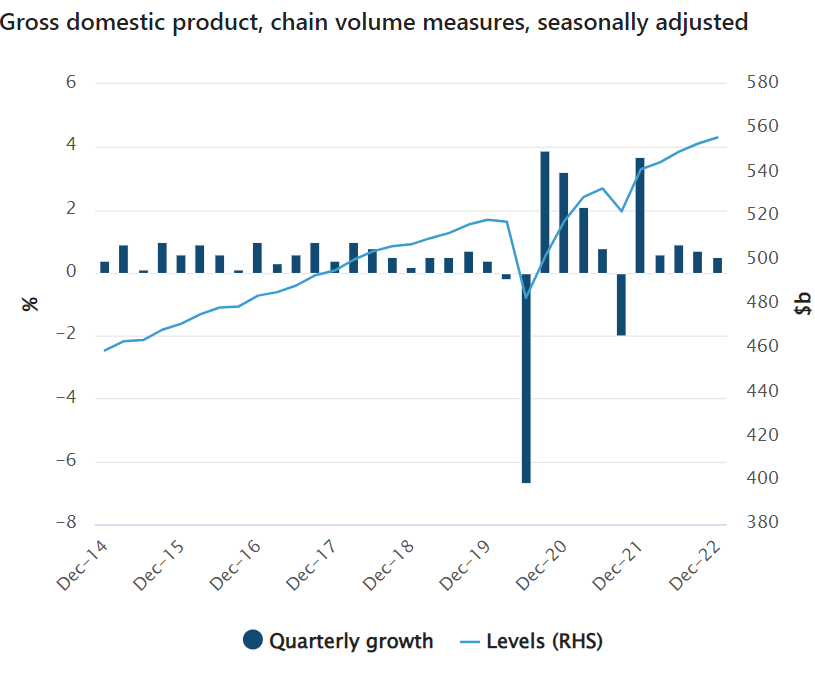
Quarterly growth figures.
Study highlights
According to the latest figures, the GDP implicit price deflator (IPD) rose by 1.6% in the December quarter, while domestic prices grew by 1.4%.
The terms of trade also saw a significant increase, rising 7.2% through the year, driving real gross domestic income up by 4.4%.
On the household front, spending increased by 0.3%, led by food, hotels, cafes, restaurants and transport services.
However, public and private investment declined, with private gross fixed capital formation falling 1.7%.
The tight labour market drove the compensation of employees up by 2.1% but the household saving-to-income ratio continued to fall for the fifth consecutive quarter.
Lastly, net trade contributed 1.1 percentage points to GDP, thanks to an increase in exports and a decrease in imports.