
Moho Resources Ltd (ASX:MOH) has kicked off aircore drilling across three licences – E70/4688, E70/5300 and E70/5154 – at the Burracoppin Rare Earth Element (REE) and Gold Project in Western Australia.
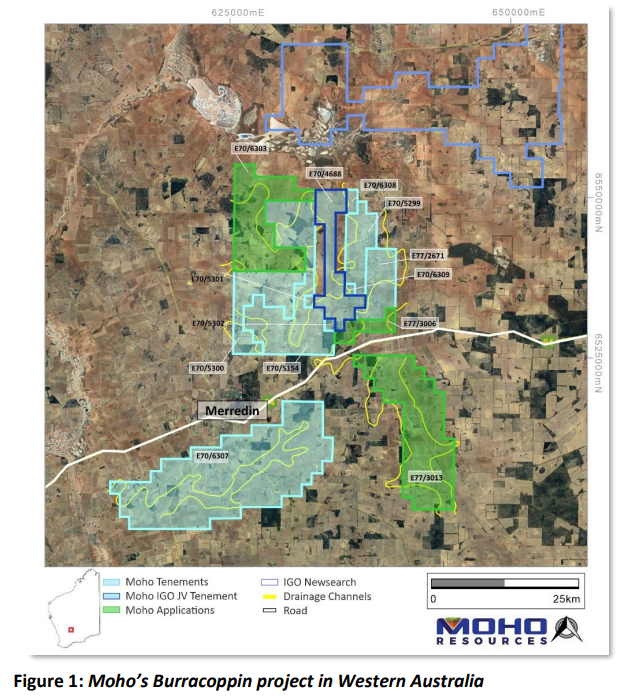
The primary objective of this program is to provide a proof of concept for accumulations of ionic clay rare earth elements (REE) within drainage channels previously picked out by Moho.
Evidence of rare earth oxides
Moho's recent geochemical evaluation of assays from project-wide soil surveys and drilling at the Crossroads gold prospect has returned evidence of elevated total rare earth oxides (TREO) in surface and downhole data.
The current aircore drilling program consists of 39 drill hole locations for about 2,000 metres and has a number of objectives:
- investigate the geological constraints of inferred drainage channels;
- test inferred drainage channels for potential clay-hosted REE mineralisation;
- investigate the bedrock source of elevated dysprosium and neodymium values; and
- follow up and test historic surface gold mineralisation.
MOH is keen to review and interpret the assay results once they start to flow in. It can then model REE results to establish the potential for ionic clay accumulations and, if warranted, undertake further drilling at other prospective areas at the tenements.
From there, further drilling will follow up any significant bedrock REE and gold mineralisation that Moho may encounter during this exercise.
To generate drill targets, the company used a combination of interpreted drainage channels and surface geochemical and airborne magnetic data but was restricted to properties with signed land access and compensation agreements.
Gold points the way
Some 23 holes have been designed to test previously identified soil gold anomalies for bedrock mineralisation across E70/5154 and E70/53003.
The soil gold anomalism is coincident with elevated arsenic values and is proximal to shearing and folding which is evident in aeromagnetic data acquired by the company.
Moho believes that coincident gold-arsenic anomalism could be related to sulphide mineralisation in the underlying bedrock.
A northern gold anomaly, which boasts greater than 8 parts per billion (ppb) gold, is also coincident with elevated neodymium and dysprosium, which may be sourced from the numerous outcropping and sub-cropping granitic units.
Moho plans to conduct multi-element analysis of drilling samples to test if there is REE mineralisation and the depth extent.
About Burracoppin
The Burracoppin Project is a 1,139-square-kilometre tenement package roughly 250 kilometres northeast of Perth, consisting of 10 granted exploration licences.
Moho and IGO Limited (ASX:IGO) have formed an unincorporated joint venture for the purpose of exploring and, if warranted, developing and mining on E70/4688.
IGO’s 30% interest will be free carried until completion of a pre-feasibility study, at which time IGO may elect to contribute pro-rata to ongoing work or convert its 30% interest to a 10% free carried interest.
Moho has also undertaken substantial exploration around E70/4688 and expanded the tenure of the Burracoppin Project.