
It’s only four years since Persimmon PLC (LSE:PSN) reported annual pre-tax profits of £1.1bn and pumped £75mln into its bosses bank account but today’s results from the housebuilder show just how quickly things.
A creaking housing market, rising mortgage rates, soaring build costs and subdued consumer confidence are all contributing to the FTSE 100-listed firms woes as is the ending of the lucrative Help To Buy scheme.
Persimmon was a particular beneficiary from the controversial scheme beloved by builders, who said it has increased supply of homes, while its detractors claimed it drove up property prices.
Critics stated there was ample evidence that help-to-buy homes were sold at a premium, with the excess providing the rocket fuel for housebuilders’ profits margins.
A report on building.co.uk found nearly half (48%) of Persimmon sales in 2020 were made up of Buy to Help sales, the highest percentage of any UK housebuilder. It estimated that in 2022 this had fallen to 20% leaving it more closely aligned to others in the sector with Bellway the most exposed at 22% of sales. Redrow is the least exposed in 2022 with an estimated 8.6% of sales.
In 2020 the scheme accounted for 35% of sales at Barratt Developments and Bellway, 46% at Taylor Wimpey and 33% at Redrow.
Russ Mould at AJ Bell noted today’s outlook for 2023 by Persimmon pointed to operating profits and operating margins being the lowest since 2012.
“It would (almost) be as if Help to Buy had never happened, and could raise the question of who was really helped the most by the scheme launched a decade ago by then Chancellor of the Exchequer, George Osborne,” he said.
He put the number of completions from the scheme at Persimmon at around a quarter in 2022.
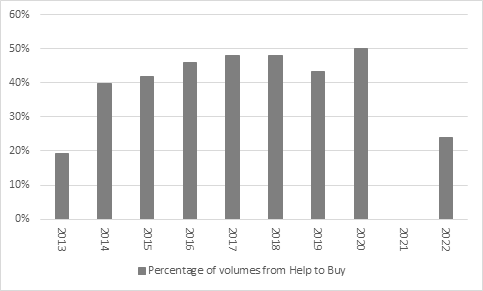
Persimmon made no detailed comment on Help to Buy today other than to note the ending of the scheme “means that for the first time in over a decade there is not a significant government scheme to assist first time buyers in place.”
Whatever the rights or wrongs of the scheme its ending could not have come at a worse time for the industry.
The fall-out from the Liz Truss administration and subsequent chaos in the mortgage market have prompted falls in house prices as demand slumped.
Today, figures from the Bank of England showed mortgage approvals at their lowest levels since 2009 (excluding the pandemic) while a report from the Nationwide showed UK house prices dropped for the fifth month in a row in February and shrank year-on-year for the first time since the start of the pandemic.
The impact was clearly seen in today’s results with the builder calculating that at current sales rates new home completions could be around 40% lower in 2023 at between 8,000 to 9,000 compared to 14,868 in 2022 taking them back to, or even below, the levels seen in 2009 following the financial crisis. Margins could fall by as much as 800 basis points, it warned.
The dividend was also slashed to 60p from 235p although the group’s cash position remains solid.
“Welcome to a new era of chaos for the housebuilders. Falling property prices and rising costs means profits are being squeezed and that will cause earnings in the sector to slump,” warned Russ Mould at AJ Bell.
“When you throw in higher interest rates and mortgage costs to an already troubling affordability issue, the UK housing market may be teetering on the brink of a nasty downturn,” he warned.