
- FTSE 100 stayed in positive territory
- Dow Jones up as US ISM manufacturing PMI rises
- Andrew Bailey says 'nothing is decided' yet on interest rates
4:30pm: FTSE 100 stays in positive territory
The FTSE 100 ended Wednesday in positive territory, closing at 7,913 â up 36 points or 0.47% for the day.
3.55pm: Swings and roundabouts
Looking at the US ISM data, Kieran Clancy, senior US economist at Pantheon Macroeconomics commented: "Februaryâs increase in the headline arrests five straight months of decline, but still leaves it below 50. Moreover, the production component fell for the fourth straight month, by 0.7 points to 48.0, and that deterioration already is being mirrored in the hard data; the monthly manufacturing output prints have been extremely noisy, thanks largely to swings in the weather, but the trend clearly has rolled over.
"That said, the recent improvement in the China manufacturing PMIs point to a modest rebound in the U.S. survey over the next few months, lifting manufacturing out of the worst of its slump. But the sector accounts for only 11% of GDP, andâlike housingâdoes not reliably lead activity in other sectors."
He added: "Production index aside, the rest of the survey is more encouraging. The single biggest improvement was in the new orders component, which rose 4.5 points to 47.0, more-than reversing its January plunge. Supplier deliveries edged lower, to 45.2 from 45.6, and although order backlogs rose, to 45.1 from 43.1, the bigger picture is that both indices are broadly back to pre-Covid levels, and remain miles away from the levels reached during the peak supply disruption in 2021. The employment index fell 1.5 points to 49.1, which makes us more confident in our view that private payroll growth softened significantly in February; our Homebase model points to a print of 200K."
3.40pm: US manufacturing a bit brighter
The US Institute for Supply Management (ISM) factory sector Purchasing Managers' Index rose from a January reading of 47.4 to 47.7 in February, but missed the consensus forecast of 47.8.
A sub-index for production eased from 48.0 to 47.3 while that for new orders improved from 42.5 to 47.0. Readings below 50 point to a continued contraction in manufacturing.
In parallel, a gauge tied to employment slipped from 50.6 to 49.1 and that for prices rose from 44.5 to 51.3.
However, upbeat comments from US purchasing managers' canvassed by the ISM appeared to outnumber negative ones, albeit sprinkled with references to supply chain issues and other caveats.
US stock indexes turned mixed again after the data, with the Dow Jones Industrial Average adding 19 points or 0.1% at 32,675, but the Nasdaq Composite remained weak, down 0.3%, as did the S&P 500 index off 0.2%.
3.25pm: M&S good for pay
Never mind interest rates what about pay hikes. Retailer Marks and Spencer has revealed that it is investing £60mln in its store colleague pay, its âbiggest everâ investment into wages.
More than 40,000 employees will see their pay increase to £10.90 an hour from £10.20 on 1 April, while the rate of pay for staff within London will increase to £12.05 an hour from £11.25.
Since 2021, the FTSE 100 retailer said it had increased the hourly salary of its employees by 20%, according to a statement.
M&S' pay award is top of £46.5mln spent on store staff pay during the 2022/23 fiscal year, meaning full-time M&S customer assistants will be earning an extra £150 per month compared to April 2022.
3.15pm: Weather eye on US rates
Having heard comments about UK interest rates today from the Bank of England Governor, the markets are also keeping a weather eye on US rates ahead of the next Federal Reserve policy decision due on 23 March.
Markets now expect the Fed Funds rate to peak at 5.5% but the Federal interest bill is soaring to suggest there is a limit to how far the Fed can go up.
AJ Bell investment director Russ Mould commented: âSticky inflation, especially in services, a tight labour market and a renewed surge in stock market speculation all mean the US Federal Reserve may be more reluctant to pause its run of interest rate increases and then pivot to cutting rates than investors had hoped as we entered 2023.
âHowever, there may be a limit to how far the Fed can go. Americaâs government is nudging up against its $31 trillion debt ceiling and while the inevitable horse-trading and pork-barrel politics on Capitol Hill mean that is likely to be increased, the federal interest bill is surging as rates rise â it already represents 23% of federal tax receipts and can only go higher if both the debt ceiling and Fed Funds rate go up."
2.50pm: New York markets cautious
The FTSE 100 index held firm but stayed off session highs as US stocks edged modestly higher after falls at the open on Wednesday as investors awaited the release of Februaryâs ISM manufacturing data, a key measure of how the economy performed last month.
Around 20 minutes after the market opened, the Dow Jones Industrial Average was up 52 points or 0.2% at 32,709, with the Nasdaq Composite also ahead 0.2%, while the S&P 500 index was essentially flat, up 0.01%.
FOREX.com market analyst Fiona Cincotta said stocks were lacking direction as investors weighed up a stronger-than-forecast economic recovery in China against concerns that the Federal Reserve will keep raising interest rates higher for longer.
âChinaâs manufacturing activity grew at the fastest pace in over a decade, fueling bets of a solid economic recovery in the workâs second-largest economy, which could help work towards the soft landing,â she said.
âHowever, itâs also worth noting that a strong economic recovery in China could also be inflationary, fueling the no-landing scenario.â
In London, around 2.50pm, the FTSE 100 index was ahead 64 points, or 0.8% at 7,940.
2.35pm: Eurozone inflation stubborn
After releases on Tuesday showed inflation in France and Spain accelerated unexpectedly in February, a German flash estimate on Wednesday put that country's inflation rate harmonized with the rest of the EU at 9.3% last month, which would be an increase from 9.2% in January.
Overall eurozone inflation figures are due out on Thursday.
In other data from the region, Italyâs statistics office reported full-year GDP growth of 6.8%, and PMI figures showed French manufacturing output declined after a strong performance in January, but the picture was brighter in Italy and Spain.
2.25pm: JLR looks to charge
Jaguar Land Roverâs owner has reportedly asked the UK government for more than £500mln in state subsidies to build a battery factory in Somerset, according to newspaper reports.
Tata Motors, part of the Indian conglomerate that owns Jaguar Land Rover (JLR), has asked for the money in the form of grants and support packages such as assistance for energy costs and research funding, the Guardian understands.
The carmaker is choosing between a potential site in Somerset and another in Spain, according to the Financial Times, which first reported the £500mln figure.
Spain has been offering large grants to companies considering battery production, in the hopes that it can attract the new industry with the potential for cheap solar power.
2.10pm: Reds on the block
Liverpool Football Club and owner FSG are said to be looking at major media companies as potential investors, according to reports.
Last week, FSGâs principal owner John W Henry confirmed to the Boston Globe that he would be seeking investment for Liverpool, distancing themselves from talks of a potential sale of the club.
Rumours have since circulated on where this investment would come from, with Singaporeâs sovereign wealth fund and RedBird Capital, which bought a 10% stake in FSG in 2021, said to be attracted to the idea of a stake in the Premier League club.
According to the Telegraph, however, one interested party could be US media giant Liberty Media, which began life in 1991 as a spin-off from cable television group TCI.
1.30pm: Hereâs a quick recap on the biggest risers and fallers of the day so far
Aston Martin Lagonda Global Holdings PLC (LSE:AML) shares revved 18% higher as results for 2022 were boosted by a strong fourth quarter.
While results from the luxury British carmaker did not really blow the doors off, delivered in the final months of th year were up 22% and the outlook for 2023 was solidified.
ValiRx PLC (AIM:VAL) shares jumped higher in early trade after the company announced the incorporation of Inaphaea BioLabs Limited, a new wholly-owned subsidiary which will be the cornerstone of ValiRx's translational Contract Research Organisation (tCRO).
ValiRx shares were trading 6.7% higher at 12.00p.
Accrol Group Holdings PLC (AIM:ACRL) has signed a deal with Unilever PLC (LSE:ULVR) to exclusively produce and sell a kitchen towel product under its Lifebuoy brand.
The company said the exclusive deal was part of its stated strategy to expand into higher margin, third-party licensed brands and the news sent shares up 4.8% to 48.5p on Wednesday in early exchanges.
International Personal Finance (LSE:IPF), the home credit business, shot up 12% to 108.2p after reporting an uptick in full-year pre-tax profits.
Profit before tax jumped 14.3% to £77.4mln, with a 6.5p final dividend, up 15% from 2021.
Inland Homes PLC (AIM:INL) shares tumbled more than 25% lower after it announced that its chair Simon Bennett and the group's other non-executive directors Carol Duncumb and Brian Johnson have resigned with immediate effect.
Artemis Resources Ltd (ASX:ARV, OTCQB:ARTTF, AIM:ARV) shares dropped 10% in morning trading after the AIM and ASX-listed firm announced a capital raise.
1.00pm: Wall Street expected to join global markets merriment
With Asian stocks getting the new month off to a good start (Hong Kong up over 4%!) and Europe continuing the money-making mood (FTSE up 0.9%), US stocks are expected to add to the buoyancy.
Upbeat China data was the spark, following an up-and-down few days, with Wall Street finishing in the red last night.
Now we are in a new month, we are starting to get new data from February, with US manufacturing data later will start to build a picture of how the economy fared last month.
Futures for the Dow Jones are pointing to a 0.2% rise for Wednesday, the same as for the broader S&P 500 index, while contracts for the Nasdaq-100 are up almost 0.4%.
All three major US indices closed out a volatile month in the red on Tuesday, with the Dow losing 4.2% over February, the S&P falling 3.6% and the tech-heavy Nasdaq Composite ending 3.05% lower â compared to a near-1.5% gain for the FTSE.
"January economic data generally surprised on the upside leading to a rapid repricing in terminal rate expectation for US rates,â said analyst Patrick Munnelly at TickMill.
"The debate amongst market watchers is the extent to which this bump in activity data was due to milder than usual weather and so February releases are expected to give a cleaner read on the underlying nature of activity in the US."
The ISM manufacturing purchasing managers' index (PMI), coming ahead of its services counterpart on Friday, will be among the first of the February readings and so "are likely to be parsed particularly closely by investors," he added.
Street consensus is looking for a continuation of the sub-50 headline figure, with a slight improvement to -48 from -47.4 in January.
Elsewhere a "potentially ominous development" was reported by Bloomberg, citing data from UBS that showed S&P 500 operating cash flows trailed profits by the most on record and that earnings have "started to expand noticeably faster than cash is coming in the door".
On the corporate earnings front, Salesforce, Loweâs, Dollar Tree and Budweiser report today as the fourth-quarter 2022 reporting season draws to a close - while the investor day for Tesla Inc (NASDAQ:TSLA) is highly anticipated at 3pm Central Time (4pm in New York and 9pm in London), with investors looking to hear the new 'Master Plan' from CEO Elon Musk.
Heading lower after results released overnight are another EV maker Rivian Automotive Inc (NASDAQ:RIVN), which is heading for a 9% plunge after falling well short of Q4 revenue expectations, and space tourism company Virgin Galactic Holdings Inc (NYSE:SPCE), with a 2% decline in pre-market trading after its losses rocketed ahead of the start of commercial flights in the coming quarter.
12.29pm: Plan for empty supermarket shelves
Following all the recent stories about empty supermarket vegetable aisles, UK farmers have called for more government support and more "fairness" from their customers in the food and supermarket sectors.
A new strategy launched by the National Farmers Union to boost UK horticulture "could be the solution to minimising future supply chain disruption", it said.
NFU president Minette Batters said: "The consequences of undervaluing growers can be seen on supermarket shelves right now. Shelves are empty. This is a reality weâve been warning government about for many months.
"Without urgent action there are real risks that empty shelves may become more commonplace as British horticulture businesses struggle with unprecedented inflationary pressures, most notably on energy and labour costs."
AB Foods (LSE:ABF) is one of the top risers on the FTSE at the moment, but that's unconnected and more to do with HSBC upgrading its rating to 'buy' with a price target of 2,530p versus the current 2028p.
Other notable broker changes today include Canaccord initiating coverage of publisher Future PLC (LSE:FUTR) with a 'sell' rating and a price target of 1,153p versus the last close at 1,402p.
Some investor favourites have seen some changes too, with British Airways owner IAG getting higher price targets from Goldman Sachs upping to 168p from 150p but remaining 'neutral' and similar from JPMorgan, upping its Madrid-listed shares to â¬2.20 from â¬2 but still 'neutral' with the shares trading at 154p and â¬1.75.
Deutsche Bank has raised its target for Rolls-Royce Holdings PLC (LSE:RR.) to 160p from 136p and reiterated a 'buy' on the back of the recent "strong" numbers and expected improvement in the core civil aero business.
"We have raised 2023-2025 sales and operating profit forecasts by an average of 6% and 19% respectively," the DB analysts said, but this does not reflect the impact from the as-yet-unannounced results of the planned transformation programme.
Midday: Optimism returns
The earlier speech from BoE boss Bailey is helping lift market sentiment, says analyst Naeem Aslam, fresh in his new role as chief investment officer at Zaye Capital Markets.
"Market players are a lot more optimistic as the governor of the Bank of England believes that the bank may take a break from hiking rates as things have started to flow in the direction that they desired.
"The fact that is this is good news from the Bank official who has been sending hawkish comments to the market which made many concerned."
London's blue chip benchmark is up almost 71 points or 0.9% at just over 7947.
It's the pre-eminent index in Europe this morning, with the DAX up 0.7% in Germany, CAC 40 up 0.8% in France, IBEX 35 rising 0.55% in Spain.
The overall STOXX 50 is up 0.86% at 4274.62, not far from its recent 18-month highs.
11.29am: FTSE nearing 8000 again
London's miners and other China-linked blue chips are carrying the index back up towards its recent 8000 milestone, hitting an intraday high of 7950.
The latest Chinese manufacturing data has positive implications in terms of commodities demand, says AJ Bell investment director Russ Mould.
He also saw further evidence of the mining industryâs positive outlook in results from industry services provider Weir which unveiled an impressive increase in its dividend and posted a record order book.
âThe strength in resources stocks helped make for a fragile housebuilding sector as Persimmonâs results created a stink and house prices continued to soften in the UK," said Mould.
Later on, US PMI data for the manufacturing sector is likely to be closely watched, he said, as investors "look for a way through recession risks and the implications for interest rates from better-than-expected data".
10.50am: BoE undecided
Bank of England governor Andrew Bailey has given a speech where he emphasised that "nothing is decided" yet by the monetary policy committee about interest rates, which the market is putting its own spin on.
"At this stage, I would caution against suggesting either that we are done with increasing Bank Rate, or that we will inevitably need to do more.
"Some further increase in Bank Rate may turn out to be appropriate, but nothing is decided."
Markets are reducing their expectations for further increases in the base rate, having priced-in a further 65bp increase over the next three meetings before the speech.
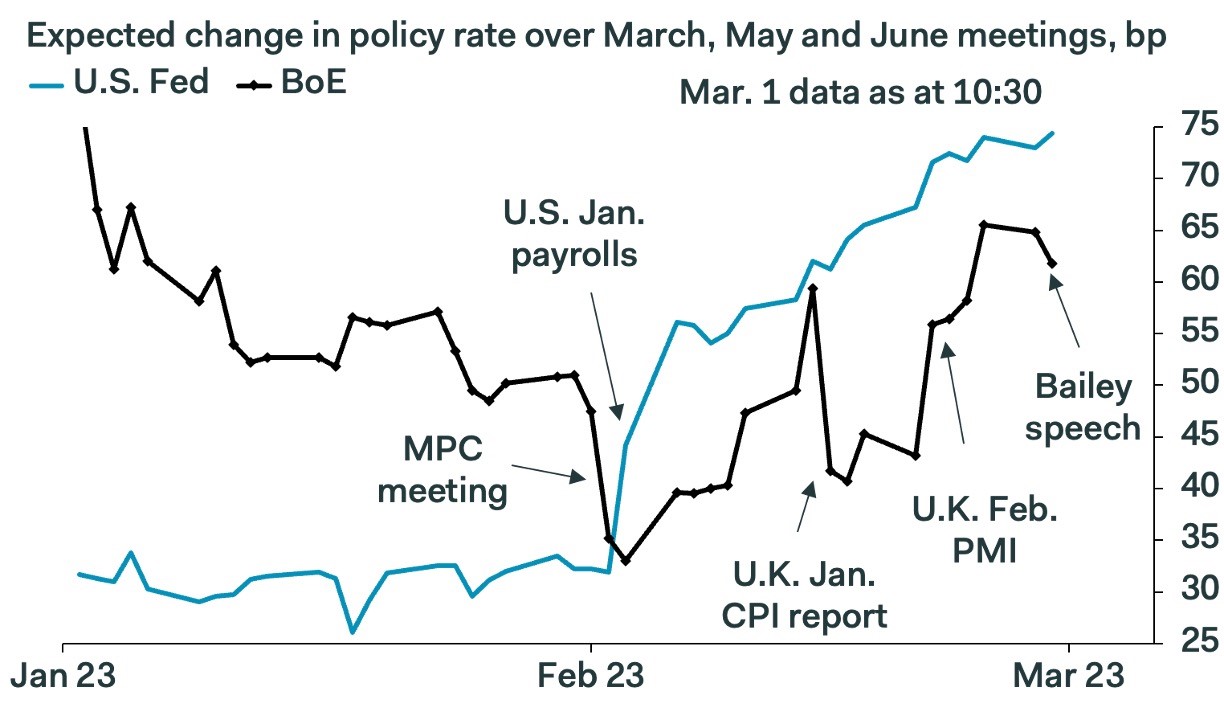
"Rightly" so said Sam Tombs at Pantheon Macro, putting forward his firm's view that the meeting on March 23 will see no hike, but with a 40% chance of a 25bp rate rise.
"Either way, it is clear from Mr. Baileyâs speech that [the MPC] is placing more emphasis on the substantial tightening already delivered and would like to call time on its hiking cycle as soon as it feasibly can."
The FTSE just hit 7938, nears its week's high but has backed off a couple of points.
"may turn out" - to me suggests the base case leans towards no further increase.
Subtly different to other options like "could" or even just "may". pic.twitter.com/wK4cndsTrO
â Andy Bruce (@BruceReuters) March 1, 2023
10.39am: Footsie back on the front foot
The FTSE 100 is heading higher again, after traders took some time to mull all the data and results out earlier. GBP/USD has also softened to provide some help.
It's up 54 points or 0.7% to 7930. The FTSE 250 is also showing more spirit, up 0.3% to 19,971.
Other data that emerged earlier from the Bank of England showed mortgage approvals fell less than expected.
Almost 39.7K house purchase mortgage approvals were recorded for January, down from an upwardly revised 40.54K the month before but not as low as the 38.5K that was forecast.
Consumer credit also rose more that estimated, to £1.597bn from £0.79bn, with the consensus pointing to £0.80bn. Households' total liquid assets increased by £3.5bn.
Martin Beck, chief economic advisor to the EY ITEM Club, noted that, apart from during the pandemic, this was the lowest level of mortgage approvals in 14 years.
"Though quoted mortgage interest rates fell in January, this offered scant support to mortgage approvals," he said.
"With house prices still high on most affordability measures, the EY ITEM Club thinks prices will fall further, and activity is likely to remain subdued in the near-term."
While data on unsecured lending and bank deposits was a little more favourable to consumer spending, gross unsecured lending is still 6% lower than last May when adjusted for inflation, and, Beck says, "itâs still debatable whether higher borrowing and lower saving will play a key role in the consumer recovery".
9.59am: Implications for inflation and the BoE
Reactions to the PMI data from Gabriella Dickens at Pantheon Macroeconomics, who said the survey "suggests that the downturn in manufacturing output is drawing to a close".
"While the headline index remained below 50, it rose for the third month in a row and reached its highest level since July 2022."
Backlogs of work index remained well below the 50 mark that separates expansion and contraction, implying that output still is above the level consistent with the flow of new orders.
"Nonetheless, demand is stabilising, both at home and abroad; the new orders balance jumped to a nine-month high of 49.6, from 44.4, while the new export orders index rose to 49.0, from 44.1."
The future activity index increased to 75.0, further above its 72.3 average since the question first featured in the survey in July 2012.
"Still, with householdsâ real disposable incomes unlikely to recover until the second half of this year, business investment likely to fall this year in response to higher interest rates, and the government set to reduce the generosity of its energy price support for businesses in April, any recovery in manufacturing output this year will be very gradual."
For how this will affect the Bank of England's thinking, Dickens said: "Meanwhile, the MPC will be happy to see a further decline in the prices balances."
With the price index at its lowest level since July 2020 and input prices back below the average since 1992 and shipping costs back at their pre-Covid levels and wholesale gas prices down sharply from their peaks last year, "we expect core goods CPI inflation to fall sharply to about zero by the end of this year".
9.38am: FTSE consolidates as PMI data comes in stronger
The latest UK purchasing managers index data for the manufacturing sector has come out stronger than expected, but the FTSE is little-moved by this news, up 30 points still at 7909.
Sterling is feeling slightly encouraged, up 0.4% against the US dollar at 1.2070.
The manufacturing PMI increased to 49.3 in February, from 47.0 in January, above the consensus and the flash estimate of 49.2.
This survey, which was collected between February 10 and 23, saw the headline index rise for the third month in a row to its highest level since July 2022.
The downturn in manufacturing output halted, as stabilising client demand and improved supply chains boosted production, said S&P Global.
Inflationary pressures also eased further, with costs rising to the least marked extent since July 2020.
Rob Dobson at S&P said: âUK manufacturing showed encouraging signs of resilience in February. Output rose for the first time in eight months, boosted by weaker cost inflation and reduced supply chain disruptions."
The slowing of input prices and im[proved supplier performance for the first time in three-and-a-half years "offset some of the ongoing negative impacts from strikes, the cost of living crisis and lower order intakes", he said.
9.22am: Aston Martin impresses
The FTSE 100 has not kept up all its initial oomph, retreating slightly to 7906, for a gain so far of 30 points or 0.4%.
Over in the mid-caps, the FTSE 250 had a less sure-footed start but is also up 30 points at 19,933.
Leading the way is Aston Martin, despite the results not really seeming to blow the doors off with its annual results, but the shares have leapt 18% higher in early trading.
Just basic competence during tough times for the auto industry was enough to impress investors after a string of disappointing years, with the shares having skidded below 90p last autumn, down over 93% since before the pandemic and around 98% over five years.
They have climbed back into at least first gear with these results.
Boosted by inflation, the company achieved a record average selling price of more than £200,000 per vehicle, while wholesale volumes increased just 4% year-on-year to 6,412, though this was lifted by a strong fourth quarter.
Revenue in the final three months of the year was higher than expected, with wholesale volumes increasing 22%.
Executive chairman Lawrence Stroll - well known to viewers of Netflix's F1 drama-documentary series Drive to Survive - said the company ended the year âwith significantly improved growth, margin enhancement and positive free cash flow in Q4, exiting 2022 with the strongest order book in many yearsâ.

For 2023 he expects to deliver âsignificant growth in profitabilityâ, primarily driven by an increase in volumes and higher gross margin, with positive free cash flow in the second half of the year.
Market analyst Joshua Warner at City Index tipped his hat at the company successfully navigating a very tough year, including component shortages and supply chain disruption.
"The outlook is improving. Aston Martin is aiming to deliver 7,000 vehicles in 2022, which was just short of the 7,350 forecast by analysts. However, investors should not be concerned with the miss considering Aston Martin said its sharpened focus on profitability will allow it to achieve its financial targets with significantly lower volumes than previously thought.
"That is a big deal considering Aston Martin has disappointed shareholders with numerous profit warnings since it went public back in 2018."
9.00am: Quick snapshot of FTSE
Here is a quick recap of some of the stories making headlines this morning.
The FTSE 100 began March in good spirits, opening higher despite data from lender Nationwide showing house prices dropped 1.1% year-on-year in February - the first annual contraction since lockdown-stricken June 2020.

Another housing market view was provided by builder Persimmon, which recorded a 24% fall in pre-tax profit for 2022 but warned that based on current sales its completions would be lower in 2023, denting margins.
Peers Barratt Developments PLC and Berkeley Group Holdings PLC are not too far behind on the fallers list.
But confidence was brewing at Reckitt Benckiser, as the hygiene and health consumer goods firm recorded a near 17% rise in operating profit to £3.44bn during 2022. It added margins should hold this coming year.
Grocer J Sainsbury PLC (LSE:SBRY) announced it would close two major Argos distribution sites in the coming years, threatening 1,400 jobs, as it looks to streamline and ramp up automation.
And with the small caps, entertainment firm Live Company rose 2% after dubbing its South African Formula E event last weekend a success, adding it took £200,000 in revenue.
There was also some retail sector data, with BRC shop price inflation flagging upside risks to underlying price pressures in the UK as retailers continued to pass on higher input costs to consumers.
According to the BRC, shop prices rose a further 0.4% month-over-month in February, taking the annual rate to 8.4%, the highest since the series began in 2005.
This reflected further acceleration in food price inflation, while non-food inflation rose too.
"While the BRC expect to see retail prices fall back through the second half of this year as cost burdens start to fade, the further erosion of households disposable income highlights the very weak outlook for consumer spending," said analysts at Daiwa.
8.34am: Oilers given China boost too
Helping the Footsie to its positive start are positive gains for oil majors Shell PLC (LSE:SHEL, NYSE:SHEL) and BP PLC (LSE:BP.), the largest and fifth-largest companies in the index both up more than 1%.
Oil prices have been lifted by the Chinese macro data out earlier, with Brent crude up 0.5% at US$83.88.
Market analyst Craig Erlam at OANDA says the latest Chinese PMIs have "provided some cause for more optimism".
"It was already believed that the transition from zero-Covid to living with it was going smoothly but this survey data suggests businesses are now extremely optimistic about the future.
"That bodes well not just for China but regionally as well, as strong demand boost trade and a resurgence in tourism restores the battered industry. There's still a long way to go and there could be setbacks along the way but investors will no doubt be encouraged by these early signs."
The likes of Burberry Group PLC (LSE:BRBY) are also on the FTSE leaderboard this morning, due to close links with China.
On oil's rally, he said: "While this was just one survey, the breakdown of the surveys was undoubtedly encouraging and that's lifting Brent and WTI in early trade.
"All we need to see now are signs of cooling price pressures and perhaps less heat in the labour market in order for crude to potentially break higher. Higher interest rates forcing a hard landing remains the main downside risk for crude prices which has driven the consolidation we've seen in recent months, and recent data has only fed those fears."
8.23am: FTSE starts on front foot, back above 7900
The FTSE 100 has started on the front foot, even more strongly than predicted, up 43 points or 0.55% to 7919.
Gains are being led by miners and retailers, with Anglo American PLC and Antofagasta PLC up 5.5% and 4% respectively.
BlackRock World Mining Trust PLC and Centamin PLC (LSE:CEY, TSX:CEE, OTC:CELTF) are also topping the mid-cap leaderboard.
An encouraging set of Chinese PMI surveys is lifting commodities stocks, with copper and iron ore prices jumping.
Among those with results out this morning, Reckitt Benckiser Group PLC (LSE:RKT, ETR:3RB) is up 0.5% after reporting double-digit growth in earnings and spouting confidently about 2023.
Persimmon is sliding the other way, down almost 8% after warning that a drop in expected completions in 2023 would hit margins as it reported a fall in annual pre-tax profits, against the backdrop of the housing price numbers earlier.
7.45am: London blue-chips heading higher despite further house price subsidence
The FTSE 100 is heading higher despite more gloomy stats from the housing market.
UK house prices dropped for the fifth month in a row in February, according to data from building society Nationwide, and shrank year-on-year for the first time since the start of the pandemic.
Higher mortgage rates and the inflation-linked consumer squeeze are putting off prospective buyers.
Property prices dropped 1.1% year-on-year, which was special for a number of reasons: it was the first annual contraction since the June 2020 lockdown, only the second fall since 2013, the largest decline in a decade and it more than the 0.9% fall economists had forecast.
House prices fell by 0.5% month-to-month and the average house price fell to £257,406 in February, down 3.7% from a peak of £273,751 last August.
Mortgage rates rose to a decade high in December following interest rate hiked by the Bank of England and a big wobble in the markets following the 'mini Budget' of Liz Truss and Kwasi Kwarteng.
The monthly drop was the sixth in a row and marked the longest period of consecutive falls since February 2009.
Meanwhile, spread betters are seeing the Footsie rising 32 points at the imminent open.
7.35am: FTSE 100 heading for bright start
The FTSE 100 is expected to open the new month higher, recouping some of yesterdayâs falls.
Spread betting companies are calling the lead index up by around 24 points.
The early focus in London will be on results from Aston Martin Lagonda Global Holdings PLC (LSE:AML), Just Eat, Persimmon PLC (LSE:PSN) and Reckitt Benckiser Group PLC (LSE:RKT, ETR:3RB) and Weir Group PLC (LSE:WEIR).
In the US, all three major US indices were in the red to close out a volatile trading month. The Dow closed at 32,657 points for a loss of 0.7% on the day, the S&P 500 was down 0.3% at 3,970 and the Nasdaq slipped into the red to finish at 11,456 for a loss of 0.1%.