
Another major nuclear fusion breakthrough has been reported, with the first successful hydrogen-boron fusion experiments in a magnetically confined fusion plasma.
The experiment was a collaboration between US-based TAE Technologies and Japan’s National Institute for Fusion Science (NIFT) and has been published in a peer-reviewed paper.
After the first net energy output breakthrough was achieved using a different fusion technology at the Lawrence Livermore National Ignition Facility (NIT) in California at the end of last year, TAE said it is "on track" for a mid-2020s demonstration by its new Copernicus reactor of net energy out – in other words, getting more energy out from nuclear fusion than is put in.
TAE said the NIFS experiment advances the development of hydrogen-boron (known as p-B11) as "a viable fuel for fusion energy" and "the cleanest, most cost-competitive, and most sustainable fuel cycle for fusion".
NIFS said: "This achievement is a big first step towards the realization of a fusion reactor using advanced fusion fuel."
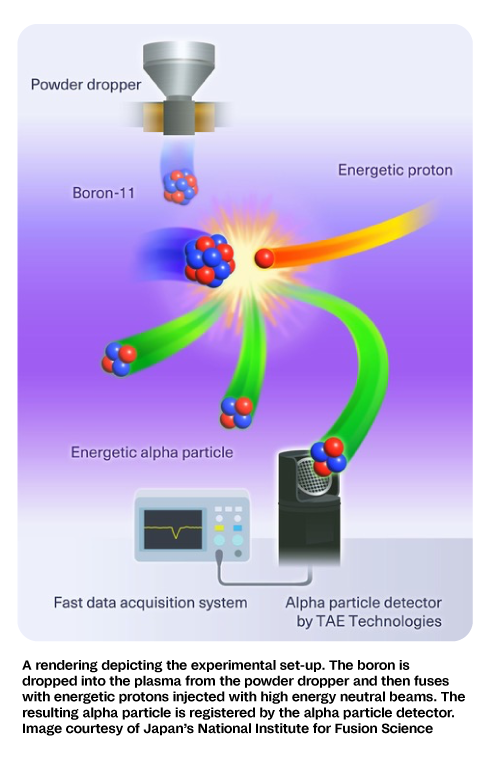
(Graphic via Nature Journal)
Backed by investors including Chevron, Google and Sumitomo Corporation, TAE collaborated with NIFS to conduct the experiments using the Japanese institute's large helical device, also known as a stellarator.
TAE says its linear configured field-reversed configuration (FRC) reactor, as will be employed in Copernicus, offers benefits over stellarators and tokamak reactors, such as are used in the UK's fusion hotbed around Oxfordshire, including ease of maintenance and more efficient magnetic confinement that it says will yield up to a hundredfold more power out.
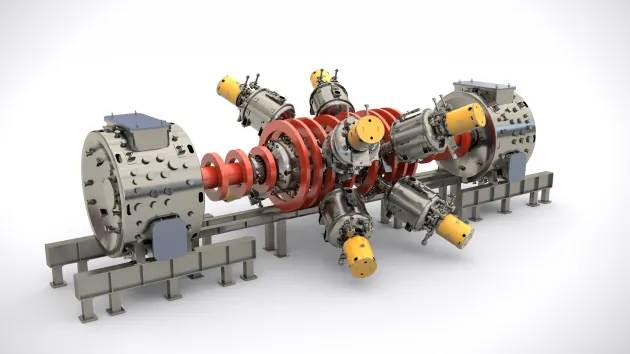
How Copernicus will look (image from TAE Technogies)
Although TAE only plans to pursue hydrogen-boron, its FRC reactors are designed to work with all fusion fuel cycles and the company has invited other companies interested in FRC for deuterium-tritium (DT) or deuterium-helium-3 fusion to license its reactor designs.
Hydrogen-boron fusion offers advantages over the more commonly researched DT fusion, TAE says, as it neither uses nor creates any radioactive materials, with its only emissions being helium, while boron is low-cost and naturally abundant, offering potentially enough to power the energy needs of the planet for more than 100,000 years. UK-based Tokamak Energy also is working on fusion using hydrogen.
TAE Technologies aims to connect the first hydrogen-boron fusion power plant to the grid "by the early 2030s".