
Most UK banks’ net interest margins (NIM) are close to peaking due to the approaching end of policy rate rises, higher pass-through rates to depositors, and lower yields and volumes in key lending segments, Fitch Ratings said Friday.
In a report, the ratings agency stated it thinks most of the banks’ NIMs will peak in 2023 as depositors become more selective in search of higher yields, mortgage margins fall, the slowing economy weighs on credit demand, and the policy rate peaks by mid-year.
Fitch expects mortgage spreads to narrow due to higher swap rates and continued competitive pressures.
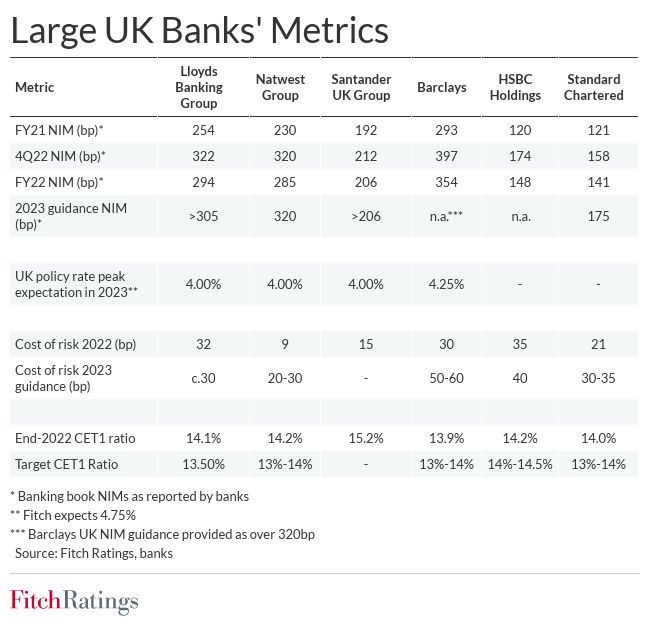
Barclays has a higher rate peak expectation than its competitors -- Source: Fitch
Funding costs are likely to increase as the recent policy rate rises gradually feed into higher deposit costs, with customers seeking the best rates available, and as wholesale funding is refinanced at higher cost.
Meanwhile, loan growth is likely to slow due to the tougher operating environment, and we expect banks to be cautious in their lending decisions, particularly in the sectors that are most exposed to an economic downturn.
These factors will be partly offset by income from structural hedges that were largely put in place in 2022, which should help to prevent a rapid significant decline in NIMs after they peak.
NIMs could be further supported if the policy rate increases beyond banks’ expectations, which it might if inflation remains high, although the impact would depend on banks' ability to pass higher rates on to borrowers, and how much this would be offset by pass-through to depositors.
Fitch forecasts the Bank of England to raise rates to 4.75% this year, before reducing them to 4.0% in 2024.
Among the major UK banks, HSBC, Standard Chartered and, to a lesser extent, Barclays are also sensitive to US dollar interest rates given their geographical profiles, the ratings agency explained.
Fitch noted the large UK banks’ asset quality held up well in 2022, with impaired loan ratios remaining near historical lows but it expects a moderately higher cost of risk in 2023, although still within their target normalised ranges.