
- FTSE 100 in negative territory, down 29 points
- IAG tumbles despite return to profit and Air Europa deal
- Consumer confidence improves in February - GfK
4:40pm: FTSE 100 closes Friday in the red
The FTSE 100 failed to change its fortunes into the weekend closing Friday slightly lower.
Finishing at 7,878, the London benchmarked was down 29 points or 0.37%.
3.56pm: FTSE 100 set to close in the red
"It's been a strange week in financial markets, one in which we've learned relatively little but reality appears to be slowly catching up on some," said Craig Erlam, senior market analyst at Oanda
"I say that as someone that doesn't think things will be as bad as they currently seem on interest rates and the economy but equally is of the belief that markets should at least reflect the risk of it being so."
"We are seeing that in some corners of the market but equity markets - and cryptos for that matter - have been reluctant to be discouraged."
2.56pm: US stocks lower
US stocks opened in the red as hotter-than-expected economic data exacerbated worries that the FED may hike interest rates faster and further than previously expected.
Mike Owens, senior sales trader at Saxo UK, said: “A tough US Core PCE inflation release for January, which printed a 0.6% increase month-on-month vs. an expected 0.4% increase, while the year-on-year accelerated to 4.7% vs. 4.3% expected and December revised higher to 4.6% (from 4.4%)."
"The two-year US treasury yield hits 4.78%, close to the high reached in November last year. Fed swaps are now fully pricing in US rate increases in March, May and June."
The Dow Jones lost 1.33% to 32,713 points, while the S&P 500 shed 1.5% to 3,951.
The tech-laden Nasdaq saw the deepest losses at the open, down 1.82% to 11,378 points.
The FTSE 100, in comparison, was down 0.29% to 7,886.
2.35pm: Goldman expects legal costs to soar
Goldman Sachs (NYSE:GS) is expecting to incur US$2.3bn more in losses from legal proceedings than it had initially set out.
The Wall Street bank has been a target of lawsuits ranging from its role in Malaysia’s 1MDB sovereign wealth fund scandal to the collapse of Archegos Capital Management in 2021.
In a regulatory filing made on Friday, the money it expects to lose was in line with estimates made at the end of September but was higher than the loss it projected in 2021.
The filing also said that Goldman has approved a US$30mln buyback program, according to Reuters.
Last month, Goldman said it was cutting around 3,200 jobs, which made up roughly 6% of its workforce.
The investment bank will be hoping for a rebound in dealmaking following a tough year for the equity markets as new listings, mergers, and acquisitions dried up.
In the UK alone, there were only 45 new listings in 2022, down from the record of 119 in 2021.
FTSE 100 is down 12 points to 7,895.
2.04pm: EFL TV rights
English Football League (EFL) television rights are set to double in value as a host of broadcasters get ready to challenge Sky Sports.
The cost to secure the TV rights for the Championship, League One and League Two, is expected to double to over £200mln a year, sources have told the Daily Mail.
The EFL has reportedly been inundated with expressions of interest since the sale process began in October ahead of the invitation to tender next week.
Sky Sports have held the rights since 2002 but will have to almost double their current £119mln-a-year deal to maintain exclusive coverage as the EFL considers a hybrid model involving several broadcasters.
Dazn, which was founded in London and gives its international users access to the Premier League, and Swedish broadcaster Viaplay are rumoured to be interested in the rights.
Next week’s tender will make every EFL game available for purchase, which could lead to the end of the 3pm Saturday blackout.
FTSE 100 is down 6 points to 7,901.
1.30pm: London's movers
A quick look at today’s fallers and risers in London.
Fallers
IAG- down 6% to 155p
British Airways owner, International Consolidated Airlines, returned to profit in 2022 and sealed a deal for the remaining shares in Air Europa it doesn’t own but the news failed to impress the market.
For the year to December 31, 2022, pre-tax profits were €431mln compared to a loss of €2.93bn in 2021 as revenue jumped to €23.07bn from €8.46bn.
Kin and Carta- down 30% to 129p
Kin + Carta PLC, the digital transformation consultancy, nosedived after issuing a profit warning due to macro headwinds experienced at the end of the first half.
“The company is reducing expectations for the year to reflect more cautionary client spending and elongated sales cycles seen across the industry,” it said.
Webis- down 6% to 2p
Shares fell after revealing its main WatchandWager arm had a difficult time during the months of September, October and November.
The gaming group’s chairman Denham Eke called it a “mixed start” to the financial year for the group’s principal subsidiary, with trading having been “strong” during the summer months, with “excellent” commission levels from Saratoga in New York and Del Mar in California.
Risers
Jupiter Fund Management- up 10% to 147p
Shares orbited higher after the group announced a better-than-expected set of results for the latter half of the year.
The FTSE 250-listed fund manager saw its share price rise on the back despite reporting a 64% decline in underlying profit to £77.6mln for the past calendar year.
However, this was much higher than the £63mln analysts had forecast, with investors also likely to have been impressed by the positive fund inflows of £0.7bn in the fourth quarter, turning positive in the second half for the first time since 2017.
1.00pm: US stocks seen lower
Wall Street is expected to open lower as the week draws to a close, with attention shifting to the release of January's Personal Consumption Expenditures (PCE) price index, the Federal Reserve’s preferred inflation measure, for further proof of slowing inflation in the US economy.
Futures for the Dow Jones Industrial Average fell 0.4% in Friday pre-market trading, while those for the broader S&P 500 index declined 0.6% and contracts for the Nasdaq-100 shed 0.9%.
Following a volatile session, the Dow ended Thursday 0.3% higher at 33,154 and the Nasdaq Composite added 0.7% to 11,590. While the S&P 500 improved by 0.5% to 4,012, it is still on track for its worst weekly performance since December.
One year on from Russia’s invasion of Ukraine and three years to the day of the first big COVID-related sell-off of risk assets, the aftershocks are still being felt every day in markets, commented Deutsche Bank strategist Jim Reid,
“This has continued this week, with intraday volatility remaining high. Risk assets whipsawed yesterday, with the S&P 500 up nearly +1% in early trading before selling off -1.5% in the late US morning following further upward revisions to inflation data in the US and Europe,” Reid said. “However that marked the high in yields for the day and a fixed income rally back lifted tech stocks, and in the end, the S&P broke a four-day losing streak to close up +0.53% with the NASDAQ at +0.72% ahead of today’s important PCE print.”
The headline PCE price index is expected to show an annualized increase of 4.9% for January, a touch lower than the 5% registered in December.
The core PCE index, which excludes food and energy, is likely to register an annualized rise of 4.3%, from 4.4% in December, according to consensus expectations.
With little corporate news out today, investors will be focusing on next week, Russ Mould, investment director at AJ Bell, said. “On the US markets, we will get a good insight into consumer spending when retailer Target and drinks group Monster Beverage report on Tuesday,” Mould said. “Home improvement group Lowe’s reports on Wednesday; so does discount retailer Dollar Tree.”
12.31pm: Leeks become latest veg off the menu
Leeks could become the latest vegetables to be rationed after a poor growing season, growers have warned.
Leek growers have suffered amid high temperatures and low rainfall - meaning supplies could run out by April.
Tim Casey, chairman of the Leek Growers Association, said customers might have to rely on imported crops through May and June.
He told the Telegraph: "The drought and the high temperatures in the summer stunted growth. Although we were irrigating the leeks like mad, all we were really doing was keeping them on life support and stopping them from dying."
"We had a relatively kind autumn and a lot of growth but it wasn't able to make up time for the crops before the winter came with cold weather and everything stopped."
The FTSE shrugged aside the latest dietary concerns, holding firm at 7,926.65, up 18.93 points, or 0.2%.
12.02pm: Fitch expects UK banks net interest margins to peak in 2023
Most UK banks’ net interest margins are close to peaking due to the approaching end of policy rate rises, higher pass-through rates to depositors, and lower yields and volumes in key lending segments, Fitch Ratings said Friday.
In a report the ratings agency stated it thinks most of the banks’ NIMs will peak in 2023 as depositors become more selective in search of higher yields, mortgage margins fall, the slowing economy weighs on credit demand, and the policy rate peaks by mid-year.
Fitch expects mortgage spreads to narrow due to higher swap rates and continued competitive pressures.
Funding costs are likely to increase as the recent policy rate rises gradually feed into higher deposit costs, with customers seeking the best rates available, and as wholesale funding is refinanced at higher cost.
Meanwhile, loan growth is likely to slow due to the tougher operating environment, and we expect banks to be cautious in their lending decisions, particularly in the sectors that are most exposed to an economic downturn.
These factors will be partly offset by income from structural hedges that were largely put in place in 2022, which should help to prevent a rapid significant decline in NIMs after they peak.
NIMs could be further supported if the policy rate increases beyond banks’ expectations, which it might if inflation remains high, although the impact would depend on banks' ability to pass higher rates on to borrowers, and how much this would be offset by pass-through to depositors.
Fitch forecasts the Bank of England to raise rates to 4.75% this year, before reducing them to 4.0% in 2024. Among the major UK banks, HSBC, Standard Chartered and, to a lesser extent, Barclays are also sensitive to US dollar interest rates given their geographical profiles, the ratings agency explained.
Fitch noted the large UK banks’ asset quality held up well in 2022, with impaired loans ratios remaining near historical lows but it expects a moderately higher cost of risk in 2023, although still within their target normalised ranges.

11.34am: ONS data confirms food shortages
The shortage of food in the shops is reflected in new data from the Office for National Statistics.
An ONS report showed a quarter of adults reported that they could not find a replacement when the items they needed were not available when food shopping in the past two weeks.
.png)
This proportion has increased from 15% in a similar period a year ago, indicating that Britain’s fruit and vegetable shortages are not just down to seasonal factors.
Nearly 2 in 10 adults experienced shortages of essential food items that were needed on a regular basis in the past two weeks, up from 13% a year ago.
Around 22% adults experienced shortages of non-essential food items in the past two weeks. Since March 2022, the proportion has seen a general increase to its current level, the ONS says.
10.59am: Turning Japanese - incoming governor lifts markets
Equities in London look set the end the week on a positive note but globally shares are heading toward their biggest weekly fall of the year.
Providing support on Friday was news from Japan where Kazuo Ueda, incoming governor of the Bank of Japan, indicated he would maintain a loose monetary policy.
During a lower house confirmation hearing, Kazuo Ueda, who will take over as governor of the Bank of Japan (BOJ) in April, said ultra-low interest rates were still needed to support Japan's fragile economy, warning of the dangers of responding to cost-driven inflation with monetary tightening
Russ Mould at AJ Bell said, “markets breathed a sigh of relief that there would not be a radical shift in strategy.”
The Nikkei 225 jumped 1.3% to 27,453.48. Back in London and the FTSE 100 is close to best levels for the day, up 0.4% at 7,935.17.
10.35am: Final screening for Cineworld?
“Is the end in sight for Cineworld as a listed business?” That was the question posed by AJ Bell’s Russ Mould after the cinema operator said it had received various expressions of interest for parts of its estate, suggesting a break-up of the group could be on the cards.
Shares in the firm crashed a further 21% on the news.
Mould said, “From where we stand today, two things look almost certain – one, that we won’t see a bidder for the whole business; and two, that shareholders will be left with nothing.”
“Even if the company does sell some of its subsidiaries, the end game still appears to be a debt-for-equity swap whereby creditors take control of the business.”
He felt, “Cineworld has paid the price for being too aggressive with its growth ambitions, weighed down by significant debt when the pandemic struck and the subsequent reopening of the cinema industry being too weak to repair its finances.”
“Selling subsidiaries doesn’t mean it will be suddenly swimming in cash. Any interested party in Cineworld’s assets knows that the cinema group is desperate and so they are likely to pitch any offers at a low level.”
But no signs of a slowdown in the FTSE 100 which is close to session highs at 7,933.38, 25.66 points, or 0.32%.
10.03am: Car production stable in January
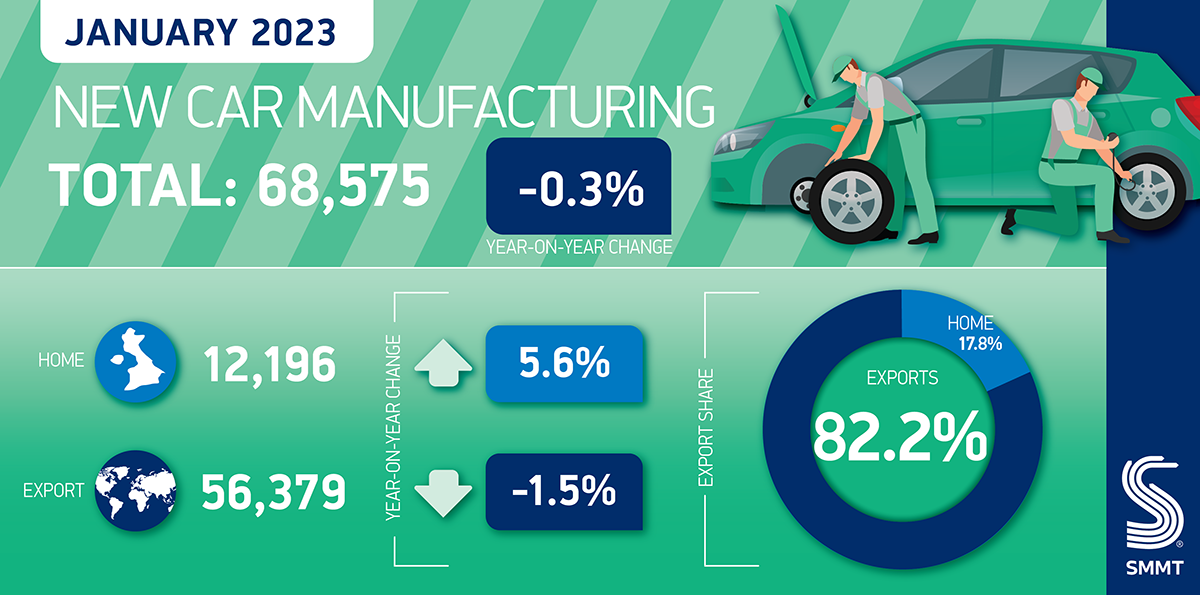
British car production was stable in January, down -0.3% with just 215 fewer units made, according to figures from industry body Society of Motor Manufacturers and Traders.
The decline was driven chiefly by structural changes, reflecting a move from car to van making at one major plant, but with supply chain shortages still afflicting some manufacturers.
The ongoing shift to electrified car production continued, with combined battery electric, plug-in hybrid and hybrid electric vehicle volumes up 49.9% to 28,329 units.
They represented more than four in every 10 (41.3%) cars made in January, a near record monthly share, and further evidence of the UK’s capability in making these important models, most of which (77.0%) are exported to meet global demand.
Production for the UK rose 5.6% to 12,196 units, while exports declined by -1.5%, largely due to the suspension of shipments to Russia, which accounted for 83.6% of the loss.

In total, some 56,379 cars – more than eight in 10 of all those produced – were destined for overseas markets, with over half of these (56.6%) for the EU, with next most important global destinations the US (9.3%), China (8.8%), Japan (4.4%) and Australia (3.3%).
Mike Hawes, SMMT chief executive, said, "Automotive manufacturing can drive long-term growth for the low carbon economy but the sector needs competitive conditions to attract investment."
“We now look to the forthcoming Budget for the necessary measures that will enable the automotive sector to deliver its undoubted potential.”
9.26am: Germany on brink of recession as Q4 GDP falls
Not good news from Germany where fourth quarter GDP in Europe’s largest economy fell 0.4% compared to the third quarter.
The figure released by Destatis was worse than expected and below a previous estimate of negative 0.2%.
Economists said it left Germany on the brink of recession.
Good Morning from Germany where economy fared worse than exp. GDP shrank 0.4% in Q422 vs prev reading of -0.2%. Private consumption plunges 1% QoQ, cap investment crashed 2.5% QoQ. Public spending rose 0.6% QoQ. Economists predict another neg quarter, would tip GER into recession pic.twitter.com/HJDeVhF9zS
— Holger Zschaepitz (@Schuldensuehner) February 24, 2023
ING Economics said, “today’s numbers mark the first part of what could become a technical recession in Germany.”
“We think that the risk of yet another contraction in the first quarter and, thus, a technical recession is high and that the German economy is still miles away from staging a strong rebound.”
Pantheon Macroeconomics agreed. “Looking ahead, the recent upturn in the surveys is positive, but we doubt that the economy has enough momentum to avoid another fall in GDP in Q1, and as a result, a technical recession.”
The news failed to stop the Dax opening higher but a gain of 0.1% meant it underperformed London and Paris where the FTSE 100 and CAC 40 are both up 0.3%.
9.00am: Footsie kicks ahead
The FTSE 100 remained in fine fettle on Friday after the GfK figures showing an improvement in consumer confidence.
At 9.00am the lead index stood at 7,930.08, up 22.36 points, or 0.28%.
Victoria Scholar, at interactive investor accepted, “consumer confidence has a long way to go to restore more normal levels, but the latest reading points to an encouraging trajectory with sentiment starting to shift away from near all-time lows.”
“With the UK narrowly staving off a recession, financial markets picking up, inflation starting to ease and interest rates approaching their peak, there are incipient signs of hope for the UK consumer,” she felt.
But the economic news was not all good with worse than expected GDP numbers in Germany and a jump in inflation In Japan. While in the US, futures are lower ahead of PCE figures, the Fed’s preferred inflation measure which could mean a volatile end to the trading week.
Rolls-Royce PLC sat top of the FTSE 100 risers, extending yesterday’s gains, when the engineer soared over 20%. Better-than-expected results and new CEO Tufan Erginbilgic’s seven-pronged transformation plan continues to attract investors.
JP Morgan raised its price target to 90p from 70p but still remains ‘underweight’ on the stock. They felt Erginbilgic’s “aims to de-lever RR’s balance sheet organically,” was “a risky strategy and leaves RR highly vulnerable to any unexpected shocks in the next few years.”
But Deutsche Bank remained a fan reiterating a ‘buy’ rating.
IAG, the owner of British Airways, remained top of the blue-chip fallers, down 1.8% despite better than expected results and the Air Europa deal.
Shares are up 25% year to date and could be susceptible to some profit-taking.
Richard Hunter, at interactive investor, commented, “a pre-tax profit for the year of €415mln compares with a loss of €3.5bn the year previous, and exceeds expectations for a number of €398mln.”
But he added, “the journey ahead is one which will need careful and constant monitoring as the airline attempts to regain its financial footing.”
He also pointed out, “IAG has a major task in repairing its balance sheet after the pandemic tore through revenues and forced the group into substantial borrowings.”
8.15am: Footsie higher as consumer confidence improves
FTSE 100 opened Friday in upbeat fashion as a closely watched survey pointed to an improved mood amongst UK consumers.
At 8.15am London's blue-chip index was at 7,934.51, up 26.79, or 0.34% while the FTSE 250 was slightly more sedate, at 19,829.95, up 39.46 points, or 0.20%.
GfK’s long-running consumer confidence Index increased seven points in February to -38. All five measures were up in comparison to the January 20th announcement.
Joe Staton, client strategy director, GfK said, “despite widely reported headwinds of inflation continuing to outstrip wage rises, and the ongoing household challenge from the cost-of-living crisis, consumers have suddenly shown more optimism about the state of their personal finances and the general economic situation, especially for the coming year.”
“While it's too early to talk about ‘green shoots of recovery’, the uptick across all measures should be welcomed. “
Gabriella Dickens senior UK economist at Pantheon Macroeconomics said the improvement made “sense, given that motor fuel prices and mortgage rates have fallen, equity prices have risen, and firms have not moved decisively to reduce employment yet, as many households feared.”
But she cautioned, “the rise in February does not necessarily suggest consumers are willing to spend; confidence remains weak.”
The economic news wasn’t so good in Europe though where GDP in Germany fell 0.4% quarter-on-quarter, below consensus and initial estimates.
ING Economics said, “today’s numbers mark the first part of what could become a technical recession in Germany.”
“We think that the risk of yet another contraction in the first quarter and, thus, a technical recession is high and that the German economy is still miles away from staging a strong rebound.”
International Consolidated Airlines Group SA (LSE:IAG), the owner of British Airways, failed to impress the market despite an improved financial showing in 2022. The airline swung back into profit on much improved revenue as the bounce back in international travel continued to gather pace post-pandemic.
IAG also announced a EUR400mln deal for the remaining shares in Air Europa that it doesn’t already own.
Sophie Lund-Yates, at Hargreaves Lansdown said the return to profit was an “impressive regaining of altitude comes as a direct result of Covid restrictions easing and a return to more normal travel.”
She felt debt “at 3.1 times cash profits the debt pile is too heavy following efforts to keep liquidity in check during the pandemic.”
But she added, “should enough passengers continue to be funnelled on to planes, that should start to come down relatively quickly.”
Shares fell 1.6% to 162.82p.
A rise in oil prices pushed index heavyweights, BP PLC (LSE:BP.) and Shell PLC (LSE:SHEL, NYSE:SHEL), higher, up 1.2% and 0.7% respectively.
But the woes of Cineworld Group PLC (LSE:CINE) continue. Shares tumbled 33% as the cinema operator said it is looking at “a number” of proposals to buy some or all of the group, but that it does not expect shareholders to see any recovery.
It stressed that none of these proposals involves an all-cash bid for the entire business, and that any sale of the whole group “would not include the sale of the equity interests in Cineworld itself” and so would not be subject to the rules of the London takeover code.
7.50am: Consumer confidence improves - GfK
GfK’s long-running consumer confidence Index increased seven points in February to -38. All five measures were up in comparison to the January 20th announcement.
Joe Staton, client strategy director, GfK said, “despite widely reported headwinds of inflation continuing to outstrip wage rises, and the ongoing household challenge from the cost-of-living crisis, consumers have suddenly shown more optimism about the state of their personal finances and the general economic situation, especially for the coming year.”

“While it's too early to talk about ‘green shoots of recovery’, the uptick across all measures should be welcomed. “
But he cautioned, “the headline consumer confidence score is still severely depressed and the mood as well as the economy remain a long way off pre-lockdown levels, but a little consumer resilience might be what we need to soften any downturn in 2023.”
Confidence in the general economic situation over the next 12 months is up by 11 points but remains at negative 43 while confidence in personal finances looking ahead to the next 12 months increased by nine points to negative 18, which is four points lower than this time last year.
The major purchase index, an indicator of confidence in buying big ticket items, is up three points to negative 37 – 22 points lower than a year ago.
7.44am: CVS reports solid growth in profits and revenue, sees full-year in line
CVS Group (AIM:CVSG) PLC reported on Friday solid growth in half-year revenue and profit and remained confident the outcome for the full-year would be in line with market expectations.
The providers of integrated veterinary services said revenue in the six months to December 31 rose 8.2% to £296.3mln from £273.7mln a year ago while pre-tax profit totalled £28.0mln compared to £22.9mln in the same period in 2021. Earnings per share were 29.6p against 24.7p.
Organic growth has continued with 7.5% like-for-like sales1 growth, within the organic revenue growth ambition of between 4% and 8%, the company said in a statement.
Adjusted EBITDA margin improved to 19.5%, a like-for-like improvement of 0.5 percentage points, while membership of its preventative healthcare scheme, Healthy Pet Club increased to 481,000, up 4.3%.
CVS said demand for our high-quality veterinary services remains robust and the positive performance of the first half has continued into the first month of the second half.
“The board remains confident that full year results will be in line with market expectations,” the statement said.
Chief Executive Richard Fairman said, “The robust performance in H1 2023 has continued into the second half of the year and we look forward to reporting further growth in the future."
7.38am: BA owner swings back into profit, buys rest of Air Europa
British Airways owner, IAG, has reported a healthy improvement in profits and revenue and a much anticipated deal to kick Friday off. For the year to December 31 pre-tax profits were €431mln compared to a loss of €2.93bn in 2021 as revenue jumped to €23.07bn from €8.46bn.
The results came as the FTSE 100 listed airline agreed to pay EUR400mln to Spain's Globalia for the remaining 80% of airline Air Europa it does not already own.
“The board of IAG believes that the acquisition remains strategically important for the group and positions it to benefit from growth opportunities in the Latin America and Caribbean market, as well as to increase connectivity to Asia,” the company said.
IAG also gave guidance for 2023. The airline forecast full year 2023 capacity of around 98% of the 2019 level, with the first quarter seen at about 96% of the quarter one level in 2019.
Full year 2023 operating profit before exceptional items is seen in the range of €1.8bn to €2.3 billion, with most of the improvement over 2022 in the first half of the year.
In quarter one, 2023 an operating loss of around €200mln is expected assuming no further setbacks related to COVID-19 or material impacts from geopolitical developments.
“We are transforming our businesses, with the intention of returning IAG to pre-COVID levels of profit within the next few years, through major initiatives to improve customer experience and operational performance,” said Luis Gallego, IAG Chief Executive Officer.
7.00am: Bright start in London
FTSE 100 is expected to make a bright start to the final day of the trading week ahead of a key inflation reading in the US.
Spread betting companies are calling London’s lead index up by around 26 points.
The early focus will be results from British Airways owner, International Consolidated Airlines Group SA (LSE:IAG), and encouraging figures from GfK which showed a rebound in consumer confidence in February.
The mood should also be lifted by gains in the US which ended the day in the green. The Dow closed Thursday up 109 points, 0.3%, at 33,154, the Nasdaq Composite added 83 points, 0.7%, to 11,590 and the S&P 500 improved 21 points, 0.5%, to 4,012.
Attention will then shift to US later today with January core PCE deflator numbers, which is the Fed’s preferred inflation measure, and which has fallen back sharply in the last few months from 5.2% in September, falling to its lowest level since October 2021 in December at 4.4%.
Michael Hewson at CMC suggested given “the strength of recent economic data, today’s January numbers may call time on the trend of lower prices, with expectations that the PCE core deflator could fall only modestly from 4.4% to 4.3%.”
In Asia on Friday, the Nikkei 225 index closed up 1.3%. Japan's consumer prices rose 4.2% in January from a year earlier, a level not seen since September 1981, fuelled in part by higher energy bills. In China, the Shanghai Composite was down 0.5%, while the Hang Seng index in Hong Kong was down 1.2%.