
Cyprium Metals Ltd (ASX:CYM, OTC:CYPMF) isn’t messing around. The team knows exactly what their purpose is – producing copper metal plate – and they know exactly how to achieve it – with honesty, ingenuity, and good old-fashioned hard work.
In this article:
- Not your average copper company
- Keep it simple; get it done
- The world runs on copper
Not your average copper company
Cyprium Metals isn’t your typical ASX-listed copper mining company.
It wasn’t founded by a single executive, or a group of shareholders, but rather by a team of geologists, metallurgists, engineers, corporate accountants, and executives with a common interest: copper processing.
“As a group, a few of us had worked together before, with the last job we did together being Finders Resources,” Cyprium Metals managing director Barry Cahill recalled, speaking on behalf of the Cyprium team.
“We’d built a sulphide heap leach SXEW (solvent extraction-electrowinning) project on a remote island in Indonesia, which was very successful but very difficult – everything had to go in by sea.
“We came out of that and thought that we really liked the sulphide leach heap technology – it allowed us to produce copper plate on-site. We wanted to come back and do it in Australia.
“There were four of us at that point. Eventually we had Gary Combs as chair, Peter van Luyt as geologist, our CFO Wayne Apted, myself as managing director, and then in the background, our metallurgist Michael Efthymiou, and Nick Rowley, a founding board director.”
Together, the team assessed some 250 copper projects in 2018, narrowing them down to a shortlist of 15 before they entered into an earn-in agreement for the Hollandaire Project, and a little further down the track, purchased the Nifty Copper Project.
“After making a few offers over the years we took over the Nifty project early in 2021. A couple of the team members from Finders joined us then, as well as a number of people who had worked on Nifty historically.”
The small, tight-knit team formed the core of Cyprium Metals, making for a company culture open to innovation, strategising and problem solving as a collaborative group exercise.
“When we sit in a room to discuss these things, everyone has a say, even when it’s a specialist subject,” Cahill explained.
“Quite frankly, a lot of solutions to problems are created by people who aren’t specialists.
“Generally, specialists can be quite blinkered and constrained, while your average person can say ‘Hang on a minute, can’t we just do this?’
“That’s happened a few times. We’re pretty free and easy like that, we have robust discussions, get the whiteboard out and problem solve.
“I think that’s what we all enjoy, inventing solutions for problems. We just get on with it.”
Keep it simple; get it done
Humanity has been mining copper for over 5,000 years, so it’s not exactly new, but it’s in no way a straightforward or easy undertaking either.
“Mining is about all these factors that are, really, outside of your control. Whether it be the weather, the rock, the location… It’s about overcoming those obstacles and those speed bumps,” Cahill emphasised.
“I think that’s what our team is really good at. Nothing ever goes to plan, but when you’re confronted with a speed bump you just need to climb over it.”
The difficulty of introducing innovations to copper processing was an unexpected obstacle, but not a barrier that gave the Cyprium team reason to pause for long.
“I can tell you, nobody finances innovation,” Cahill laughed.
“If they tell you they do, they’re lying. As soon as you put some innovation, something a bit magical in there, people get fixated on that and won’t give you any money.
“So, we just went back to plain vanilla. The site itself has produced 200,000 tonnes of copper metal plate, 500,000 tonnes of copper concentrate, it’s all been done before. We made it simple.
“In phase two, once we’ve paid off all our debts, then we can pursue innovation because we’ll have the cash flow to do it.
“We’ll just go and do it. That’s probably a major philosophy of ours, ‘Just do it.’”
Cyprium’s proprietary sulphide leach heap extraction method boasts several advantages over typical smelting and extraction methods.
Unlike typical copper processing, which involves floatation tanks and complex chemical reagents, the heap leach process offers a simplified, self-contained solution that significantly reduces operating costs and environmental impact.
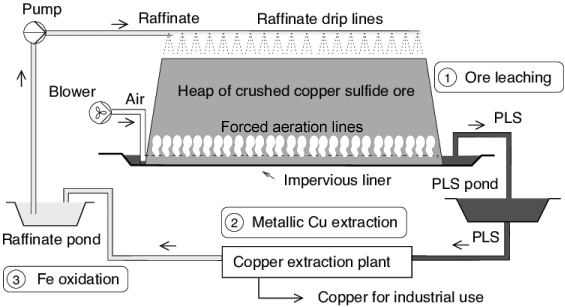
A diagram of Cyprium’s proprietary leach heap process.
“It’s a closed circuit, so deleterious elements stay on site. You can extract the copper, the waste stays on-site to be managed in a rehabilitation process, rather than put into concentrates and spread all over the world,” Cahill outlined.
“It lowers energy costs and carbon emissions, which everyone is raving about at the moment.
“Commercially, you also get a lot more revenue. If you go concentrate, you have to transport it, you have smelter charges, smelter recovery, refinery charges, penalty elements, it all adds up.”
The world runs on copper
Lithium, cobalt, nickel, and manganese.
Battery or critical metals have been getting a lot of attention in recent years, labelled as the mineral gateways to a decarbonised future.
Copper, however, hasn’t received the same attention, despite the vital role it plays in crucial infrastructure and public services.
“Copper is necessary, but I don’t think the market recognises that,” Cahill said. “Worldwide, if you want to increase standard of living, you’ve got to energise, you’ve got to create infrastructure.
“Things like copper tubes for water pipes and electricity cables, rod and bar, components in electronics…
“Batteries in particular require a lot of copper even outside the chemistries themselves, copper connectors, copper cables to transport renewable power in remote places. It’s all copper and aluminium in high quality infrastructure.
“And there’s not enough of it, which is an opportunity in itself.”
The global economy consumed 24.4 million tonnes of copper last year but produced only 21.2 million tonnes.
Looking forward, BMO Capital Markets (NYSE:BMO) has forecast a 9-million-tonne deficit by 2030, Goldman Sachs (NYSE:GS) Inc estimates an 8-million-tonne shortage, while CRU Group is predicting a 4.7-million-tonne gap in the same period.
“Grades are dropping, there are no new big discoveries, there’s no new mines, there’s going to be a dearth of supply,” Cahill explained.
“For us, the idea is to build Nifty over the next 12 months and to step through that window of opportunity, be producing copper plate into a rising market.
“Our purpose is to provide those necessary materials, and our skill set is mining ore bodies and producing copper metal plate. Pretty simple.
“We’ll just work our way, step by step forward, toward producing copper plate on-site.”
By all accounts, that’s just what Cyprium is doing; the company recently secured $35 million in funding from a share placement to finance Nifty, with strong interest from domestic and offshore institutions.
Nifty, as a brownfield refurbishment project, already has much of the mine and processing infrastructure necessary, and a proven mineralised body boasting a resource estimate of 940,200 tonnes of copper metal.
With four more projects at various stages of exploration to leverage in a heating copper market, it seems the only thing left to do is ‘get on with it’.
“We’re here to produce copper,” Cahill said. “Drill holes, break rocks, produce copper metal plate.
“Simple.”