
Anson Resources Ltd (ASX:ASN) welcomes the highly positive test results of water sampled from the Colorado River for use in its Paradox Lithium Project in the Paradox Basin in Utah, USA.
The test work has classified water from the river as ‘fresh water’ with low levels of salts and no detection of deleterious minerals, which means it is suitable for use by technology partner Sunresin New Materials Co. Ltd in its direct lithium extraction (DLE) process.
The Colorado River is expected to meet the water needs of the proposed 13,000 tonnes per annum LCE production plant of the Paradox Project.
Advantage over competitors
“De-ionised water is an essential part of the Sunresin DLE circuit, replacing acids that are used in other DLE processes,” Anson executive chairman and chief executive officer Bruce Richardson said.
“The test work that Anson has completed has shown that the Colorado River water is suitable for use in the Sunresin full production process to lithium carbonate.
“The Paradox Brine Project has several competitive advantages over its competitors. Access to water from the nearby Colorado River is one of those advantages, negating the need to access groundwater or transport water from remote locations.
“In addition, water use reduction is an element of focus for the company with regard to its ESG credentials, and recycling and reduction of use of water is one of our major objectives.”
Safe for use
Water from the Colorado River has been used by a nearby potash plant for over 60 years.
Its quality is regularly assayed by an independent laboratory that has so far indicated only slight seasonal changes in the water constituents.
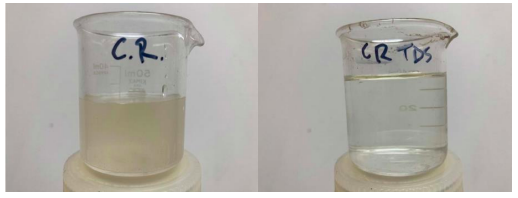
Colorado River water sample before and after being filtered.
Anson’s test work showed that the only intervention required is a simple reverse osmosis (RO) process to remove the salts, to make the water suitable for use in the DLE circuit.
More than 80% of the water used in the lithium extraction and purification process is recycled inside the battery limits.
Nevertheless, Anson is conducting studies to further improve recycling of the water, which will also have an impact on its operating costs while also meeting the company’s environmental policy.