
Element 25 Ltd (ASX:E25) has revealed the results of an independent Life Cycle Assessment (LCA) for its battery‐grade high purity manganese sulphate monohydrate (HPMSM) production process which confirms that the mine-to-market carbon footprint for the production of E25 HPMSM is the lowest in the global manganese industry based on published data.
The LCA is based on data from E25’s Butcherbird operations in the Pilbara region of WA and its feasibility study for a proposed HPMSM plant in Louisiana, USA and was compared to publicly available LCA reports from peers Euro Manganese and Giyani Metals, which are also developing HPMSM projects as well as independently validated data on the carbon intensity of current Chinese production methods.
E25’s HPMSM process is estimated to produce just 1.7kg CO2 equivalent per kg of product, which is ~67% lower than competitors in China, and up to 47% lower than planned projects outside China.
Peers included in the comparative analysis include Euro Manganese’s Chvaletice project in the Czech Republic and Giyani Metals’ K. Hill project in Botswana.
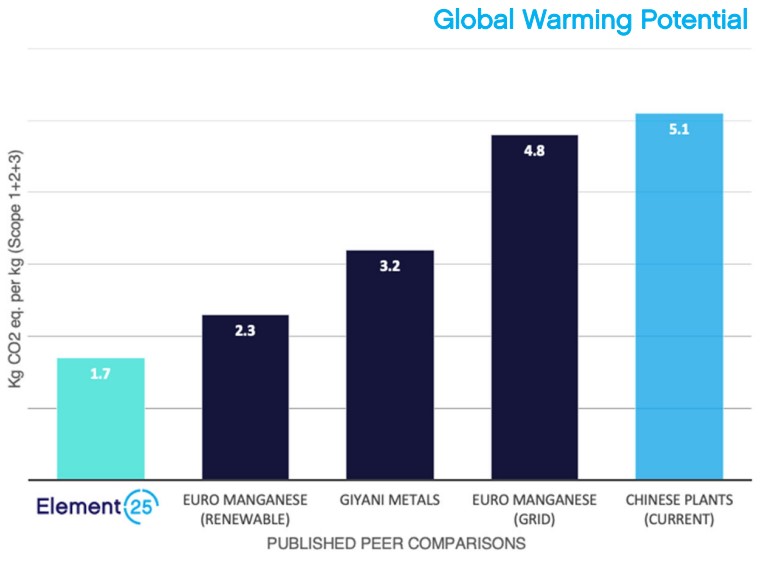
E25 HPMSM carbon intensity compared to available peer results.
E25 Managing Director Justin Brown said: “We are delighted with the results of the life cycle assessment completed on our proposed HPMSM plant in Louisiana, USA.
“As we expected, the results confirm just how low our carbon footprint will be compared to other projects in development.
“It has also highlighted some areas which we can further investigate to further reduce our carbon intensity.
“The study also underlined the massive potential carbon reduction opportunity of manganese compared to other battery metals such a cobalt and nickel – and E25 manganese is the lowest carbon of all.
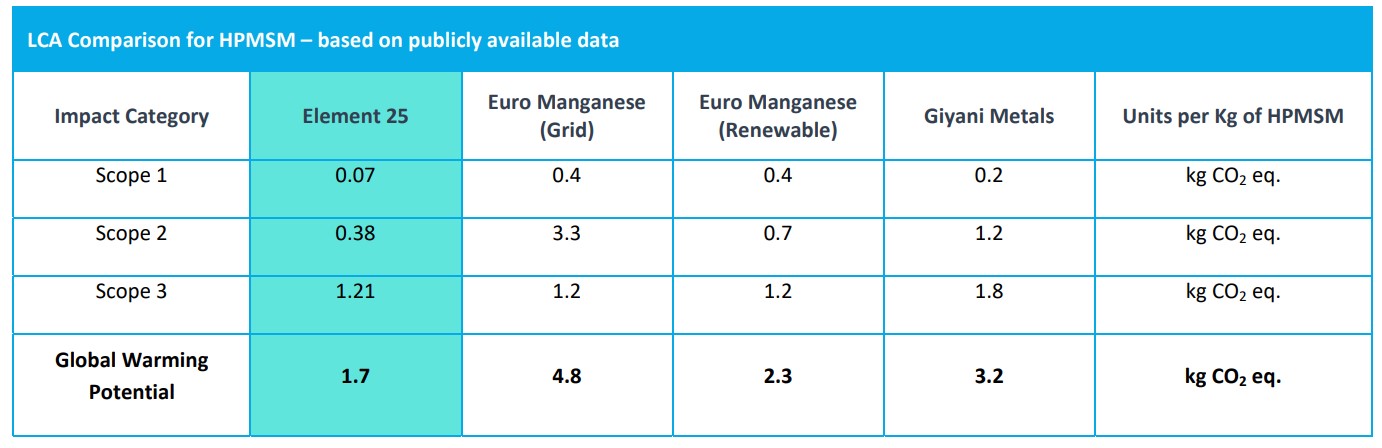
HPMSM LCA published results comparison.
Perth‐based consultancy Super Smart Energy completed the cradle‐to‐gate study, which means the life cycle has been assessed from the point of resource extraction (cradle; including pre‐extractive removal of overburden and waste rock) to end gate, which is HPMSM ready for distribution.
The study aims to assist in project development and improvement through the identification of environmental hotspots, and it was carried out in accordance with ISO‐14040/44:2006 and ISO‐14044:2006 standards, with 16 Environmental Footprint 3.0 impact categories evaluated.
Climate change and water scarcity footprint impacts were investigated in more detail via contribution analysis.
Focus on renewable energy
The most significant contributors in the production of E25’s HPMSM to climate change impact are the reagents required for the process and electricity associated with the plant.
The plant is initially expected to source electricity from the grid based on natural gas-fired generation, which does not include optimization using renewable energy (RE) integration.
The LCA has recommended that E25 focus on sourcing RE for the plant, which is expected to further reduce its carbon footprint.
E25 intends to include RE in pre‐construction optimization work, either sourced from the grid via established RE producers or by utilizing on-site roof top solar and other similar technologies.
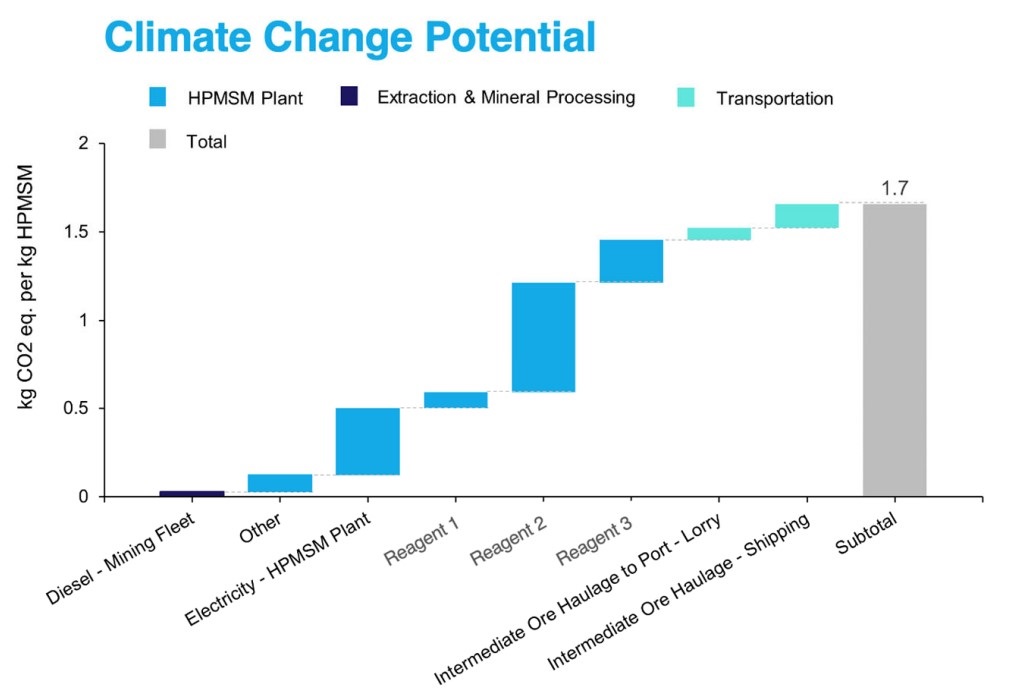
Climate change potential waterfall by supply chain segment.
There is also an opportunity to consider the environmental impact of reagents by transitioning over time to reagents produced using RE and/or non-petrochemical feedstocks.
E25 will further investigate these opportunities as part of a longer-term decarbonisation strategy.
As a base case, this LCA has successfully shown the Element 25 process can produce HPMSM with the lowest global warming potential compared to all available competitors and there remains significant potential to further reduce the carbon intensity of the E25 HPMSM product.
Brown added: “With our large manganese resources at Butcherbird, E25 can potentially supply low carbon ethically sourced manganese to battery markets around the globe with fully transparent and traceable supply changes from cradle to gate.”
“E25 intends to go beyond what is outlined today in this initial LCA, with a number of additional opportunities identified around renewable energy integration and the use of lower carbon reagents as we continue on our journey to net zero.”