
- FTSE 100 losing hopes for another record close
- Dow Jones joins S&P 500 and Nasdaq back in the red
- UK retail sales in surprise January rise, up 0.5%
- NatWest drops as cautious outlook outweighs profits jump
4:45pm: FTSE 100 ends positive week above 8,000
The FTSE 100 finished Friday at 8,004, marking a 122 point or 1.55% gain for the week.
It sees the company close out the week above the key psychological level of 8,000 having reach the marker for the first time in the benchmark’s history.
3.55pm: Directly down
Direct Line Group PLC was a faller on Friday as analysts at RBC Capital Markets downgraded their rating for the insurance group to 'sector perform' from 'outperform' and slashed the price target to 190p from 260p.
"We think DLG can restore its solvency towards the 160% level organically in 2023, predicated on a dividend rebasing that we think is the most economically sensible option," the RBC analysts said in a note to clients.
"While this challenges DLG's dividend appeal, it averts the need of a capital raise, at a time when access to market funding is costly, if not undesirable to shareholders," they added.
The RBC analysts pointed out that the appointment of a new CEO could catalyse a recovery, albeit it might not be immediate and timelines are not clear.
FTSE 250-listed Direct Line shares shed 0.6% at 183.90p.
3.35pm: Crude moves
Oil prices fell by around 2.5% on Friday, putting them on course for a weekly decline, amid concerns over higher for longer US interest rates that could weigh on demand and with signs of ample supply.
Russian oil producers are expect to maintain current volumes of crude oil exports, despite the government's plan to cut oil output in March, the Vedomosti newspaper said on Friday, citing sources familiar with companies' plans, according to a Reuters report.
The latest US supply data, released on Wednesday, showed crude inventories in the week to February 10, 2023, rose by 16.3 million barrels to 471.4 million barrels, their highest level since June 2021.
In afternoon trading, Brent crude futures were down 2.5%, to $79.07 a barrel, while West Texas Intermediate (WTI) crude fell 2.6%, to $75.83.
3.15pm: A look at some of the biggest movers
Inland Homes PLC up 72% at 15.25p: The brownfield site developer, housebuilder and regeneration specialists saw its shares rocket after it said that it has secured waivers from two lenders, after breaching its covenants with both following a challenging financial year. The stock remains down 72% over the past 12 months, having traded above 50p a year ago. On January 25, the company said that with revised financial provisioning and expected IFRS net assets at approximately £90.0 million at September 30, 2023, the group was a going concern.
Creo Medical PLC up 34% at 33p: The developer of minimally invasive surgical kit saw its shares jump as broker Cenkos said the firm is at an 'inflexion point' based on a growing user base and increasing adoption of its core devices. In a note, the company's corporate broker rated Creo shares as ‘buy’ with a 99p price target after a successful and oversubscribed fundraise brought in £28.5mln.
EnSilica PLC up 9% to 102/5p: The mixed signal chipmaker's shares rose after it revealed it had won a €5mln contract to develop satellite broadband chips, alongside stronger half-year results which saw an adjusted operating profit of £0.15mln for the first half of 2023, up from a £0.17mln loss a year earlier.
Enquest PLC down 13% to 18.5p: The North Sea-focused oiler saw its shares tumble as it warned of lower production in 2023 allied to the impact of the energy profits levy. Enquest said 2023 output would be between 42,000-46,000 barrels daily in the current twelve months, compared to an average 47,259 in 2022. It also said it was postponing new drilling at the Kraken field due to uncertainty over the impact of the levy.
2.45pm: Wall Street pressure remains
The FTSE 100 index stayed weaker as US stocks started Friday in the red after a slew of stronger-than-forecast data this week and hawkish Federal Reserve member comments have re-ignited fears about the central bank’s path of interest rate hikes.
Around 15 minutes after the market opened, the Dow Jones Industrial Average was down 136 points or 0.4% at 33,560, the S&P 500 was off 0.8%, and the Nasdaq Composite shed 1.2%.
FOREX.com market analyst Fiona Cincotta noted: “After an optimistic start to 2023, February is proving to be a much more troubling month for stocks ... In light of the blowout jobs report, hotter-than-expected inflation, and a rebound in retail sales, the market is now starting to price in three more 25 basis point rate hikes over coming Fed meetings, up from a previously expected two more rate hikes.”
Cincotta said with inflation proving to be stickier than expected, a terminal rate of 5.5%, was looking very plausible, which is up from expectations of a terminal rate of 5% at the start of the month.
“The data is forcing the market to finally pay attention to what the Fed has been saying that rates need to rise further and stay high for longer to rein in inflation, which is still too high,” she said.
In London, after Thursday's double-record-breaking performance, the FTSE 100 index had retreated back below the 8,000 level, off around 19 points or 0.2% at 7,993.
2.20pm: Quel surprise
UK energy supplier EDF posted a huge profit in 2022 as it took full advantage of soaring electricity prices. In stark contrast to its French business, underlying profits from EDF's UK arm, which supplies around a sixth of the country’s power, soared to £1.12bn from a loss of £21mln in 2021, which it attributed to its nuclear power stations and higher prices.
Five nuclear power stations in the UK are run by the French group, which also has a large number of wind farms, and that combination meant it was able to sell electricity at inflated prices in the UK without having to buy similarly expensive gas to generate it.
The retail business, however, lost £200mln, which it said was due to the energy price cap and buying at levels above the capped level.
Elsewhere, EDF reported huge losses from its troubled nuclear station estate in France. Group underlying losses in 2022 rose to €4.99bn (£4.44bn), blamed on "the decline in nuclear output" and "the impact of the exceptional regulatory measures to limit price increases for consumers in 2022".
2.10pm: Waiting for the whistle
The deadline for bids to arrive for Manchester United is 10.00pm today, and the Premier League club is expected to garner plenty of interest.
Lifelong fan and British billionaire Jim Ratcliffe, who owns chemicals group INEOS, has already put his name in the hat, with JPMorgan said to be advising the company.
Other interested parties include US-based consortiums and Qatar Sports Investment (QSI), a subsidiary of Qatar’s sovereign wealth fund, the Qatar Investments Authority.
Raine Group, the investment bank which also conducted the sale of Chelsea, will be running the process for United and will draw up a shortlist once proof of funds have been submitted.
The Glazer Family, which have overseen Manchester United for almost 20 years, are said to be seeking up to £8bn from any would-be buyer.
1.00pm: US markets set for further falls
US stocks are expected to extend the previous session's sharp falls at the open on Friday as worries over stubbornly high inflation mount up, while comments from Federal Reserve officials point to interest rates remaining higher for longer.
Futures for the blue-chip Dow Jones Industrial Average (DJIA) were 0.6% lower in pre-market trading, while those for the broader S&P 500 and tech-laden Nasdaq-100 fell 0.8% and 1.1%, respectively.
On Thursday, the DJIA shed 431 points, or 1.3%, while the S&P 500 lost 1.4%, and the Nasdaq Composite dropped 1.8%.
The losses came after January’s producer price index (PPI) rose by 0.7%, well above forecasts for a 0.4% increase in wholesale inflation, which came hot on the heels of a stronger-than-expected consumer price index (CPI) reading for January earlier in the week. The Labor Department also reported an unexpected fall in initial jobless claims for the week ending February 11 on Thursday.
The sell-off intensified late in the day following comments from St. Louis Federal Reserve president James Bullard who had backed a 50 basis point interest rate hike at the central bank’s previous policy meeting and said that he would not rule out a rate increase of that magnitude at the March meeting.
Neil Wilson, chief market analyst at markets.com, commented: "I’ve been saying it here for long enough – the Fed will go higher and for longer than the market keeps hoping. Now the latest PPI print and some more hawkish noises from James Bullard has scattered the bulls ... This is telling us that inflation is proving to be stickier and broader than feared."
He added: "Fundamentally, the market and perhaps the Fed were declaring victory on inflation too soon. It’s the old pivot narrative from last year but remember the Fed was never going to pivot and now can’t because it’s become data dependent; and the data won’t allow it."
Investors will watch Fed officials for more hints on the central bank’s rate-hiking campaign on Friday, with Richmond Fed president Tom Barkin speaking about the labor market on Friday morning and Fed Governor Michelle Bowman taking part in a discussion at the Tennessee Bankers Association’s credit conference.
On a weekly basis, the major indexes are mixed ahead of Friday’s session. The DJIA is down 0.5% for the week and on pace for its third negative week in a row, the first since September. The Nasdaq Composite is up 1.18% for the week, on track for its sixth week of gains in seven, but the S&P 500 is flat.
12.30pm: Santander eyeing Abrdn's private equity unit - Sky
An arm of Santander, the Spanish banking giant, is in talks to swoop on the £14bn private equity unit of Abrdn PLC (LSE:ABDN), the British fund manager, according to a report.
Sky News has learnt that Santander Asset Management is one of a small number of parties vying to buy the business from Abrdn.
Revealed: The asset management arm of Santander, the Spanish banking giant, is in talks to buy abrdn’s private equity unit, which manages about £14bn in assets, in a deal which could cost roughly £250m. https://t.co/GnwS7HlBmz
— Mark Kleinman (@MarkKleinmanSky) February 17, 2023
Sources said a deal was expected to be struck between Abrdn and a buyer in the next couple of months that could value the division at approximately £250mln.
Shares in Abrdn were down 0.3% at 215.24p, off earlier lows. The FTSE 100 is at 7,990.84, down 21.69 points, or 0.27%.
12.04pm: Segro shares rise as portfolio shows strong rental growth
Segro PLC was a winner in the market today with shares up 4%. Liberum noted while the firm a net tangible asset (NTA) decline of 15% for 2022 the performance is ahead of the wider market as the portfolio continues to see strong rental growth.
“We think property yields are showing signs of stabilisation in quarter one 2023 after the rapid repricing in the second half of 2022 and that the continued demand/supply imbalance for warehouse space should drive further rental growth in 2023,” the broker said.
Liberum felt Segro with its modern portfolio focussed on major cities is well placed to benefit from this dynamic and with an LTV ratio of 32% has one of the strongest balance sheets in the REIT sector.
Liberum reiterated a buy rating.
Analyst Andrew Saunders at Shore Capital was also positive.
“With a continued imbalance between the supply and demand of quality sites for warehousing, logistics and data centres supported by ongoing development we see Segro capable of sustaining premium earnings growth and reiterate our buy recommendation.”
11.30am: Sterling slips against dollar on expectations US rates will rise further
The pound has extended losses against the dollar, heading below US$1.20, touching its weakest level since January 5th, as investors rushed for the greenback amid renewed bets of the US Federal Reserve sticking to its aggressive monetary policy tightening.
Comments from US Federal Reserve chiefs suggesting that interest rates will rise higher than expected supported the move.
Federal Reserve Bank of Cleveland President Loretta Mester said she had seen a "compelling economic case" for rolling out another 50 basis-point increase in the US, while St Louis President James Bullard said he would not rule out supporting a half-percentage-point increase at the March meeting.
Sterling was 0.5% lower at US$1.19 approaching midday.
The FTSE 100 has slipped back again to 7,980.02, down 32.51 points, or 0.41%.
11.00am: UK retail sales still trending down despite rise in January
January's increase in retail sales wasn't enough to reverse a steep fall around Christmas, and the big picture is that sales have been on a downward trend, according to James Smith of ING Economics.
Smith stressed these are volatile numbers and should be viewed in the context of a gradual downtrend since October 2021 and are down 7% since then, and indeed now lie below pre-Covid levels.
But “what’s interesting is that the ONS has said the brighter spots in January’s numbers – online and non-food sales – were bolstered by discounting.”
“This is only anecdotal evidence admittedly, but it does support the trend we’re seeing in core goods inflation, which has been easing rapidly on lower consumer demand, improved supply chains and rising retail inventories. Goods prices aren’t the main area of focus for the Bank of England, but it does help the overall inflation story,” he explained.
Smith still suspects “we’ll see the downward path of retail sales continue for at least a couple more months, but the outlook should begin to turn brighter.”
He calculated the average household energy bill will no longer rise to £3,000 as planned in April, and in fact should have fallen to £2,100-2,200 by the summer, from £2,500 currently.
“That’s still high by historical standards, but the lack of a further increase should help limit the fallout in consumer activity,” Smith said.
He highlighted two main areas of uncertainty. On the positive side, there’s potential for consumers to dip into savings but the housing market is probably the main negative risk, and a price correction is clearly underway.
“Overall, we’re expecting a very mild recession through the first half of this year,” Smith concluded.
Meanwhile the FTSE 100 is at 7,992.69, down 20.80 points, or 0.26%.
10.20am: Downgrades seen at NatWest, guidance falls below City hopes
Shares in NatWest Group PLC (LSE:NWG) have recovered from their worst levels, now down 6.4%, after falling more than 9% earlier.
Cautious comments and below consensus forecasts in a number of key metrics explained the fall and analysts highlighted the bank faces challenges if margins don’t improve from here.
AJ Bell’s Russ Mould noted “NatWest may have delivered its biggest profit since the financial crisis but investors are far more concerned about what’s coming next and that’s less positive.”
“Income for 2023 is now guided to be lower than expected, with the key net interest margin metric also falling short. Costs are also set to be higher than forecast.”
The banking team at UBS noted the high street lender shared new 2023 guidance with total income of £14.8bn around 1% below the consensus of £15bn.
Net interest margin guidance for 2023 was 3.2% below the City consensus of 3.38% which implies a 5% downgrade if UK interest rates stay at 4% or 3% if they match the 4.4% curve implied 4.4% peak.
Forecast impairments of 20-30bps were better than expected (38bps) and return on equity guidance of 14% to 16% compared to consensus of 15.8%.
“Our workings suggest a 5% downgrade to consensus pre-tax profits on management's assumptions with a weaker expected mix on lower net interest income and higher fee income.”
“The key medium term issue is whether NatWest can realistically deliver a 14-16% return on total equity as net interest income likely falls on lower rates,” UBS said.
“In 2024 the elimination of Ulster will do much of this work but later it'll be tougher, we think.”
“If successful, the share still looks good value but risks to delivery are higher than we thought,” UBS analysts wrote.
Mould suggested “While impairments are anticipated to be a bit lower than estimates the market may be cautious of taking NatWest at its word given the difficult backdrop for consumers and businesses which could lead to a big increase in bad debts.”
“With the rate cycle nearing its peak the recent momentum in banking shares could be difficult to maintain. Whether this will act as a catalyst for the government to sell down more of its remaining stake remains to be seen,” he added.
“Natwest’s rescue by the state during the financial crisis means criticism of its tardiness in passing on higher interest rates to savers arguably carries more weight and that could have some impact on profitability.”
Richard Hunter, head of markets at interactive investor, took a more upbeat view.
He commented “NatWest finished its year in fine style, buoyed by an embarrassment of riches which further strengthen its financial position.”
“For the moment NatWest is delivering across the board, while also remaining prudent in the use of its excess capital,” he added.
He described the market reaction as “slightly perplexing” but pointed out the share price has risen by 17% over the last year, as compared to a gain of 6.3% for the wider FTSE100, and 24% over the last three months.
9.55am: European gas prices below €50 for first time in 17 months
European natural gas prices have slipped below €50 for the first time in 17 months as the continent gets used to life without Russian energy.
Prices have plunged more than 80% from their August peak when Russian gas cuts hit Europe with about US$1trn in costs, sending inflation surging to its highest levels in decades.
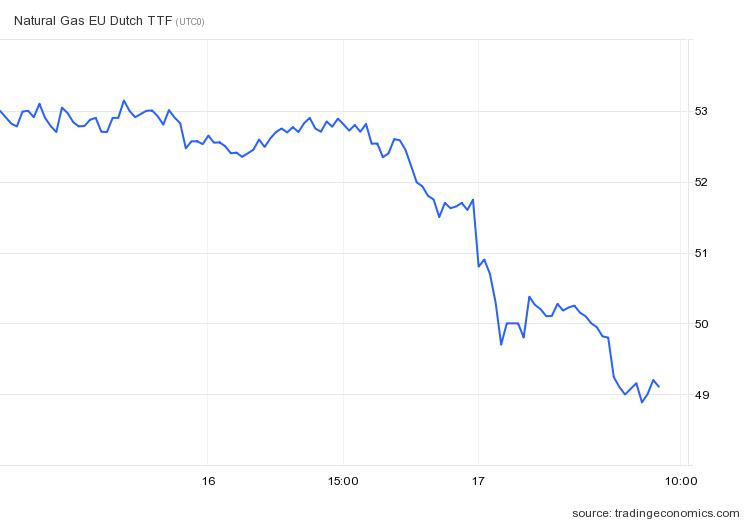
Prices have since turned around sharply thanks to relatively mild weather over winter and efforts to reduce consumption and boost reserves.
Benchmark front-month futures dropped 5.5% to €49.10 to the lowest intra-day level since September 1, 2021 while UK gas prices fell 5.8% to 122p/therm.
Tobias Davis, head of LNG for Asia at brokerage Tullet Prebon, said: "The market absorbs patches of demand appearing in Far East markets just as Europe remains unseasonably warm, windy and well supplied to meet a slowing demand profile" quoted by the Telegraph.
9.15am: PurpleBricks plunges on warning, puts for sale sign up
Online estate agent PurpleBricks Group PLC could be sold after the business launched a strategic review and announced a profit warning today.
Shares plunged 13% as the firm warned full year revenue would be between £60mln and £65mln, compared to previous estimates of between £67.5mln and £72.5mln given in December.
An adjusted EBITDA loss is expected between £15mln to £20mln.
“The board recognise that the potential of the group may be better realised under an alternative ownership structure, and has, therefore, decided to conduct a strategic review of the group’s business with the aim of delivering maximum value for shareholders,” the company said.
Chief Executive Helena Marston said despite efforts to improve sales, raise standards, establish Purplebricks Financial Services, and stabilise lettings, these actions and “our upside potential is not currently reflected in our market valuation.”
No offers have been received yet and the business is not currently in talks with any specific buyers, PurpleBricks said.
9.00am: Footsie on the backfoot
London’s blue-chips remained on the backfoot on Friday despite better-than-expected retail sales figures with fresh falls in bank shares prices dragging the index lower.
At 9.00am the FTSE 100 was at 7,976.80, down 35.73 points, or 0.45% while the FTSE 250 stood at 20,047.40, down 134.05 points, or 0.66%.
The declines in London followed heavy falls in the US on Thursday after disappoint economic data with stronger-than-expected producer price inflation figures and a slump in a closely watched manufacturing index.
Neil Wilson suggested that “the Fed will go higher and for longer than the market keeps hoping.”
“The latest PPI print and some more hawkish noises from James Bullard has scattered the bulls,” he added.
He noted “markets moved to reprice rates expectations after the PPI came in hot at +0.7% vs the +0.4% expected. This came after the CPI earlier in the week hit +0.5% vs the +0.4% anticipated. This is telling us that inflation is proving to be stickier and broader than feared.”
“The shift in rates has been significant – a fortnight ago markets priced in one more hike and 2 cuts this year – now pricing the chance of 4 hikes this year,” he pointed out.
Back in London and NatWest Group PLC (LSE:NWG) topped the fallers, tumbling 8.3% to 280.20p, as cautious comments on guidance overshadowed strong increases in profits and dividends. The high street lender also plans a £800mln buyback.
Profits topped £5bn for the full year but Shore Capital analyst Gary Greenwood said “ “We expect the lower-than-expected pre-provision profit outlook may cause some disappointment.”
Guidance for net income and net interest margin was below consensus he said while costs are seen above City forecasts. Bad debts though are forecast below current expectations, he added.
Richard Hunter, head of markets at interactive investor, called the early market response to the results "slightly perplexing" but noted the stock was up nearly a quarter in the past three months. He said NatWest is "delivering across the board".
Steve Clayton, Head of Equity Funds at Hargreaves Lansdown felt the share price fall reflected comments that “margins will expand no further from here.”
“With the stock having stormed 20% higher so far this year, some will be expecting more than that from the group. That explains the sharp tumble the shares have taken this morning,” he added.
The news dragged Lloyds Banking Group PLC (LSE:LLOY) down 4.4% ahead of its annual results on February 22.
The other FTSE 100 company reporting today enjoyed better fortunes. Shares in Segro PLC held firm, up 0.4%, against the falling market after it reported what it described as a strong operational result for 2022 with profits up 8.4%.
This was driven by a record level of rent roll growth, active asset management and strong leasing performance, according to CEO David Sleath.
The company's warehouses are in high demand from a diverse range of occupiers, investors were told.
Peel Hunt which has an ‘add’ rating on Segro noted encouragingly “there are early signs of liquidity returning to the investment markets as investors see value at current levels of pricing”.
The broker expects to move its 2023 NAV forecast up by c.2-3%.
8.20am: FTSE 100 falls, banks tumble on NatWest's cautious outlook
FTSE 100 opened lower and gave up the 8,000 level following US and Asian markets lower and as banks suffered further pain in the wake of NatWest’s full-year profits.
At 8.20am London's blue-chip index was at 7,978.82, down 33.71 points, or 0.42%.
Ipek Ozkardeskaya, senior analyst at Swissquote Bank noted “The equity marathon that kept going on for questionable reasons since Tuesday ended in tears yesterday, with the arrival of a new set of economic data that crushed the optimistic rhetoric of soft landing.”
Higher producer price inflation figures in the US showed that inflation may be falling but it’s going to be a long ride while the Philli Fed manufacturing index dropped unexpectedly negative 8.9 to negative 24.3. The expectation was a negative 7.4 print.
There was better news in the UK where retail sales bounced 0.5% in January after a downwardly revised fall of 1.2% in December.
Despite the rise Samuel Tombs, chief UK economist at Pantheon Macroeconomics thinks retail sales remain on a downward trend.
“January’s partial recovery in retail sales should not distract from the dismal near-term outlook,” he said. He highlighted a reduction in the energy support package, higher mortgage payments and rising unemployment as drags to retail sales going forward.
Fuel sales rose 1.7% “perhaps in response both to the sharp fall in fuel prices and the absence of adverse weather during the month,” he suggested while non-store sales volumes rose 2% “after strikes by postal workers in December made some shoppers doubt whether parcels would arrive in time for Christmas.”
NatWest Group PLC (LSE:NWG) tumbled 7% in early exchanges despite a strong increase in profits and dividends in 2022 as guidance for 2023 and beyond disappointed the City.
Shore Capital analyst Gary Greenwood said “We expect the lower-than-expected pre-provision profit outlook may cause some disappointment.”
He noted the results were in line with expectations, but line by line guidance for 2023 “appears to be weaker than expected.”
He pointed out income guidance of c.£14.8bn is below consensus of £15.0bn including NIM of c.3.20% against consensus of 3.38% and costs guidance of c.£7.6bn is higher than consensus of £7.2bn.
There was better news on bad debts with the impairment ratio of 20-30bps compared to consensus forecasts of 37bps, he noted.
The cautious outlook sent shares down 9% to 278p pushing Lloyds Banking Group PLC (LSE:LLOY) down 4.1% to 50.75p while Barclays slipped 1% 172.83p.
7.45am: NatWest profits top £5bn, plans £800mln buyback
NatWest Group PLC (LSE:NWG) reported a strong increase in profits, a big increase in the dividend and a £800mln buyback as rising interest rates boosted performance.
Operating pre-tax profits to £5.13bn from £3.84bn, broadly in line with City expectations, total income jumped to £13.16bn from £10.43bn and earnings per share rose to 33.8p from 27.3p.
Bank net interest margin (NIM) for year was 2.85%, 55 basis points higher than 2021 with a strong increase in the fourth quarter to 3.2%, up 21 basis points compared to the third quarter of 2022.
The FTSE 100-listed lender said it expected NIM of 3.2% in 2023 assuming interest rates of around 4% for the rest of the year.
Impairment charges were £337mln in 2022, around 9 basis points of gross customer loans, principally reflecting the latest macro-economics. “Underlying book performance remains strong, with credit conditions remaining benign and levels of default remaining low,” the bank said.
Impairment losses in 2023 are expected to be in line with through the cycle guidance of 20-30 basis points, the bank said.
The bumper profits saw shareholders rewarded with a final dividend of 10p, up from 7.5p a year ago, and the lender became the latest high profile firm to propose a share buy-back, of up to £800mln. This will start in the first half of the new financial year.
NatWest said this took “total distributions deducted from capital in the year to £5.1bn, or 53p per share.”
Net lending increased by £7.3bn to £366.3bn during 2022 primarily reflecting £14.4bn of growth in Retail Banking mortgages, with gross new mortgage lending of £41.4bn, and a £5.7bn increase in Commercial & Institutional, partially offset by a £6.4bn decrease related to the exit from the Republic of Ireland.
Customer deposits decreased by £29.5bn during 2022 to £450.3bn, principally reflecting a £14.2bn reduction in Commercial & Institutional and a £12.2bn reduction from the Irish exit.
The CET1 ratio of 14.2% was 170 basis points lower a year ago reflecting distributions and linked pension accruals.
NatWest continues to expect a return on tangible equity of 14-16%, forecast income for the year of £14.8bn and sees
dividend payouts of 40% of attributable profit with further buybacks will be dependent on government policy and limited to 4.99% of share capital.
7.10am: Retail sales bounce back in January
Retail sales bounced back in January, rising 0.5%, following a fall of 1.2% in December 2022 (revised from a fall of 1.0%) and better than City forecasts for a fall of 0.3%, according to figures from the Office for National Statistics.
Sales volumes fell by 0.9% in the three months to January 2023 when compared with the previous three months leaving them 1.4% below their pre-coronavirus (COVID-19) February 2020 levels.
Retail sales volumes increased by 0.5% in January 2023, following a fall of 1.2% in December 2022.
Retail remains 1.4% below its pre #COVID19 level.
— Office for National Statistics (ONS) (@ONS) February 17, 2023
Non-store retailing (predominantly online retailers) sales volumes rose by 2.0% in January, with some feedback that January sales promotions supported the rise.
Automotive fuel sales volumes rose by 1.7% in January, following a rise of 0.3% in December as fuel prices continued to fall.
Non-food stores sales volumes rose by 0.6% over the month, following a fall of 2.5% in December with feedback from retailers that growth was supported by sales promotions; despite this pickup, sales volumes were 2.9% below their pre-coronavirus February 2020 levels.
Food store sales volumes fell by 0.5% in January following a fall of 0.7% in December.
The proportion of retail sales online fell to 25.0% in January from 25.7% in December; despite this fall, it remains significantly above pre-coronavirus levels (19.8% in February 2020).
7.00am: FTSE to follow US lower
FTSE 100 is expected to head back below 8,000 after posting a new record closing high yesterday following heavy falls in the US on Thursday.
Spread betting firms are calling the lead index down by around 26 points.
The Dow closed Thursday down 432 points, 1.3%, at 33,696, the Nasdaq Composite dropped 215 points, 1.8%, to 11,856 and the S&P 500 fell 57 points, 1.4%, to 4,091.
The benchmarks took a steep dive in the afternoon. Among the laggards were Microsoft Corporation (NASDAQ:MSFT) and The Walt Disney Company (NYSE:DIS), shares of which fell 2.6% and 3.1%, respectively.
The market was already in the red after January’s producer price index (PPI) rose 0.7% on the month, surpassing the expected 0.4% increase, but things took a turn for the worse late in the day.
In Asia on Friday, the Nikkei 225 index was down 0.7%. In China, the Shanghai Composite was down 0.6%, while the Hang Seng index in Hong Kong was down 1.1%. The S&P/ASX 200 in Sydney closed down 0.9%
Back in London and NatWest Group PLC (LSE:NWG) continues the UK banking reporting season while UK retail sales figures will provide another early focus.