
The Niyama first nations called it ‘gubar’, meaning ‘red earth’ or ‘burnt earth’, the red tinge in Cobar’s terrain that beckoned explorers to this NSW town for more than a century in search of copper.
Over the decades, the once barren land has transformed into one of the most prolific copper regions in Australia, with its ‘Cobar-style’ deposits becoming highly sought after in the Australian mining industry not only for copper but for other base and precious metals also.
Capitalising on this play is Helix Resources Ltd (ASX:HLX), which is making a name for itself as a major copper player in the Cobar region in New South Wales.
Helix’s exploration efforts have focused on discovering "Cobar-style" deposits, targeting the untested regional potential across this highly prospective tenement package in the Cobar region.
In the article:
What makes "Cobar-style" mineralisation so special?
Prospective tenements
Hunt for high-grade copper at Canbelego
Emerging Caballero Prospect
Nickel and cobalt potential
What makes "Cobar-style" mineralisation so special?
Let’s break it down. A Cobar-style deposit is a large-scale, high-grade deposit characterised by a small footprint in a deep vertical extension within a polymetallic ore body.
This type of deposit is valuable because it allows for the extraction of multiple metals from a single deposit, reducing mining costs and increasing profitability.
The significance of Cobar-style mineralisation in central NSW is not lost on Helix Resources.
The company has established itself as a major player in the region and has been exploring its highly prospective tenement package to uncover new mineral deposits.

Hunt for 'Cobar' style deposits
Prospective tenements
One of Helix's most promising discoveries at this moment in the Cobar region is the Canbelogo JV project with Aeris Resources.
The Canbelego Project lies along the regional scale Rochford Copper Trend and falls within a 70:30 ‘contributing’ joint venture with Helix holding 70% and serving as an operator and Aeris holding 30%.
Notably, the Rochford Trend has the potential to host ‘Cobar-style’ copper deposits analogous to the large-scale, high-grade mineralisation found at the nearby CSA Copper Mine that is under offer from Metals Acquisition Corp.
The Canbelego Project is a 40-square-kilometre tenure prospective for copper, hosting 1.5 million tonnes at 1.2% copper.
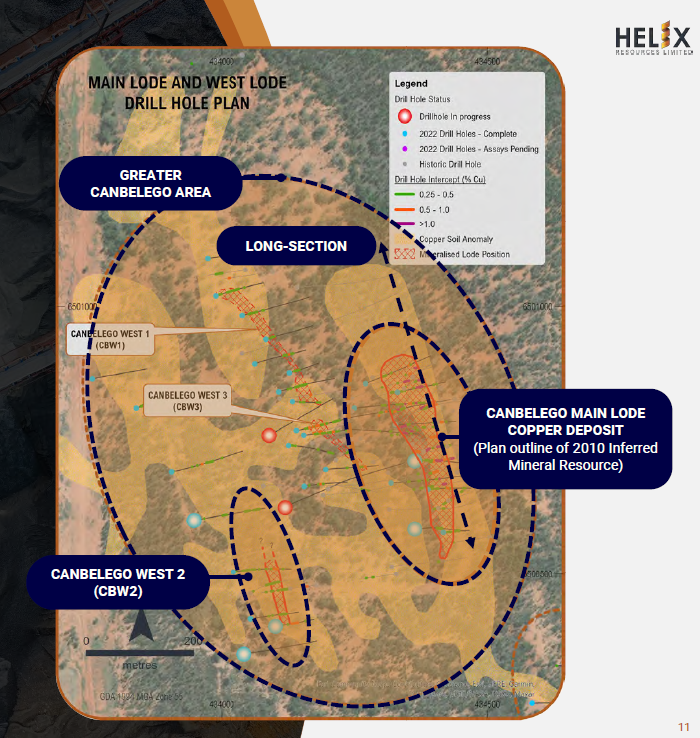
Drill plan at Canbelego.
Meanwhile, the company is on the hunt for the 'tritton' style of mineralisation at the Collerina Project, comprising a tenement package of more than 1,500 square kilometres, including over 85 kilometres of copper-prospective ‘Collerina’ trend.
The Collerina Project is surrounded by multiple operating base metal and gold mines within the broader Cobar Basin which includes Tritton, Hera, Peak and CSA mines.
Aeris' tritton copper operations is along trend of the Collerina Project, which hosts a total metal endowment of 560,000 tonnes of copper, 250,000 ounces of gold and three million ounces of silver.
Interestingly, Helix's success in the region can be attributed to its innovative approach to exploration and development.
The company is always looking for new and better ways to identify and extract mineral resources, which has led to the discovery of several new mineral deposits.
Hunt for high-grade copper at Canbelego
Helix is off to a strong start in 2023, with reverse circulation (RC) drilling intersecting “significant” shallow copper mineralisation at the Canbelogo JV Project.
Copper mineralisation was observed in five drill holes following up extensions to a high-grade interval of 16 metres at 3.12% copper from 117 metres reported in October 2022.
“Early indications from the RC drill logging – with significant copper mineral abundance observed, is very encouraging for us to extend the new shallow high-grade copper zone identified in October last year; 16 metres at 3.2% copper," Helix managing director Mike Rosenstreich said.
"The team has identified large gaps in the historical drill coverage and saw the potential for extensions of this high-grade mineralisation up dip and north toward the historical workings. We are rushing these samples to the assay lab.”
Subsequently, drill testing of a ‘high order’ conductive geophysical target returned visible copper sulphide minerals in drill core over 14 metres from 594 metres downhole.
While assays are pending, the mineralisation in diamond hole CANDD016C occurs in the Canbelego Main Lode position and is potentially continuous with significant copper intercepts about 200 metres higher in the mineralised shear.
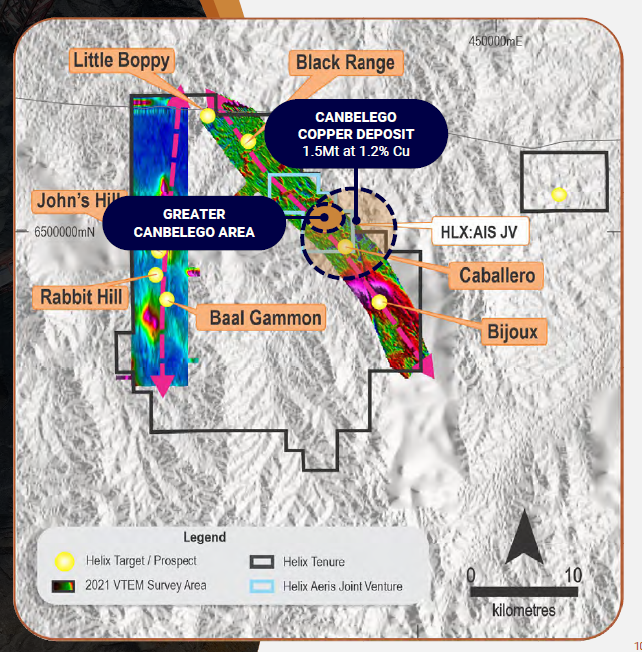
Map of the greater Canabelago area.
Rosenstreich adds: "There appears to be ample scope to delineate significant additional contained copper tonnes in this area as well as further up and down plunge which remains untested.
"This will be a focus for our next drilling and could be very important for our updated mineral resource.
"It’s an exciting time for the exploration team to have now verified this target as representing a copper shoot within the overall shear structure in an area never drilled previously.
"The accuracy of the DHEM modelling by Southern Geoscience is very valuable for efficiently targeting the ongoing drill program which can now be optimised for the drill conditions.”

Emerging Caballero Prospect
Also along the Rochford trend is the emerging Caballero prospect which underwent its first drilling in eight years in mid-last year.
During the RC drilling, Helix identified significant open-ended zones of copper mineralisation and intense alteration, indicating a “significant copper-mineralised system” at Caballero.
A follow-up diamond core hole, 50 metres beneath these intervals, also intersected weak visible copper mineralisation and silica-chlorite alteration zone over a 120 metres zone from 254 metres downhole.
The results at Caballero, consisting of significant copper assays and visual copper mineralisation ‘downlode dip’ in the follow-up diamond core hole, are very exciting for the potential discovery of a new copper deposit.
“These results indicate we have identified a significant copper-mineralised system at Caballero – the scale and intensity of the alteration zone in the diamond hole, supported by highly anomalous copper assays in the RC hole are very encouraging," Rosenstreich said.
“The team is excited about these early-stage results at Caballero, and we will reassess our priorities and ongoing work program, as we think persistence could pay off around the West Lodes mineralisation.
“It has been an interrupted process with weather-related access issues and queues in the assay lab. Nonetheless, we are already preparing for the follow-up campaign, including additional drilling at Caballero, a program of ‘bold’ deep holes we have planned at Canbelego Main Lode to test for depth extension as well as our ongoing regional target generation work. We remain focused on testing and turnover of targets and reprioritising the best for follow-up work.”
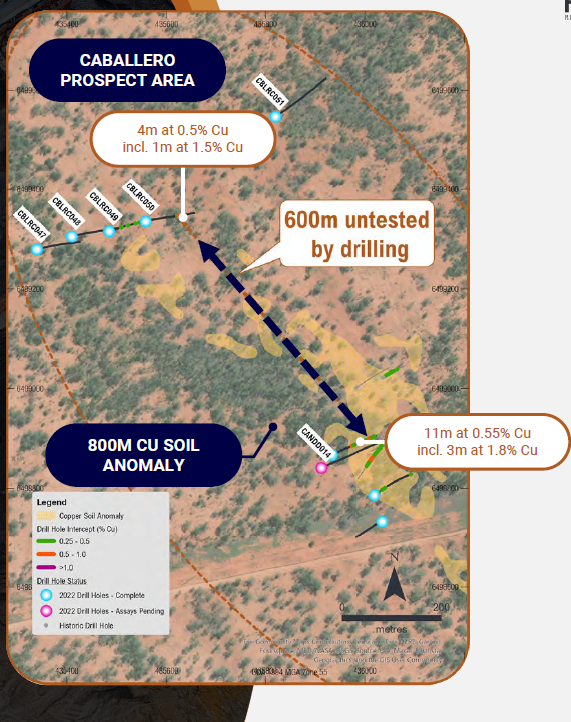
Caballero prospect
Nickel and cobalt potential
Helix has delivered significant nickel-cobalt laterite and PGM potential at the Nyngan Nickel-Cobalt (NNCP) Project in New South Wales.
Along the Collerina trend, the Homeville nickel-cobalt deposit hosts 18 million tonnes at 0.9% nickel and 0.6% cobalt.
At NNCP, the primary focus is to mind more tonnes as ‘excellent’ nickel and cobalt grades were already observed across several prospects.
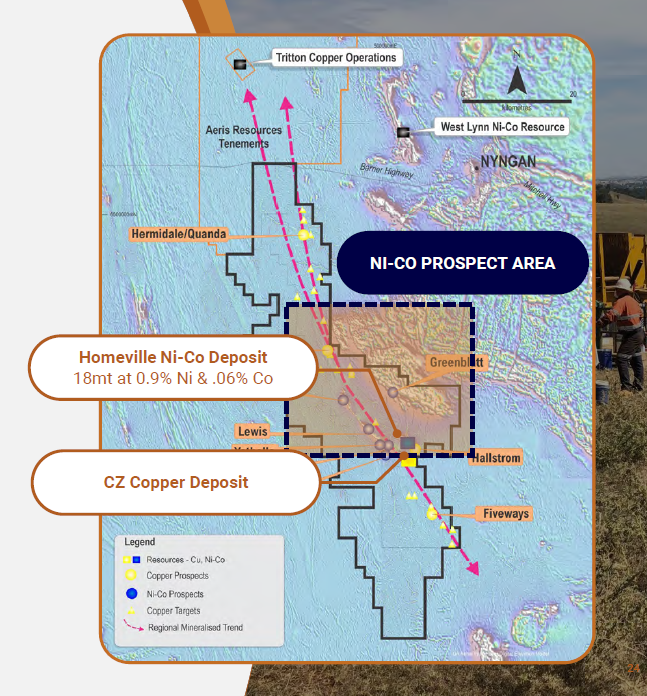
Nickel-cobalt prospect area.