
Network competition in the rollout of full-fibre broadband across the UK appears to be stronger than ever, creating extra competition for BT Group PLC (LSE:BT.A) and Virgin Media O2.
Independent full fibre alternative networks, known as altnets, passed 5.8mln premises at the end of 2022, according to data supplied by Point Topic, up by half a million in the last two months of the year.
Full-fibre, or fibre-to-the-premise (FTTP) broadband cables, create an unbroken fibre connection from an exchange directly to a property, supplanting outdated copper network infrastructure.
Network speed can reach as much as one gigabit per second (Gbps), or up to 10 times faster than legacy copper networks.
Among altnets with at least 50,000 premises passed, Yorkshire and West Midlands-based Brsk had the highest annual growth, from just 1,000 premises at end of 2021 to 100,000 at end of 2022.
CityFibre (AIM:CFHL), Toob, Jurassic Fibre and Fibrus all more than doubled their fibre networks during 2022.
By the end of 2022, over 130 local authorities had two or more independent full-fibre providers operating in their areas, while more than 1.3mln premises across the UK could choose between at least three independent full-fibre providers.
These numbers suggest that the momentum for altnets is showing no signs of slowing down, although BT-owned Openreach is the largest network owner by a wide margin, supplying over around 8mln of the 14mln households using FTTP broadband.
CityFibre (AIM:CFHL) has the second-largest network followed by Virgin Media O2.
The trend of the growing number of postcodes served by several fibre providers will continue for a while but in the next few years the industry will inevitably see consolidation, Point Topic’s report stated.
Investment firm Fern Trading, for instance, announced plans this month to consolidate several fibre providers it owns, including Giganet, Jurassic Fibre, Swish Fibre and AllPoints Fibre own into a single entity.
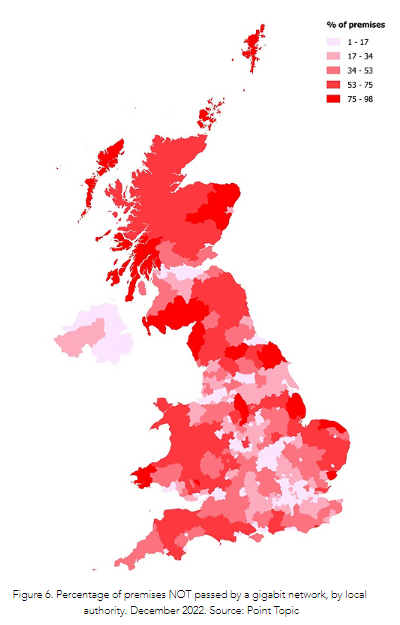
Despite greater competition among network owners, 28% of UK premises still did not have access to gigabit-capable broadband, with the figure highest in Wales at 45%.
Northern Ireland was the least ‘gigabit deficient’ with only 13% of premises not passed by a gigabit network.
Compared to October 2022, these percentages went down by 1% in England and Scotland and by 2% in Wales.