
- FTSE 100 hit new intra-day peak at 8,003.65
- UK CPI lower than forecast at 10.1% in January
- US retail sales rebound hits Wall Street
- Barclays drops as impairments hit profits
4.45pm: Boring is the new sexy in equities
The FTSE 100 index breached the 8,000 level for the first time ever today and ended at a new record closing high too, though it failed to end above the new magic number.
At the finish, the UK blue chip index was up 43.98 points, or 0.6%, at 7,997.82, easily surpassing the previous closing peak of 7,948 set on Monday.
The benchmark got a boost from a lower-than-expected UK inflation numbers in January, which should please the Bank of England, while its pre-eminent dollar-earners got a boost from a rise in the US currency after US retail sales data rebounded adding more pressure on the Federal Reserve to keep hiking interest rates, sending Wall Street lower - though the main US indexes had turned mixed, with the Nasdaq Composite once more finding gains as the others stayed weak
Jason Hollands, managing director of Bestinvest, the online investment service, commented: “UK equities have gotten off to a cracking start this year and today the FTSE 100 Index of blue-chip companies briefly crossed the 8,000 point threshold for the first-time ever. This will partially be down to a combination of today’s better-than-expected inflation figures aided by a weakening of the Pound versus the Dollar, as the highly international companies in the FTSE 100 have significant Dollar earnings exposure so the currency conversion effect benefits them. In fact, FTSE 100 stocks earn more of their revenues in the US, than they do in the UK.
“Despite the new high for the index, UK equities remain incredibly cheap with the FTSE 100 trading at a multiple of 10.7 times forecast earnings. This is low both compared to longer-term trend and it is also one of the widest discounts to the rest of the world in living memory. This is a good starting point, indicating the potential for further gains, while UK shares also provide an attractive level of dividend yield at circa 4.0%."
He added: “The UK market is increasingly seen as a bargain by international investors, with a number of large investment banks taking a positive view on the opportunity. However, this view has yet to filter down to private investors who have been heavy sellers of UK equity funds for several months, probably ground down by relentless gloomy news on the domestic economic outlook. However, the FTSE 100 is not a barometer of the UK domestic economy. Far from it. It is a highly international index, which makes around 79% of its revenues overseas. This includes around 13% of revenues earned in China, and so these companies should also be a beneficiary of the expected rebound in the Chinese economy this year following its ditching of draconian COVID restrictions in December.
“In recent years, many investors have dismissed UK blue chip shares as ‘boring’, lacking exposure to exciting sectors like technology and social media. But in a more trying economic environment, solid companies churning out reliable dividends are well worth considering. Boring is the new sexy. With an abundance of exposure to energy, commodities, consumer staples and healthcare companies, the FTSE 100 looks well placed for the current environment.”
4.30pm: Purely psychological milestone
Laith Khalaf, head of investment analysis at AJ Bell, commenting on the FTSE 100 breaching the 8,000 point mark today said: “It’s redemption day for the FTSE 100 as it breached the 8,000 mark after a long spell in the wilderness. The 8,000 level is a purely psychological milestone, but investors in the UK stock market will nonetheless be happily counting their coffers after a year in which it has been one of the best-performing major markets. Pension and ISA valuations will be looking pretty healthy thanks to the performance of the FTSE 100 and indeed the continued resurgence in the US stock market since the turn of the year.
He said the rapid advance in the FTSE 100 during the dotcom bubble of the late 1990s, where future growth was priced-in by rampant speculation, “skews the figures somewhat, but it’s also important to note that each subsequent 1,000 point advance marks a progressively less impressive price appreciation for the index.
“The first 1,000-point climb from 1,000 to 2,000 required a doubling in the price of the index. The move from 7,000 to 8,000 represents a jump in the FTSE 100 of just 14.3%, which translates into a compound capital return of just 1.7% a year for the last eight years. Not a slap in the face when you consider that doesn’t include dividends, but hardly a stellar performance either.”
4.10pm: Every dog has its day
Commenting on the new FTSE 100 record, John Moore, senior investment manager at RBC Brewin Dolphin, said: “The FTSE 100’s rise from being an out-of-favour index to new record highs shows how quickly the investment world can change.
“During the Covid-19 pandemic, tech companies and growth stocks were massively in fashion – precious few of which are included on London’s main index.
“Now, with inflation persistently high, elevated oil prices, and interest rates rising the consumer staples giants, oil and gas explorers, mining groups, and financials that make up the FTSE 100 are looking at a much more supportive near-term environment.
“It is a salutary lesson that every dog has its day. While the story of the past decade was very much about the rise of the tech sector, the perennially forward-looking stock market sees a very different 10 years in front of us with cash generation, resilience, and self-funded growth likely to offer options to businesses and investors looking to navigate the challenges ahead and maximise opportunities.
“However, the fact of the matter is that many of the changes of recent times have been underpinned by technology and they are likely to remain with us.
“There will undoubtedly be more changes to come and the challenge for the FTSE 100 is to replicate the quick 1,000 point gain witnessed between the 5,000 mark reached when Tony Blair gained power to the 6,000 level broken not two years later. The struggle for the largest constituents to grow and events like the banking crisis made it 17 years from that 6,000 level being reached till 7,000 was achieved.”
3.50pm: It's only gone and done it!
The FTSE 100 index finally breached the 8,000 level in buoyant late afternoon trading, hitting a new all-time intra-day high of 8,003.65.
It dipped back below that magic level but still looks set for a record closing high too - currently that peak is 7,948. Around 3.45pm, the UK benchmark was up around 42 points, or 0.5%, at 7,995.
3.20pm: Flybe buyer-less
Administrators for Flybe have been unable to find a buyer for the collapsed airline, with Interpath saying it will begin "winding down the business" and "identifying options" for the sale of "rights, interests and assets".
The regional carrier fell into bankruptcy for the second time in three years on January 28, with all flights grounded.
There was speculation that airline groups Deutsche Lufthansa AG and Air France KLM SA were in talks with the administrators to buy the airline, which held lucrative take-off and landing slots at Heathrow Airport.
2.55pm: Wall Street weakness exposed
The FTSE 100 index reached a new session high, up 19 points, or 0.2% to 7,973 boosted by its plethora of dollar earners as the US currency got a boost from more resilient US data which increased chances of higher Federal Reserve interest rates for longer.
US stocks kicked off the day’s trading in the red as US retail sales for January came in ahead of expectations, with headline sales up 3% compared to the forecast 2%.
Around 25 minutes after the New York open, the Dow Jones Industrial Average had shed 206 points, or 0.6% at 33,886 points, with the S&P 500 also down 0.6%, and the Nasdaq Composite off 0.5%.
ING chief international economist James Knightley noted that weather had played a significant role in January’s very strong US retail sales report.
“Remember that December experienced very cold temperatures with heavy snowfall disrupting travel in many parts of the nation,” he said. “This also depressed spending with November and December both posting 1.1% month-over-month declines.”
Knightley continued: “Therefore we should expect a rebound in January anyway, but then very warm temperatures providing an additional stimulus that tempted more people to leave their homes and spend.”
He cautioned with weather patterns returning to more seasonal norms in February, that there could be a significant correction next month, especially with household finances remaining under pressure from high inflation and slowing wage growth.
“Consequently, today's numbers back the case for a March and probably a May hike, but it shouldn’t push the case for Fed tightening beyond that,” Knightley said.
2.25pm: Unseasonally warm weather behind US data beat
In a quick reaction to the US data, Kieran Clancy, senior US economist at Pantheon Macroeconomics said: "In one line: January strength in retail sales unlikely to last, autos excepted."
He noted: " Headline sales were boosted by a surge in vehicle sales, up 6.4%, due in part—at least—to the unseasonably warm weather in January, boosting visits to dealerships. That said, some of the increase also reflects catch-up demand; unit auto sales were depressed by a lack of supply for much of the past two years, but auto production returned to pre-Covid levels in the middle of 2022, and unit sales have been trending higher since then.
"Auto sales likely will dip in February, given that the weather so far this month has been much closer in line with seasonal norms. But we think that will only partially reverse January’s gain, given the significant scope for further catch-up demand; unit sales in January were still some 7.5% below the pre-Covid level. The big picture here, then, is that rising auto sales look set to be a significant boost to Q1 quarter consumption."
Clancy concluded: "The upshot from this report, then, is that a good chunk of the January strength in retail sales likely is due to unseasonably warm weather, which will reverse in the months ahead. That won’t stop markets fretting that the economy is impervious to the Fed, but we think that view is just wrong. Once core sales correct, auto sales will be left to do the heavy lifting if consumption is to avoid outright declines over the coming quarters. We think that’s a decent bet, at least in the near term, but eventually the pent-up demand for autos will weaken in the face of significantly higher financing costs."
2.10pm: US retail sales rebound
The FTSE 100 consolidated its modest gains even as US stock futures edged down further after data showed a rebound in US retail sales, a sign of economic strength that could encourage the Federal Reserve to keep combating inflation by raising interest rates.
US retail sales rose 3% in January, ahead of the 1.9% forecast and up from a 1.1% drop in December, another sign of strength in the economy hot on the heels of bumper jobs numbers 10 days ago and a stubborn inflation reading yesterday.
With 20 minutes to go to the New York open, futures for the Dow Jones Industrial Average were down 0.4% in pre-market trading, while those for the broader S&P 500 index and for the Nasdaq-100 both fell 0.3%.
Around 2.00pm, the FTSE 100 index was up 10 points, or 0.1% at 7,964, just below the session peak of 7,968.43 but well below Tuesday's all-time intra-day peak a whisker away from the 8,000 level.
1.40pm: A few of today’s fallers and risers in London
Bidstack Group PLC (AIM:BIDS, OTC:FTBGF) shares rallied over 10% after the in-game advertising company announced the appointment of Thomas Bullen as its chief financial officer.
LPA Group (AIM:LPA) shares jumped 9.8% to 84p in morning trade after the maker of LED lighting, electronic and electro-mechanical systems announced a new contract and a record order book. In a statement, the company said it won a £5.3mln order to supply electro-mechanical products to the UK rail industry, taking its order book to £34mln.
Clontarf Energy PLC (AIM:CLON) shares surged 70% to 0.13p as the AIM-quoted company announced a heads of agreement around the potential formation of a 50:50 joint venture with US-based NEXT-ChemX. According to a statement from the lithium exploration company, part of the JV will cover the testing, marketing and deployment of NCX’s propriety direct lithium-ion extraction technology in Bolivia.
Gattaca PLC (AIM:GATC) shares fell around 8.6% after the specialist STEM recruiter warned that permanent hiring had shown signs of weakness since the turn of the year. Chief executive Matthew Wragg said: “As we enter the second half, we are conscious of softening in some external sectors, and perm is likely to be impacted by a level of restraint around hiring, shifting candidate sentiment and, as such, slightly longer hiring cycles.”
1.10pm: US stocks to add drag
Ahead of Wall Street's opening bell, the FTSE 100 index was giving up its meagre daily gains, with US stocks seen lower as investors still react to yesterday's inflation numbers and look to retail sales data later for further direction.
Futures for the Dow Jones Industrial Average were down 0.25% in pre-market trading, while those for the broader S&P 500 index point to a 0.34% decline and futures for the Nasdaq-100 slipped 0.35%.
Yesterday's consumer price index (CPI) for January came in higher than expected at 6.4%, although the monthly rise of 0.5% was in line with estimates.
Core CPI, which excludes more volatile food and energy prices, rose 5.6% on the year and 0.4% on the month. The annual increase was ahead of the expected 5.4%, while the monthly was on par with the Street’s expectation.
“The inflation report really needed to over-deliver after the red-hot labour market figures earlier in the month and it simply didn't do it,” commented Craig Erlam, senior market analyst at OANDA.
He said the Federal Reserve's next 25 basis point interest rate hike “was never really in doubt anyway but now markets are factoring in much more, including another in May and a good chance of one more in June”.
Meanwhile, US retail sales for January are expected to have bounced back from the weakness seen in December, said analyst James Harte at TickMill.
Sales are seen rising 1.9% after a 1.1% fall, with core sales up 0.9% to rebound from a similar 1.1% decline, Harte said.
“Resilience in the US economy, particularly coupled with a fresh jump in inflation, is supporting the view that the Fed will continue with hikes for longer than expected this year.”
12.50pm: Footsie edging towards record highs again
The FTSE 100 is seeing some extra momentum as US traders wake up, with the index up 13 points or 0.17% to 7,968.36, another new day's high.
A weaker pound is often a boost for the many overseas earners that make up the index, with sterling down 1% against the dollar at 1.2050 and not far above one-month lows.
Market analyst Fawad Razaqzada at City Index notes the US dollar is "continuing to show potential bottoming signs", helped by expectations that there will not be a pivot that soon from the US Fed as inflation yesterday was hotter-than-expected.
"This combined with weaker CPI data from the UK and a drop in Eurozone industrial production today, have all helped to boost the appeal of the US dollar in favour of the euro and pound."
The US dollar index (DXY) is up 0.4% at 103.64.
But whether or not the recovery for the dollar will hold remains to be seen, Razaqzada added: "The greenback has absorbed a lot of hawkish Fed speak and above-forecast US data. Yet it has bounced only modestly off its lows. Investors have repeatedly shown preference to racier equities, which has weighed on the appetite for haven US dollar. But is the tide turning? Will the dollar index start trending higher again? The immediate focus will be on US retail sales due for release shortly."
Acting as a big brake on the blue-chip index today is the banking sector after disappointing results from Barclays PLC (LSE:BARC), which sent its shares nearly 10% lower.
Investors have also marked down sector peers Lloyds Banking Group PLC (LSE:LLOY) and NatWest Group PLC (LSE:NWG) heavily today, with these more UK-focused than overseas-focused HSBC and Standard Chartered.
But details within Barclays numbers may suggest better, if not brilliant, news for more domestically focused rivals, analysts suggest.
12.30pm: Competition to return to UK energy market "within weeks"
Falling energy prices should lead to competition returning to the UK energy market this spring and summer, with an estimated 5.5mln households having held back from switching providers while the government has been supporting bills.
That's according to Cornwall Insight, which predicted the number of households switching their energy supplier "could rise from July", as falling energy wholesale prices are coupled with reduced government support.
The government support runs up until April, which in combination with the price cap has removed the incentive for people to switch suppliers.
Household switching rates dropped from an average of 496,000 electricity supply points moving per month in 2019 to just 85,000 per month in 2022, Cornwall Insight's Kate Mulvany said,
Meanwhile, wholesale prices have decreased, meaning lower costs for suppliers. This means there is "a good chance that suppliers will be able to offer fixed tariffs that compete with the capped government prices, reviving the benefits of switching suppliers".
"Although such an outcome is subject to wholesale market volatility, early indications are that suppliers may be able to offer competitively priced tariffs within a matter of weeks."
The main energy provider on the market is Centrica PLC (LSE:CNA), owner of British Gas. Its shares were little moved today but up 26% over the past year.
12.05pm: US stocks heading lower, could add drag
The FTSE 100 is creeping higher, up to the day's new high of 7,963.66 but still some way off its big milestone.
A sliding pound could be helping, with GBP/USD now down 0.9% at 1.2059.
But London's blue-chip index is comparing badly with a 1% gain for France's CAC 40 and a 0.4% rise for Germany's DAX today. Spain's Ibex is up 0.18% while Italy's MIB index is down 0.13%.
It looks like US stocks are poised to join those in Italy, possibly adding to the negative forces in London. Futures for the Dow Jones Industrial Average were down 0.28% in pre-market trading, while those for the broader S&P 500 index point to a 0.35% decline and futures for the Nasdaq-100 slipped 0.49%.
Yesterday's US consumer price index (CPI) reading for January came in higher than expected at 6.4%, although the monthly rise of 0.5% was in line with estimates.
Core CPI, which excludes more volatile food and energy prices, rose 5.6% on the year and 0.4% on the month. The annual increase was ahead of the expected 5.4%, while the monthly was on par with the Street’s expectation.
US stocks ended mixed overnight, with the DJIA losing 0.5% at 34,089, while the S&P 500 ended flat at 4,136, and the Nasdaq Composite gained 0.6% to 11,960.
11.35am: Burberry tops the blue-chip risers
Topping the FTSE 100 leaderboard is Burberry PLC, which seems to be getting a boost despite mixed results at fellow luxury fashion stock Kering, which owns Yves Saint Laurent, Gucci and Balenciaga.
The French luxury group reported a “très solide” performance for last year but gave a gallic shrug over a fourth quarter that was “contrasté” – or “mixed” in the English translation.
Revenue from Gucci fell more than expected in Q4, down 14% while analysts had forecast an 11% drop.
Analyst Zainab Atiyyah at Third Bridge said: “Kering will be looking east and hoping Chinese revenge travel and spending after COVID drives their growth in 2023. Our experts expect Europe and China to be good markets for Kering as Chinese tourists opt to visit France and Italy, thanks to the weak euro.”
Atiyyah noted that YSL enjoyed sales growth across all regions in 2022, which is “likely to continue, thanks to a strategic decision to focus on local clients and heritage”, while Gucci has a “very different” strategy to embrace big trends.
Burberry shares are up nearly 3%, while Kering's fell 4% in early trade but are now up 5%.
Elsewhere, Coca Cola HBC AG (LSE:CCH) is second among the blue-chip risers, helped by positive analyst reaction to its results yesterday.
Credit Suisse hiked its EPS forecasts by 9% and Deutsche Bank said the results "should lead to low to high single-digit upgrades to consensus EBIT and EPS", which has helped continue the gains for a second day for its still-depressed shares.
Share price rises for housebuilder Persimmon PLC (LSE:PSN), after the house price numbers earlier, Ladbrokes owner Entain PLC (LSE:ENT) rebounding from the MGM rebuff last week, and Rolls-Royce Holdings PLC (LSE:RR.), following the big Indian contract yesterday, are not far behind.
The Footsie index has crept back into the green, up just over 1 point at 7,955. Can it add five more?
11.10am: Oilers supporting FTSE as demand expected to rise
Oil heavyweights Shell PLC (LSE:SHEL, NYSE:SHEL) and BP PLC (LSE:BP.) are providing some support this morning, though the London benchmark index is a sliver below where it finished yesterday.
Helping things for the fossil fuel producers is a forecast hike from the International Energy Agency (IEA), which predicts demand will increase by 500,000 barrels this quarter more than it previously expected.
Following a modest year-on-year contraction in the last quarter of 2022, the IEA predicted global oil demand will rise by 2mln barrels per day (mb/d) in 2023 to 101.9 mb/d.
Fuelled by a "resurgent China", adding 900,000 barrels a day, the Asia-Pacific region is seen as providing the boost, with the monthly report from the agency saying "the reopening of borders will boost air traffic" to lift jet fuel demand by an expected 1.1 mb/d, 90% of 2019 levels.
Supply has held "largely steady" in January, after a sharp decline at the end of 2022 led by the US and Saudi Arabia, the IEA said.
"We expect global output to grow 1.2 mb/d in 2023, driven by non-OPEC+. Supply from OPEC+ is projected to contract with Russia pressured by sanctions."
Shell shares are up 0.5% and BP rose 0.2%, which makes a difference as the energy stocks are almost 10% of the FTSE 100's weighting.
10.20am: Blue chips held back by banks
The FTSE 100 is back into the red, down just a couple of points, with Barclays's 8% decline a big weight stopping the index from climbing back towards the 8,000-point peak, followed by Natwest and Lloyds both down 2%, with HSBC and Standard Chartered also in the red.
Lenders are directly linked to the housing market struggles, that the fresh ONS house price figures have outlined.
The "whack" to buyer affordability over the past few months from higher mortgage rates started to weigh more heavily on house prices in December, said economist Gabriella Dickens at Pantheon Macroeconomics.
She noted that, on a seasonally-adjusted basis, prices fell outright for the first time since October 2021, when Stamp Duty was reverted back from its temporary higher level.
Prices have probably continued to fall this year, she added, with Nationwide’s measure of house prices down for the fifth month in a row in January, the longest period of consecutive falls since February 2009, while 68% of homes were sold under the asking price in December, well above the average over the past two years, 35%, according to the NAEA.
"We think house prices will continue to decline over the next six months or so, resulting in a peak-to-trough fall of about 8%," she said.
This is despite mortgage rates coming back down from October’s peaks, but Dickens said they still look set to remain around two and a half times higher than they were at the start of 2022, "meaning someone having to refinance will see the share of their incomes absorbed by repayments jump to around 28%, from 21%".
What's more, a greater number of potential buyers will fail lenders' affordability tests, given that they have become harder to pass since interest rates have risen, not to mention real disposable incomes poised to be hit by the withdrawal of government support for energy bills in the next quarter.
Further ahead, Dickens said prices have "scope to bounce back", if mortgage rates fall substantially and households benefit from lower wholesale energy prices, leading to Pantheon forecasting a 5% recovery in house prices over the course of 2024.
9.55am: Housebuilders up as house prices growth slows
Official UK house price growth slowed to 9.8% in the 12 months to December 2022, down from the 10.6% figure for November and below the consensus forecast of 11.2%.
December was down 0.4% month-on-month and in seasonally adjusted terms, prices fell by 0.2%.
Following its earlier update showing that UK CPI inflation cooled, the Office for National Statistics has just released house price data for December and rents data for January.
The average UK house price was £294,000 in December 2022, which is £26,000 higher than 12 months ago but a slight change from last month's record high of £296,000.
“Annual house price inflation, measured using final transaction prices, slowed again in December across the majority of the nations and regions," said ONS assistant deputy director of prices, Chris Jenkins.
He noted that the East Midlands showed the highest annual growth, while Scotland remains the slowest growing part of the UK.
“Rental prices continue to increase at pace with the largest annual percentage change since UK records began in 2016. London’s rental growth continues to pick up with the strongest growth for over seven years.”
Blue-chip housebuilders are helping the FTSE 100 this morning, with Persimmon PLC (LSE:PSN) up over 2%, Barratt Developments PLC (LSE:BDEV) and Taylor Wimpey PLC (LSE:TW.) over 1% and Berkeley Group Holdings PLC just below that.
The Footsie is currently two points above the plumb-line, at 7,955.86.
9.35am: Pound falls after weaker-than-expected inflation numbers
Sterling fell over 0.5% against the US dollar further retreating from $1.24 touched early in the month, after fresh CPI figures showed inflation in the UK slowed more than anticipated in January to 10.1%.
Also, the monthly rate actually turned negative for the first in a year, and annual core inflation eased to the lowest in seven months.
.jpeg)
The new figures offered some relief that price pressures may be finally easing, raising bets the Bank of England will not need to pursue a more aggressive policy stance.
Money markets are now pricing a 4.55% interest rate peak by September compared to 4.69% before the CPI report.
Meanwhile, the FTSE 100 has settled slightly lower at 7,947.93, down 5.92 points, or 0.074%.
At 9.30am, the pound was trading 0.69% lower at US$1.20860.
9.00am: Footsie recovers poise
The FTSE 100 recovered its poise after early falls as better-than-expected inflation figures limited the damage caused by falls in the bank and mining sectors.
At 9.00am, London’s blue-chip index was at 7,952.85, down 1.00, or 0.013%, after being more than 20 points lower.
Barclays led the FTSE 100 fallers, down 8.3%, dragging NatWest Group PLC (LSE:NWG) and Lloyds Banking Group PLC (LSE:LLOY) down with it as it highlighted rising bad debt charges due to the current macroeconomic uncertainty.
The high street lender was also hit by litigation charges which saw annual pre-tax profits fall with the overall performance worse than the market expected led by the corporate and investment banking division.
Sophie Lund-Yates, Lead Equity Analyst at Hargreaves Lansdown said: “Barclays has bitterly disappointed the market with its full-year numbers.
“Profits have been stunted partly because of a big increase in litigation costs relating to the over-issuance of US securities. This costly mistake has been known about for some time, but these are now the hard consequences biting the bottom line."
“Barclays is more than able to stomach this financially, the wider-reaching difficulties come from reputational damage. The tolerance margin for a similar mistake is now very thin,” she suggested.
Mining stocks were a weak feature on concerns about economic growth. A fund manager survey from Bank of America yesterday showed the sector was least favoured amongst stock pickers surveyed.
Anglo American PLC (LSE:AAL) lost 1% and Rio Tinto PLC (LSE:RIO) 0.6%, while not even a US$7.1bn cash return by Glencore PLC (LSE:GLEN) could halt its shares slipping 1% as well.
Hargreaves Lansdown PLC (LSE:HL.) was top of the FTSE 100 risers, up 5.3% to 999p, after full-year results which were well ahead of expectations.
Peel Hunt said underlying profits increased by 30% to £212mln, compared to a consensus figure of £179mln.
Coca-Cola HBC AG extended gains following yesterday’s results. Shares rose 2.3% to 2,083.50p as Deutsche Bank increased its price target to 2,580p from 2,420p and reiterated a ‘buy’ rating.
Rolls Royce Holdings PLC rose 1.2% after yesterday’s award of its biggest-ever contract for Trent XWB-97 engines from Air India, part of Tata Group.
The bumper agreement won by Derby-based Rolls Royce includes orders for 68 Trent XWB-97 engines, used in the Airbus A350-1000, plus options for 20 more, and 12 Trent XWB-84 engines, used in the Airbus A350-900.
Financial details were not disclosed but the agreement makes Air India the largest operator of the Trent XWB-97 in the world.
8.20am: FTSE 100 heads lower, banks fall after Barclays' numbers
FTSE 100 opened lower as better-than-expected UK inflation numbers were offset by disappointing results from high street lender Barclays PLC (LSE:BARC).
At 8.15am, London's blue-chip index was at 7,930.32, down 23.53 points, or 0.30% while the FTSE 250 was little changed at 20,011.61, down 6.62 points, or 0.033%.
UK CPI rose 10.1% in the year to January, lower than City expectations for a 10.3% increase, and down from December’s 10.5% rise.
ING Economics said the numbers certainly “throw in a curveball for the Bank of England’s March meeting.”
They highlighted that core inflation was “was also much lower than expected, and slipped below 6% for the first time since last June.”
ING still expects the Bank of England to raise interest rates by 25 basis points (bps) next month but said that “if this trend in services inflation persists, then it would be a strong argument in favour of pausing in May.”
Simon French at Panmure Gordon agreed. He tweeted: “An encouraging UK inflation report. There were just signs in the November & December reports that UK was at risk of becoming an outlier. Less compelling in today's report. Core inflation pressures easing to +5.8% YoY (+6.3% prev.) probably the most pleasing data point.”
But the brighter inflation news was in contrast to disappointing results from Barclays PLC (LSE:BARC) where shares tumbled 7.5% hit by a hefty litigation charge relating to the over-issuance of securities.
The high street lender booked litigation charges of £1,597mln for the year (2021: £397mln) which took pre-tax profits for 2022 to £7.01bn, down 14% from £8.19bn in 2021 and below the City consensus of £7.2bn.
John Moore, senior investment manager at RBC Brewin Dolphin, noted: “While the bank is benefitting from the tailwind of better interest rate economics and has been razor sharp on costs, it has also had to set capital aside for overselling securities and seen fee income drop significantly at its investment banking division.
“That said, profits may have taken a hit but they remain at a healthy level and are underpinning shareholder returns through an increased dividend and share buyback programme.
“When Barclays can turn its back on errors and legacy issues, which have been a consistent part of results in recent years, the bank should be the best placed of the major UK lenders in the current environment.”
Other banks fell with NatWest Group PLC (LSE:NWG) down 3% and Lloyds Banking Group PLC (LSE:LLOY) down 2%.
8.00am: Inflation eases
Price rises in the UK slowed for the third month in a row but inflation remains near a 40-year high, official figures show.
UK CPI fell to 10.1% in the year to January, down from 10.5% in December, better than City forecasts of 10.3%, according to the Office for National Statistics (ONS).
On a monthly basis, CPI fell by 0.6% in January 2023, compared with a fall of 0.1% in January 2022.
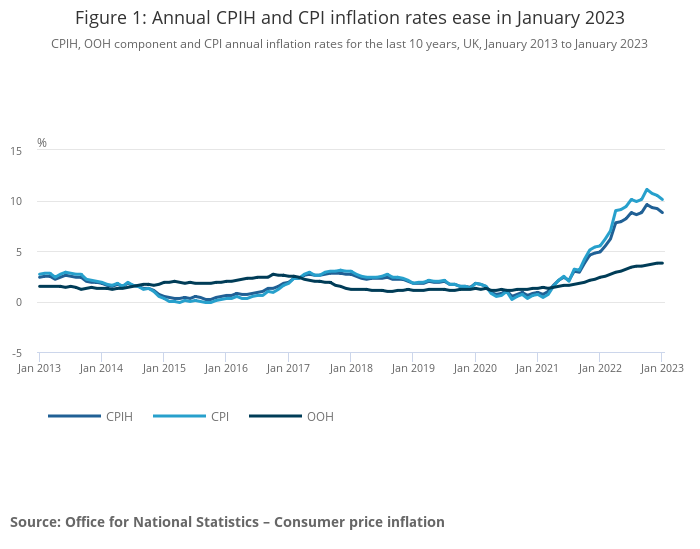
The largest downward contribution to the change came from transport and restaurants and hotels, with rising prices in alcoholic beverages and tobacco making the largest partially offsetting upward contribution to the change.
Food inflation also remained high in January at 16.7% and is one of the main drivers fuelling overall inflation, along with energy bills, according to the ONS.
Core Consumer Prices Index including owner occupiers' housing costs which excludes energy, food, alcohol and tobacco fell to 5.3% in the 12 months to January 2023 from 5.8% in December 2022.
7.55am: Barclays profits fall
Barclays PLC (LSE:BARC) reported a fall in annual pre-tax profits hit by litigation charges relating to the over-issuance of securities.
The high street lender booked litigation charges of £1,597mln for the year (2021: £397mln) which took pre-tax profits for the year to £7.01bn, down 14% from £8.19bn in 2021 and below the City consensus of £7.2bn.
Net income totalled £24.96bn, up 14% from £21.94bn a year ago with fourth-quarter net income of £5.8bn, up 12%, from £5.16bn in 2021. Earnings per share were 30.8p compared to 36.5p in 2021.
The FTSE 100 listed bank reported momentum across all business areas and benefited from favourable forex movements notably the stronger dollar against the pound.
Credit impairment charges soared to £1.22bn compared to a release of £653mln in 2021 reflecting the deteriorating macroeconomic conditions.
Returns on equity booked by the international unit which houses Barclays' transatlantic investment bank fell to 10.2% from 14.4% a year earlier, as fees from advising on deals particularly in debt and equity capital markets, plunged by almost two-fifths year on year.
The Tier 1 ratio deteriorated to 13.9% in the year, down 120 bps from December 2021, and Barclays expects to operate within a ratio range of 13-14%.
Despite the fall in profits shareholders were rewarded with a 21% increase in the dividend to 7.25p while the lender also announced plans for a new £0.5bn share buy-back.
In 2023, Barclays UK net interest margin is expected to be greater than 3.20% while it is targeting a return on total equity of greater than 10% in 2023.
Barclays said its diversified income streams continue to position the group well for the current economic and market environment including higher interest rates.
Chief Executive CS Venkatakrishnan, commented: “Barclays performed strongly in 2022. Each business delivered income growth, with group income up 14%.
“We achieved our RoTE target of over 10%, maintained a strong common equity Tier 1 (CET1) capital ratio of 13.9%, and returned capital to shareholders. We are cautious about global economic conditions, but continue to see growth opportunities across our businesses through 2023."
7.30am: FTSE 100 seen slightly higher
The FTSE 100 is expected to start slightly higher on Wednesday as investors digest the latest UK inflation numbers and as Barclays kicks off the banking reporting season.
Spread betting companies are calling the lead index up by around 4 points.
Michael Hewson at CMC Markets said: "Unlike the US and Europe, headline CPI in the UK is proving be a lot stickier having fallen only modestly from its October peaks of 11.1%, with today's January CPI number expected to see a fall to 10.3%. This seems fairly modest when compared to the bigger slowdowns we've seen in both the US and Europe, where headline inflation is much lower."
In the US, the Dow Jones Industrial Average closed Tuesday down 157 points, 0.5%, at 34,089, while the Nasdaq Composite added 68 points, 0.6%, to 11,960, and the S&P 500 lost 1 point to 4,136.
It was a choppy day for the US benchmarks as investors digested slightly higher-than-expected consumer price index numbers. The 6.4% annual rate figure wasn't a big surprise, but the question remains how long it will take for inflation to fall to normal levels.