
There’s a growing appetite for green energy — wind turbines, electric vehicles and rechargeable batteries are garnering global attention.
And as the world moves to more sustainable energy sources, it’s easy to see why demand for rare earths — the linchpin in so many of these emerging technologies — continues to run hot.
Enter Parabellum Resources Ltd (ASX:PBL) — an Australian explorer that’s just revealed it’s sitting on a rare earths goldmine at its Khotgor Project in Mongolia.
With a rare earth element (REE) bounty exceeding 2.2 million tonnes, Khotgor (pronounced ‘hotgor‘) is touted as one of the world’s larger undeveloped rare earth deposits with the potential to be a major supplier of high-value neodymium and praseodymium (NdPR).
The best news of all? Parabellum is just getting started.
In this article:
- Unveiling the maiden resource
- Who’s at the helm?
- A closer look at Khotgor
- Why rare earths?
- Beyond REEs: copper and gold in NSW
Unveiling the maiden resource
To understand Khotgor’s scale potential, you needn’t look further than the company’s maiden mineral resource — an important benchmark as Parabellum finalises its initial scoping study (due Q2 this year) and prepares to move into definitive feasibility work.
This 2.2-million-tonne-plus resource indicates Khotgor’s average NdPr grades make up a substantial 20% of its total rare earth oxides, highlighting its attractive grade potential to the burgeoning EV and magnets markets. The new resource has focused on the higher grade envelope in the core of the ore body that will be targeted for future production.
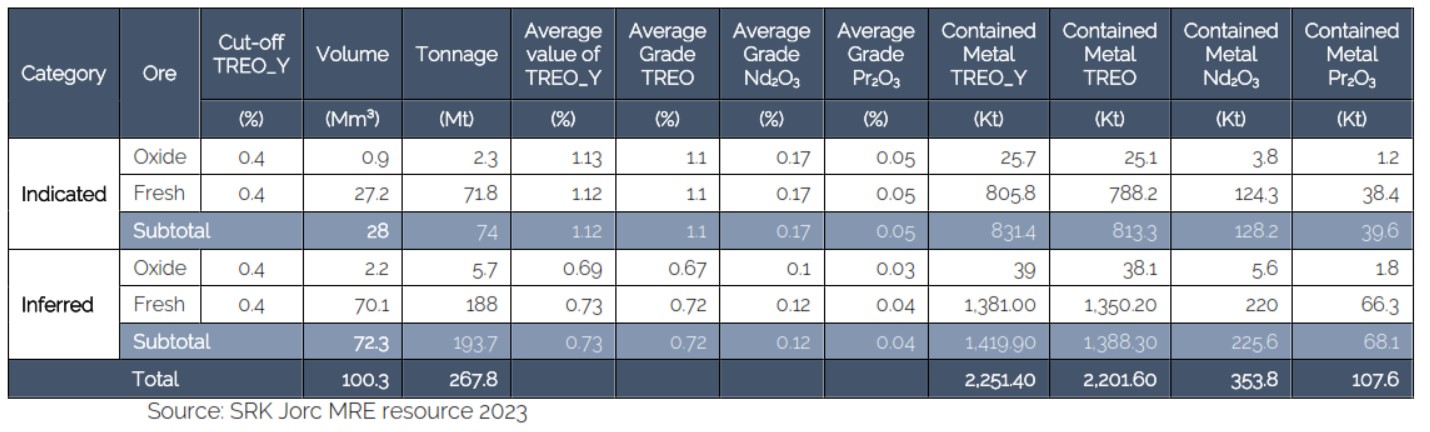
Mineral resource summary, calculated at 0.4% total rare earth oxides plus yttrium oxide (TREO-Y) cut-off.
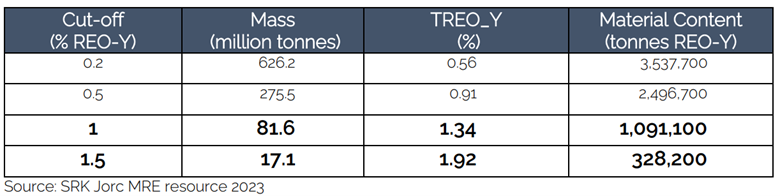
Block model tonnage-grade summary (at 0.2 to 1.5% TREO cut-off grades).
Parabellum entered into an agreement with Temarise Limited (UK) that holds the exclusive option to acquire 80% of the Khotgor Project. Parabellum now holds 30% of the fully diluted issued capital in Temerise, after paying $A3,900,000 across four tranches, that completed in January 2023.
The results reported from this latest MRE continue to demonstrate the large scale and attractive grade of the Khotgor Project. This marks a very positive development in the company’s plans to finalise the initial scoping study due in Q2, 2023 and subsequently move into the definitive feasibility study (DFS) stage of the project.
Further to this, the company is undertaking environmental survey work and further metallurgical studies that are ongoing through the first half of 2023.
Who’s at the helm?
Parabellum chair Mark Hohnen and executive director Peter Secker together bring more than 80 years of uranium, lithium and critical mineral experience to Parabellum — expertise that will come in handy as the explorer considers its development pathways at Khotgor.
Hohnen is an industry veteran who chaired Bacanora Lithium PLC until the Ganfeng Lithium takeover in 2021. Beyond his work at Parabellum, he’s also the non-executive chair at Cameroon bauxite player Canyon Resources Ltd (ASX:CAY).
It’s still early days at Khotgor, but Hohnen continues to be very impressed with the work to date at the Mongolian rare earths play. And with metallurgical test-work, resource modelling, engineering studies and pilot plant construction on the cards, there’s more news to come in 2023.
“We look forward to presenting further project updates over the next few months,” Hohnen told the market this week.

By his side is executive director Peter Secker, who’s developed and operated greenfield projects in Australia, China, Africa, Canada and Mexico.
Secker’s worked with multiple commodities, including lithium, titanium, copper, gold and iron ore, but this marks his first foray into the world of rare earths.
Like Hohnen, he hails from Bacanora Lithium, where he served as CEO and was instrumental in guiding the company through the £285 million Ganfeng takeover.
“Developing very large, long-life projects is something I enjoy very much. Khotgor will be my fifth green fields development in 40 years,” Secker explained.
“The MRE has demonstrated that we have a long-life resource that contains large tonnages of NdPr and this dovetails very well with the metallurgical test work we released late last year, which shows good rare earth oxide recoveries into concentrates and carbonates.”
A closer look at Khotgor
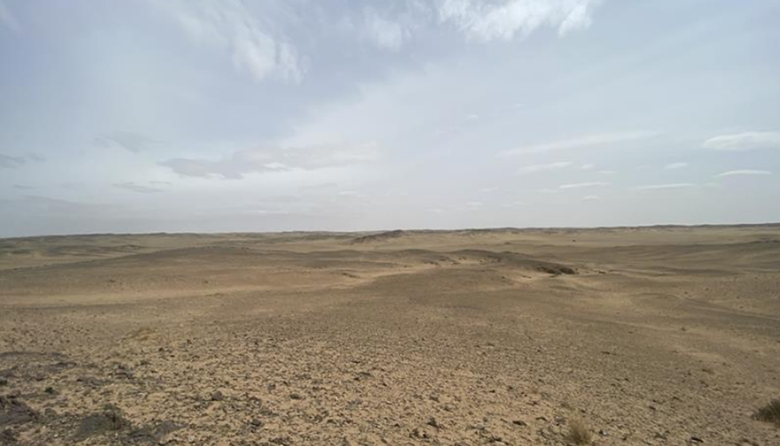
Khotgor REE Project landscape.
The Khotgor REE project is situated some 500 kilometres south of Ulan Bataar in the south Gobi region of Mongolia.
The project was initially discovered in the 1970s, well before rare earths’ strategic significance in powerful magnets was understood.
Secker’s excitement over the project is well-founded, given the asset is close to globally significant operations (including Rio Tinto's Oyu Tolgoi copper mine), and is just 300 kilometres from the Chinese border — the world's largest REE market.
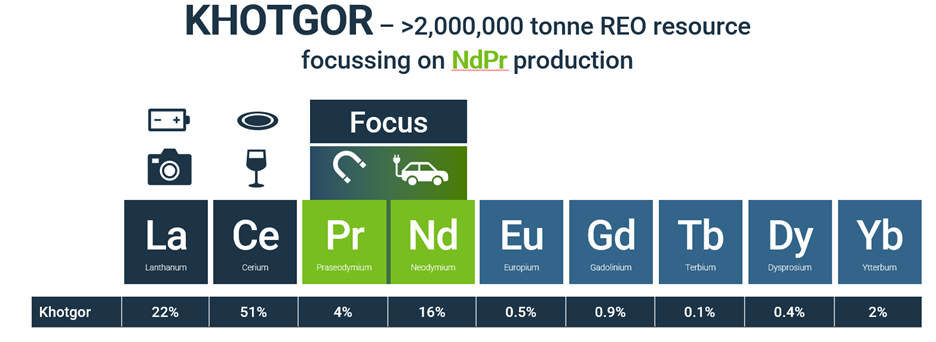
Favourable mineral suite focused on NdPr.
Parabellum has spent about A$4 million on the project to date (on top of A$15 million spent by previous owners) and is currently finalising its engineering scoping study, relying on the experience of Australian engineering firms Primero, SRK and ALS.
The company also has a small trial pilot processing plant under construction in Ulan Bataar that’s piqued to enter operation in Q1, 2023.
So, how does it all tie together? Parabellum’s plan is to design a full-scale mine and processing plant at Khotgor, which will produce an intermediate carbonate product that will be sold for third party processing.
From there, when the project enters production in 2024/5, Parabellum believes it’ll be ready to supply a significant market share of global NdPr demand.
Secker continued: “Because there is a significant amount of data already available and we have been working on the project for the past two years, we are working towards a fast-track development that will get us to a feed engineering stage by end 2024.”
It’s important to know that the Khotgor story doesn’t stop at rare earths: the company has also identified several potentially useful compounds beyond the scope of this resource estimate.
One example is some 5.5-million-tonnes of phosphorus pentoxide, which will be evaluated as a possible fertiliser product at the DFS stage and followed up in future studies.
Why rare earths?
In 2022, Adamas Intelligence calculated that US$3.8 billion worth of magnet rare earth oxides were consumed globally for energy-transition-related applications, including EV traction motors and wind power generators.
Adamas noted that the total value of rare earth oxides consumed for the energy transition each year quadrupled between 2020 and 2022.
Specifically, from 2022 through 2035, Adamas forecasts that the value of rare earth oxides consumed by energy-transition-related applications will rise at a compound annual growth rate of 19.1%, moving from US$3.8 billion in 2022 to US$36.2 billion in 2035.
Most importantly for Parabellum, Adamas expects NdPr consumption value to see the greatest rise over the forecast period, increasing 11-fold by 2035.
The value of rare earth oxides (#REO) consumed by #EnergyTransition applications will rise at a CAGR of 19% by 2035 led by #EV's (50%) and #windturbine's (25%). @ParabellumRes developing #Khotgor #REE project to produce #NdPrhttps://t.co/kTiG8eq96U
— ParabellumRes (@ParabellumRes) February 6, 2023
The two key drivers of NdPr demand (and thus rare earths consumption) will be for permanent magnets used in EVs and wind turbines.
UBS expects EVs to comprise about 50% of new car sales by 2030 at an estimated 45 million units (compared to 7.8 million today).
This will have a significant knock-off effect on rare earths demand, as a typical EV uses about 1.2 kilograms of NdPr.
For wind turbines, rare earths such as NdPr are used to make the powerful permanent magnets found in the turbines' generators which are essential for converting the rotational energy of the wind into electrical energy.
The growing number of wind turbines is leading to an increased demand for rare earths, given that a 3-megawatt wind turbine consumes close to two tonnes of REE magnets.
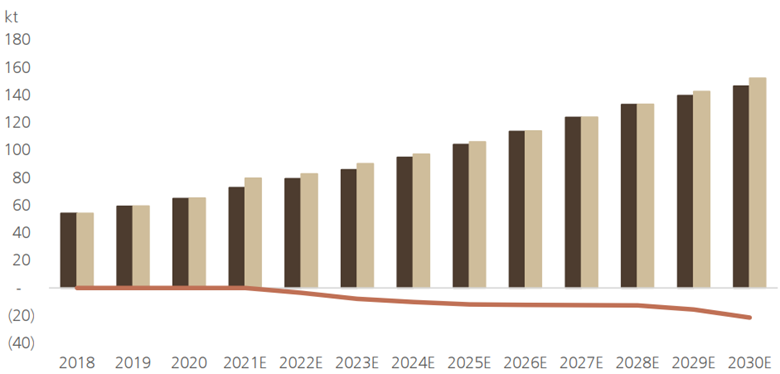
NdPr supply-demand balance (Source: Company filings, UBS).
Rare earths supply is dominated by China, with the country responsible for about 65% of primary supply and about 90% of global processing capacity, according to UBS.
In turn, China’s dominance has sparked raft of government initiatives from major mineral movers, including the US and Australia, to help boost rare earth supply chains and production outside the superpower.
Secker added: “As the world moves into a better understanding that renewable energy is a fact rather than a dream, the NdPr rare earths are going to be a critical part of the renewables supply chain for wind turbine magnets and electric vehicles.”
Beyond REEs: copper and gold in NSW
Alongside its REE opportunity in Mongolia, Parabellum is also advancing four copper-gold projects in New South Wales — the Redlands/Whitbarrow, Recovery, Lunns Dam and Obley assets.
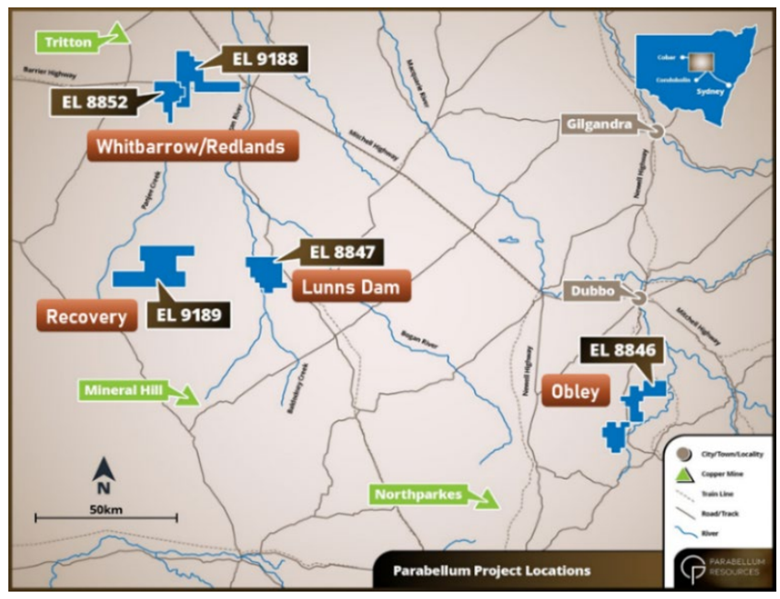
Projects in New South Wales.
A ground electromagnetic program continues across the projects, and once completed, the final modelling and interpretation will help rank targets for drill testing.
In this vein, Parabellum is already engaging with three drilling companies that have active programs in the region. The company will provide an update as it readies for next steps.
Big-picture, Secker says Parabellum will continue to push the battery metals theme down under, with the copper focus in New South Wales to complement the hunt for rare earths in Mongolia.