
Castillo Copper Ltd (ASX:CCZ, LSE:CCZ) has lifted confidence in the shallow, clay-hosted rare earths potential of the BHA Project’s East Zone near Broken Hill in Far West New South Wales with strong diamond core assays.
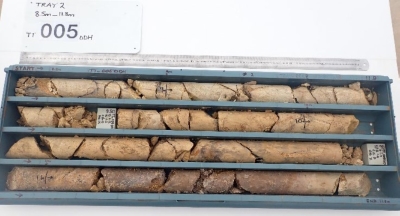
Diamond hole TT_005DD at the Tors Tank Project has provided the most encouragement, returning 13 metres at 1,550ppm total rare earth oxides (TREO) from just 5 metres.
Impressively, the content of high-value, in-demand magnetic rare earth oxides (MREO) was 38.9% of the TREO grade compared to the peer average of 25%.
Also, re-assays of 4-metre composite samples at the Tors Tank and Fence Gossan prospects in the centre of East Zone to 1-metre have provided greater clarity on the underlying geology as well as delivering further evidence of an extensive, shallow REE system.
Confidence boosted
Castillo Copper’s MD Dr Dennis Jensen said: “The board is delighted with the latest results, especially the diamond core assay at Tors Tank and exceptional MREO value, as it increases confidence in the underlying REE system.”
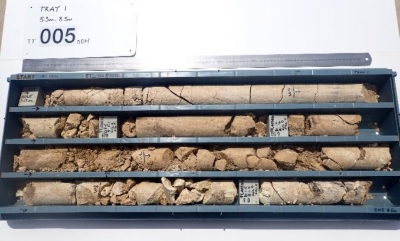
ABOVE and BELOW: Tors Tank diamond core from 5.3 to 11.8 metres.
Re-assays provide evidence
The best intercepts from the re-assaying in parts per million (ppm) include:
- 17 metres at 1,605ppm TREO from 2 metres and 1-metre at 3,236ppm from 19 metres;
- 10 metres at 1,013ppm from 49 metres;
- 6 metres at 1,480ppm from 7 metres;
- 5 metres at 1,598ppm from 14 metres;
- 4 metres at 1,342ppm from 28 metres; and
- 2 metres at 3,491ppm from 7 metres.
Interpreting the re-assays provides clearer evidence there is an extensive, shallow REE mineralisation system across the centre of the BHA Project’s East Zone.
“A treasure trove”
Another encouraging outcome for Castillo Copper has been the assays for around 70% of the recent hand auger surface sampling campaign across Fence Gossan that have delineated a 4.5 square kilometre anomalous area for REE mineralisation.
Even better, a preliminary interpretation suggests there are several more prime targets to test-drill that could potentially extend known mineralisation between Fence Gossan and Tors Tank prospects.
“The hand auger surface sampling campaign is proving to be a treasure trove of insights, with several new targets now on the radar,” Jensen said.
"The board looks forward to receiving the remaining assays and charting the next phase of the exploration campaign.”
So far, for Fence Gossan Prospect, around 70% of the hand auger surface sampling assays have been returned.
Surface readings indicate anomalous areas to the south, southwest and northwest of the four recent cobalt-focused Fence Gossan drill holes which suggest possible higher mineralisation in these zones than identified in the holes.
Likely indicator
Having reconciled these findings and performed a statistical analysis, CCZ’s geology team believes surface sample readings with cerium >100ppm is a likely indicator of higher-grade REE mineralisation at depth.
As such, these are interpreted to be prime targets for test-drilling that could extend known mineralisation between the Tors Tank and Fence Gossan prospects.