
C29 Metals Ltd (ASX:C29) is encouraged by a ground gravity survey that has yielded nine prospects at the Mayfield copper-gold exploration project in the Mt Isa inlier in Queensland.
The company completed an extensive ground gravity survey comprising 555 stations covering 68% of EPM 19843 on 200 x 200-metres and 200 x 100-metre grid spacings in Q4 of 2022, noting that results were consistent with recent successful exploration programs in the region.
C29 will now conduct an IP survey to further target its drill program, with drilling expected in the middle of 2023.
"Compelling targets"
“We are very pleased to see the information gathered from our recent gravity survey giving us a high number of compelling targets,” C29 executive director Jeremy King said.
“Until now, Mayfield has not benefited from modern exploration techniques. C29’s technical team will now use this data to design Induced Polarisation (IP) programs over the higher-ranked targets.
"IP has proved very successful as a drill targeting tool in the region, and this will allow detailed drill hole planning and execution toward the middle of this calendar year.”
Nine gravity targets defined
Having finished its high-quality, high-resolution gravity survey, along with subsequent processing and interpretation, C29 delineated nine gravity targets, which, when combined with other data sets such as geochemistry, magnetics and geology, have been ranked in order of prospectivity.
The Cloncurry district is renowned for iron oxide copper-gold (IOCG) mineralisation, however, the mineralisation present is highly diverse, with a number of deposit styles present, including IOCG, iron sulphide copper-gold (ISCG), Broken Hill type (BHT), sedex, skarn and intrusion-related copper-molybdenum.
A common feature of these deposit types is the presence of positive gravity anomalies due to the metal content and therefore density of the mineralised rocks. Given this information, C29 is encouraged by the presence of these gravity anomalies at Mayfield.
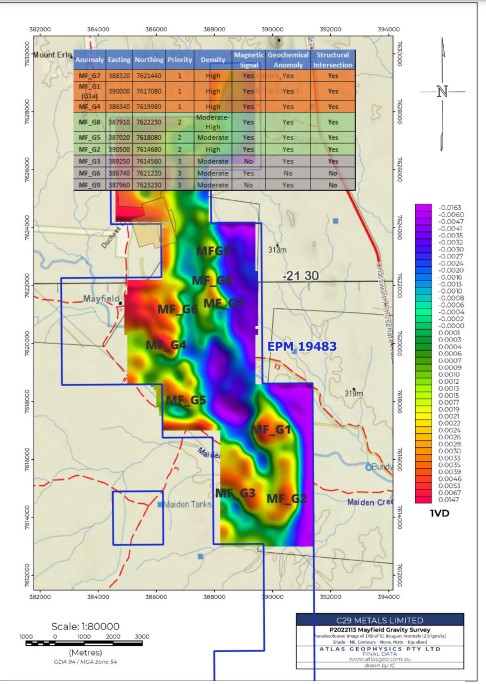
Mayfield gravity survey and resulting anomalies.
What’s next?
C29 will utilise this data to design suitable IP programs over the higher-ranked targets.
IP is useful in identifying chargeable sulphide zone and resistive siliceous zones, both of which are key mineralisation indicators.
Once the IP is complete, C29 will turn its attention to designing well-targeted drilling programs.