
AuKing Mining Ltd (ASX:AKN) is set to hit the ground running at the recently acquired Manyoni Uranium Project in central Tanzania as it puts the advanced project on a path to near-term production.
Plans include 2,000 metres of near-surface drilling aimed at upgrading the historical JORC 2004 mineral resource estimate (MRE) of 92 million tonnes at a 100ppm cut-off containing 29 million pounds of U3O8 to JORC 2012 standard.
The company plans to kick-off exploration as soon as the wet season eases and expects this to be next month.
AuKing recently completed the acquisition of a 100% interest in five prospecting licence areas at Mayoni with its holdings incorporating almost all the historical estimated 2010 uranium resources.
Potential near-term production
CEO Paul Williams said that Manyoni had the potential to be a near-term uranium production asset for the company.
“We can take advantage of the substantial amount of previous exploration and drilling at Manyoni in order to increase overall resources and place the project in a position to commence development studies later in 2023,” he said.
“Manyoni is already a significant near-surface uranium resource situated only 100 kilometres west of the major central-Tanzanian city of Dodoma. Our first program is due to commence in March and we cannot wait to get started,” he said.
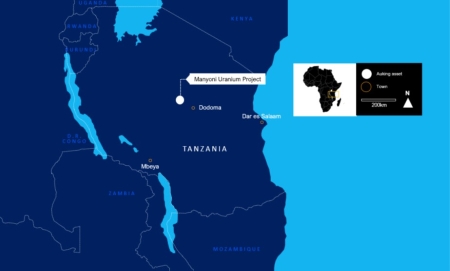
Manyoni Project location.
Previous exploration
The areas now owned by AuKing were previously held by Uranex (ASX:UNX) NL (UNX), which is now Magnis Energy Technologies Ltd (ASX:MNS, OTCQX:MNSEF).
Manyoni had been the focus of UNX activities from the early 2000s until 2013. The Fukushima disaster in 2011 had a dramatic impact on the uranium market and UNX’s apparent focus turned to graphite interests in the region.
The uranium deposits discovered at Manyoni to date are shallow, generally less than 10 metres deep. To date several individual uranium bearing playa lakes/project areas also referred to as Mbugas have been identified through exploration.
IAEA classification
Manyoni deposit is classed in the IAEA (International Atomic Energy Agency) classification of uranium deposits as a surficial deposit; surficial deposits typically vary in size and generally contain low-grade uranium.
Surficial uranium deposits were formed in the Tertiary and Recent where uranium-rich granites were deeply weathered in a semi-arid to arid climate. The uranium mineralisation is often associated with fine-grained surficial sand and clay.
AuKing is looking to take advantage of the previous work completed by UNX, including the June 2010 updated MRE, prepared by Hellman & Schofield.
This was based on more than 25,000 metres of combined pit and trench sampling and auger, aircore, RAB (rotary air blast), RC (reverse circulation) and sonic core drill holes.
The MRE for Manyoni was initially reported to ASX on June 30, 2010, by UNX. Accordingly, this was prepared in accordance with the JORC 2004 reporting standards.
A competent person hasn’t done sufficient work to classify the MRE as mineral resources in accordance with the JORC Code (2012).
It is uncertain that further work/evaluation will enable the resources to be reported as mineral resources in accordance with the JORC Code (2012).
Detailed program
AuKing’s exploration team is finalising a detailed drilling and exploration program that will begin as soon as the wet season eases and drilling rigs can be deployed – expected during the course of March.
An estimated 6-8 week drilling program with 2,000 metres of combined aircore, RC and sonic core drilling is proposed.
The intention is to test the potential for resource expansion in area outside and below the existing resource as well as to validate the historical results and previous metallurgical results.
AuKing hopes this work will provide a platform for fast-tracking development at Manyoni, supported by existing personnel with in-country expertise and assuming the results from the drilling program provide a sound basis for an updated MRE.
Samples will be collected from the AuKing drilling program for the purpose of conducting further metallurgical tests, not only to clarify historic recoveries but also to apply the latest metallurgical techniques that have been developed for uranium deposits over the past 15 years.
The location of the project near Dodoma in central Tanzania and near-surface mineralisation are key attributes that remove development hurdles experienced elsewhere.