
Frontier Energy Ltd (ASX:FHE) has found a way to curb costs on its stage one solar farm at the Bristol Springs Green Hydrogen Project in Western Australia ahead of a pivotal definitive feasibility study (DFS).
The energy stock could save up to A$9.5 million if it relocates a point of connection to the Landwehr power terminal — a move that would materially decrease the A$166 million capital cost estimate outlined in a 2022 pre-feasibility study.
The 114-megawatt solar scheme is an important part of Frontier’s green hydrogen project. Once it comes online, the asset promises to be one of Australia’s lowest-cost green hydrogen assets, with an early-mover advantage to boot.
Work on Bristol Springs comes as the WA Government continues to roll out decarbonisation targets, meaning there’s increasing focus on green energy projects that can tie in with the grid.
Collective push for green energy
Amid global inflation and supply chain pressures, Frontier managing director Sam Lee Mohan said it was pleasing to find ways to curb capital expenditure.
“This should ensure we do not see a cost blowout for the 114-megawatt solar farm when the DFS is completed in March 2023,” he explained.
Mohan went on to say that the WA Government’s focus on decarbonisation was an important context for the optimisation work.
“Recent moves include planned legislation for net-zero by 2050, 2030 gas emissions reduction target of 80% (compared to 2020) for all government agencies and potentially most important for our project, the government is targeting 1% of the state’s electricity generation to be powered by green hydrogen,” he clarified.
“These policy positions are progressive for the industry as a whole and we will continue working with government to ensure that timing for implementation does not slip.
“These targets and commitments continue to enhance the project’s strategic importance, given that it is the only major renewable energy project (scalable to +1 gigawatt) that also connects to the unconstrained 330-kilovolt terminal and lines while being adjacent to the Dampier to Bunbury Gas Pipeline,” Mohan concluded.
How will Frontier curb costs?
Ahead of the March DFS release, Frontier engaged Aussie engineering firm Incite Energy to provide an optimised concept design for the stage one solar project’s transmission line route and substation.
Incite previously completed front-end engineering design (FEED) work for the 114-megawatt project and it concluded that moving the point of connection to the Landwehr power terminal would save around 5 kilometres of power lines.
Thanks to the compacted distance (and the reduced infrastructure requirements), Frontier can practically halve the A$19.1 million pre-feasibility cost estimate earmarked to connect the power terminal.
Incite is reviewing and finalising all capital estimates for the Bristol Springs solar project, meaning they will underpin the outcomes in the March DFS.
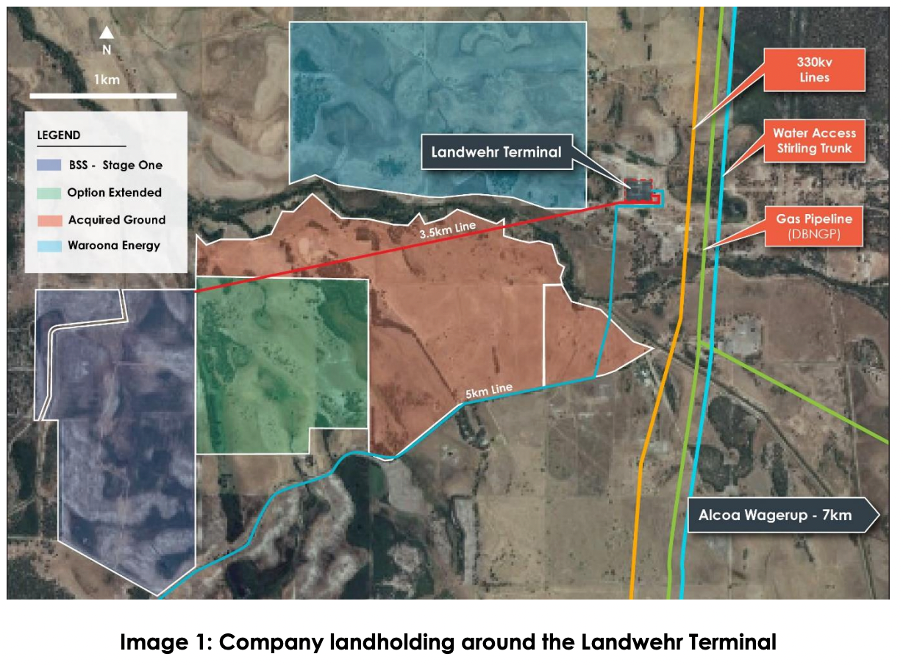
Landwehr “a major differentiator”
The Landwehr terminal may be crucial to optimising costs, but Frontier also believes this key piece of infrastructure will help it stand out from the competition.
Landwehr connects to the WA electricity grid (the South West Interconnected System (SWIS)) and Frontier secured one of only two remaining connections at the power terminal.
The other connecter is Waroona Energy Pty Ltd, which struck up an agreement with Frontier in October last year and vowed to collaborate on renewable energy production.
Landwehr is connected to 330-kilovolt transmission lines — the largest of their kind in WA — that links Perth and Collie, historically the major source of energy generation for the SWIS.
What’s more, the connection to Landwehr allows for periods of unused daytime power to be sold into the balancing market or to a consumer via a power purchase agreement.
This means that Bristol Springs can use the grid as a virtual battery, ensuring a stable supply of electricity during low energy production periods (such as nighttime).