
PNX Metals Ltd (ASX:PNX) has found ‘large geochemical anomalism’ after it collected numerous high-grade surface gold samples during an assessment of the northern leases of its Burnside exploration project in the Northern Territory.
These leases cover a 20-square-kilometre area of the project. Burnside forms part of the broader Pine Creek region, which hosts a gold endowment in excess of 20 million ounces.
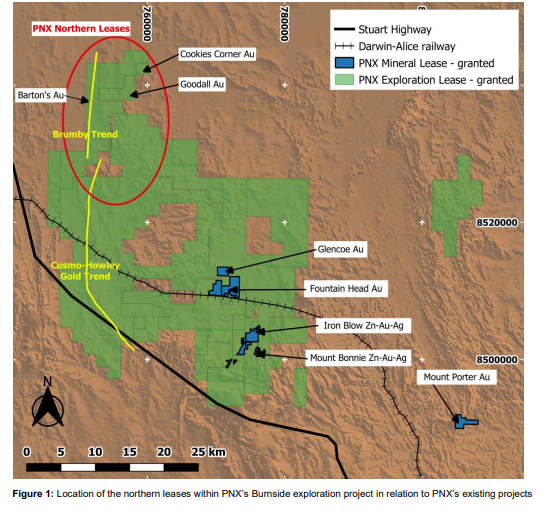
Essentially untested gold corridors
PNX’s assessments highlight that large parts of the northern leases remain essentially untested despite being adjacent to existing gold deposits and potentially highly prospective for economic gold mineralisation.
Most of the regional exploration in the Burnside area took place between the late 1980s and early 2000s when low gold prices prevailed.
These areas can be found, along with PNX’s Fountain Head and Hayes Creek zinc, gold and silver projects, in the Pine Creek region of the NT, roughly 170 kilometres from Darwin.
The company’s field mapping and high-grade surface rock chip sampling campaign supports a ‘strong discovery potential’, with multiple high-priority gold targets across kilometre-scale gold corridors found on these northern exploration leases.
PNX hopes to discover and delineate additional standalone gold deposits that can be processed through its proposed Fountain Head Plant.
Highlights
During reconnaissance of these areas late last year, PNX collected 114 rock chip samples from outcrop returning numerous high-grade gold values.
The results highlight two north-south corridors – Brumby and C6 – with very strong surface and historical drilling gold results that have been prioritised for follow-up.
High-grade gold results from Brumy samples include 11.6 g/t, 11.2 g/t, 24.3 g/t and 25.0 g/t. The company also fielded 8 metres at 6.16 g/t gold from surface, including 2 metres at 18.90 g/t from 4 metres.
At the C6 prospect, PNX welcomed results including 6.1 g/t, 25 g/t, 24.33 g/t and 3 metres at 5.6 g/t gold from 10 metres, including 1-metre at 12.6 g/t from 10 metres.
“The high-grade gold in rock chips being reported and assessment of historic data, highlight the potential for further discovery of economically significant gold mineralisation within our existing exploration leases,” managing director James Fox said.
“Away from the known deposits, historic mines and prospects, minimal exploration has taken place. We look forward to drill testing these prospective ‘gold’ corridors early in 2023, after the NT wet season, and continuing to define other targets in our Pine Creek land package.”
Proposed follow-up
Next up, PNX plans aircore drilling across these prospective gold corridors, 3D modelling of historical drill results and integration with field data.
Beyond the two high-priority corridors, PNX will continue exploring the remainder of its northern leases by compiling and digitising further historical exploration reports and integrating this information with field mapping and targeted sampling of high-priority areas.
This is expected to continue through the wet season depending on access.