
Future Metals NL (ASX:FME, AIM:FME) has made a breakthrough at the Panton Project with bulk ore sorting and flotation optimisation and repeatability test work demonstrating strong platinum group metals (PGM) recoveries.
The results provide encouragement as they represent de-risking for future mining and processing of the 6.9-million-ounce palladium-equivalent JORC resource.
They also provide a credible path towards developing a low-capital, high-margin PGM-nickel operation.

Positive test results
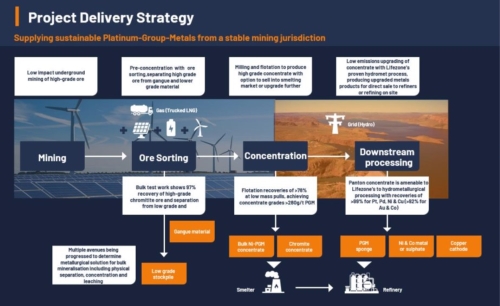
Flotation repeatability was achieved through conventional crushing, grinding and flotation processing techniques with the tests resulting in PGM recoveries averaging 78% at concentrate grades averaging 286 g/t PGM3E from the high-grade PGM chromitite ore.
This material makes up 2.9 million ounces of the 5-million-ounce PGM3E contained in the JORC resource at Panton.
Bulk ore sorting test work demonstrated 97% recovery of high-grade PGM-bearing ore and rejection of low-grade material and waste, improving mill feed grade by 11% and reducing mass by 13%.
“Credible metallurgical solution”
Future Metals managing director Jardee Kininmonth said: “We have now demonstrated a credible metallurgical solution which places Panton firmly on the development pathway.
"Panton is the highest grade PGM deposit in Australia, enabling us to progress a low capital and high margin operation with significant growth upside.”
Amenability to ore sorting and consistency of flotation performance significantly de-risk Panton’s future development.
“Strong recoveries”
"Optimisation and variability flotation test work has demonstrated highly repeatable results with strong recoveries at high concentrate grades,” Kininmonth said.
"The ore sorting results are significant, as it is the key to increasing mineable tonnes while ensuring the ore reporting to the mill is high grade.
"This allows for increased economies of scale within the mine, utilising conventional underground mining methods, while decreasing processing plant capital costs by increasing the grade of the mill feed, with negligible losses of high-grade ore."
Adopting innovation
Future Metals has been investigating options to de-risk and improve Panton development economics through innovation and recent technological improvements.
One pathway is the rejection of waste early in the comminution process via ore sorting, technology that has been used in the PGM and chromite mining industry for more than 10 years.
The technology classifies and separates individual rocks by their physical and chemical properties. By removing gangue and low-grade ore, the size of the crushing, milling and flotation equipment can be optimised.
Reducing the process plant throughput rate while increasing grade provides direct savings in capital and operating costs. Ore sorting also reduces the impact of dilution allowing for the use of conventional mining equipment, further driving down operating costs.
Reductions in mining & process operating costs allows the mining cut-off grade to be optimised and the viable mining inventory to be potentially increased.
Sighter test work
The company has performed sighter and bulk test work with Steinert Sorting Solutions. The sighter tests involved a three-stage separation process applied to a mixed feed of chromitite, magnesite and dunite.
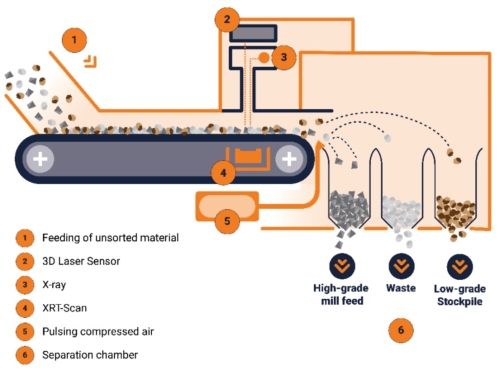
Steinert KSS XT CLI Ore Sorter.
Greater than 95% chromitite recovery was achieved during the first pass, using an x-ray transmission (XRT) 3D-laser combination sort program, due to the chromitite being substantially higher in atomic density.
100% of magnesite was recovered during the second pass, using an XRT-3D combination (due to magnesite’s lower atomic density) and laser brightness (due to the high colour contrast between magnesite and the other materials).
Following the success of this work, a bulk test was completed, which involved compositing separate chromitite and dunite samples to replicate the expected feed mix from a mine stope.
The bulk ore sort test work validated the sighter test work on multiple size fractions, demonstrating 96.7% recovery of high-grade ore and rejection of low-grade and waste, increasing the PGM grade of the potential mill feed by 10.7% and reducing the throughput volume by 12.7%.
This is a positive result early into the test work process and the company is planning follow-up work which will involve further optimisation, variability and repeatability testing.
Downstream integration option
Future Metals has also started scoping study and test work evaluation with PGM downstream processing technology providers.
Previous test work on Panton concentrate has demonstrated recoveries of 99%+ for a majority of metals in the concentrate.
These processes produce upgraded metals products for direct sale to refineries, or refining on site, improving payabilities, reducing logistics costs and reducing emissions relative to the smelting process route.
Initial assessment of the Lifezone Metals Ltd hydrometallurgy (hydromet) technology suggests that this would be a low capital flow sheet addition with significant operating and economic benefits.
Low-capital option
"Additionally, we have been progressing discussions with potential technology partners to assess a low-capital downstream integration option at Panton,” Kininmonth said.
"Downstream integration enables the production of high margin metals products while also significantly decreasing the emissions profile associated with those products, thereby differentiating Panton from the majority of South African and Russia producers which use coal-fired power and generate other emissions such as sulphur dioxide.
"Downstream processing also closely aligns Panton with the Australian Government’s critical minerals strategy which incentivises onshore upgrading and development of strategically important deposits such as Panton.”