
- FTSE 100 finishes 29 points lower
- US stocks remain mixed after data
- UK Q4 growth stalls but recession avoided
4.45pm: FTSE lower on broad market pullback
The FTSE 100 couldn't hold onto its record gains from earlier in the week, finishing 0.4% lower at 7,882 points.
The index was unable to escape the enveloping gloom seen across most indices this week, according to IG's Chris Beauchamp.
"Caught between a strong payrolls report and next week’s US CPI reading, which has been the only piece of economic data worth watching of late, most stock markets have struggled to make headway this week. The FTSE 100, and other European markets, have had a rollicking start to the year, but it looks time to hand back some of those gains as economic pessimism rises again.”
3.55pm: Superbowl Sunday
As this Sunday brings Super Bowl LVII, it is time to revist the Super Bowl Indicator, a nonscientific barometer of the stock market.
The idea behind the indicator is that a Super Bowl win for an NFL American Football Conference (AFC) team predicts a stock market decline (a bear market) in the next year. On the other hand, a win for a team from the National Football Conference (NFC) foretells a rise in the market or a bull run in the upcoming year.
Leonard Koppett, a sportswriter for The New York Times, first introduced the Super Bowl Indicator in 1978. Up until that point, the Super Bowl Indicator had never been wrong.
At one point in time, the Super Bowl Indicator boasted a more than 90% success rate in predicting the up-or-down outcome of the S&P 500 before the dotcom years (1998-2001). As of the end of 2022, the indicator has been correct 41 out of 56 times, as measured by the S&P 500 Index. This is a success rate of around 73%.
Super Bowl LVII will be played at the State Farm Stadium, Glendale, Arizona on Sunday, 12 February 2023, between the AFC champions Kansas City Chiefs and the NFC champions Philadelphia Eagles, with kick-off at 4.30pm MST/11.30pm GMT.
3.35pm: Michigan confidence rises
Wall Street turned mixed again after the University of Michigan's latest consumer confidence index rose from a reading of 64.9 in January to 66.4 for mid-February. The consensus had been for a reading of 65.1.
However, Joanne Jsu, the survey's director, described attitudes among consumers as "mixed" and short-term inflation expectations rose.
"Overall, high prices continue to weigh on consumers despite the recent moderation in inflation, and sentiment remains more than 22% below its historical average since 1978," Hsu said.
Around an hour after the US market opened, the Dow Jones Industrial Average was up 80 points, or 0.3% at 33,6780, while the S&P 500 added 0.2% but the Nasdaq Composite had shed 0.4%.
Around 3.30pm, the FTSE 100 index was 41 points, or 0.5% lower at 7,861, having reached all-time closing and intra-day highs on Thursday.
3.25pm: Not so Co-operative
The Co-operative Group has said it is aware of an over £450mln ($545mln) legal claim issued by the liquidators of The Food Retailer Operations Limited which it is disputing, Reuters has reported.
The Co-op, which is owned by its members, and operates Britain's seventh largest supermarket chain as well as funeral, insurance and legal services, said the claim was in connection with transactions in 2015 and 2016 relating to the Somerfield supermarket business it acquired in 2009.
"Co-op strongly disputes both liability and quantum of the claim and the claim will be vigorously defended," it said in a statement, Reuters noted.
2.55pm: Dull US Friday start
The FTSE 100 index headed back towards session lows as US stocks kicked off the last day of the trading week lower amid recurring concerns over Federal Reserve interest rate hike momentum and disappointing corporate earnings.
Around 20 minutes after the US market opened, the Dow Jones Industrial Average was down 42 points. or 0.1% at 33,692 points, while the S&P 500 was down 0.5% and the Nasdaq Composite had shed 0.9%.
Noting that equity markets were ending the week on a flat or slightly downbeat note, which largely reflected the mood all week, OANDA senior market analyst Craig Erlam said: “Central bankers, particularly from the Fed, have been out in force stressing caution over interest rate expectations and it's clearly had an impact following that red-hot jobs report last week."
“Markets are now pricing in two more hikes from the Fed and possibly one cut later in the year,” he added.
Around 2.45pm, the FTSE 100 index was down 56 points, or 0.4% at 7,857, having hit all-time closing and intra-day highs on Thursday.
2.25pm: StanChart ahoy
Standard Chartered shares remained around 5% lower at 731p, giving back a chunk of Thursday's gains after First Abu Dhabi Bank’s denials of a bid for the FTSE 100-listed bank, although the UK group's share price has not been this high since 2018.
No smoke without fire seems to be the market’s reasoning and the possibility of a bid will weigh heavy on management when StanChart unveils its full-year/fourth-quarter results next Thursday.
Analysts are looking for a pre-tax profit of US$574mln (compared to US$1.4bn in the third quarter and a loss of US$331mln a year ago), but the focus will be on the bad debt line.
In October, StanChart mildly spooked its backers by doubling its provisions to US$227mln with US$130mln of that in China, where the Asia-focused bank has some US$3.5bn of exposure to an embattled property sector.
China’s easing of Covid restrictions recently might be of help, but the market will want confirmation and also that the punchy (upgraded) forecast of 13% income growth this year is still intact.
For 2022 as a whole, profits of US$4.7bn, compared to US$3.3bn, is the consensus and US$5bn on an underlying basis.
2.10pm: Net gain for the week
Another big gainer was NetScientific PLC, which added another 20% to 79.30p on Friday, bringing total returns for the week above 30%.
The rally comes in a week that saw NetScientific portfolio company PDS Biotechnology Corporation announce that preclinical studies on its investigational platform Infectimune showed that Infectimune can generate a broad immune response against viruses such as SARS-CoV-2 and influenza.
Results were published in the Viruses peer-reviewed journal.
1.30pm: Some of today’s fallers and risers in London
Fallers
Itim Group - down 27% to 35p Shares shrank as the group said revenues for the financial year ending December 31, 2022, are expected to be in line with expectations, however underlying EBITDA is expected to be a disappointing £200,000 compared to £2.2mln in 2021.
Risers
Nostrum Oil & Gas - up 30% to 3.2p The stock jumped after the oil and gas company said 150mln shares have been admitted to the London Stock Exchange as part of its restructuring.
Pantheon Resources - up 6% to 56.7p Jay Cheatham, chief executive of Pantheon Resources, said he is confident that the company’s Alkaid #2 well on Alaska’s North Slope will prove a commercial success, despite several ‘niggles’ faced during the well cleanout process.
1.00pm: Further falls seen across the pond
Wall Street is expected to open down as the week draws to a close amid deteriorating sentiment, with investors looking ahead to next week's consumer price index (CPI) inflation report for further direction.
Futures for the Dow Jones Industrial Average (DJIA) fell 0.4% in Friday pre-market trading, while those for the broader S&P 500 index declined 0.6%, and contracts for the Nasdaq-100 shed 1.1%.
US stocks turned around to end weaker on Thursday, weighed down by Nasdaq heavyweight Alphabet following a failed demonstration by its AI chatbot Bard AI, and as more Fed officials re-emphasised the need for interest rates to go higher.
The DJIA closed 0.7% down at 33,670, the Nasdaq Composite lost 1%, to 11,790, and the S&P 500 dropped 0.9% to 4,082.
“US stocks kicked off Thursday session on a positive note, but sentiment rapidly soured as the Fed hawks didn’t let the bulls enjoy gains,” commented Ipek Ozkardeskaya, senior analyst at Swissquote Bank.
“Topsellers will likely remain in charge of the market on the possibility that maybe inflation in the US may have not eased to 6.2% as expected by analysts. But nothing is clear before next Tuesday’s CPI release, in terms of Fed expectations,” she added.
The CPI data, due out on February 14, is expected to show headline inflation for January easing further from the 6.6% annual increase registered in December. Headline inflation is expected to show a month-over-month rate of 0.5%.
“For now, there is rising will to believe that the Fed will continue hiking the rates. If inflation numbers don’t show the easing expected, that willpower will get even stronger, and could result in a sharp pullback in the equity rally,” Ozkardeskaya said.
Ahead of the US open, the FTSE 100 was close to session lows at 7,858.29, down 52.86 points, or 0.67%.
12.35pm: Holidaymakers face car hire price hikes - Which?
UK holidaymakers heading overseas this Easter will typically have to fork out 72% more to hire a car than they did just before the Covid pandemic, a report has shown.
The consumer group Which? said the hire cost in some holiday hotspots would be double what it was in 2019.
The big rises have been blamed on a series of factors, many of them linked to Covid and its fallout.
The cost of car hire rose sharply last year and has stayed high as global shortages mean rental companies have been paying more for new vehicles. Many had sold off much of their stock of cars during the pandemic as demand collapsed.
Which? said that while companies had now had an opportunity to begin restocking their fleets, rental rates had settled at levels “far higher than travellers were accustomed to pre-pandemic”.
Which? examined data supplied by the car hire broker Zest Car Rental for more than 5,000 rentals in popular holiday destinations including Spain, France, Italy and the US. It found the cost of hiring a car for a week increased by more than £100 in seven out of the nine locations.
Meanwhile, the FTSE 100 remained in reverse gear at 7,859.26, down 51.89 points, or 0.66%.
12.05pm: BP's market cap tops £100bn for first time in three years
The latest rise in BP PLC's (LSE:BP.) share price, up a further 4.1% today, has taken its market value above £100bn for the first time in three years.
At its current level the oil major is valued at £102.50bn as the City continued to react positively to fourth quarter results and strategic plans announced by chief executive Bernard Looney.
The FTSE 100 listed oiler has seen its shares surge 19% since it announced record profits of £23bn on Tuesday with a number of analysts highlighting further potential upside in the share price.
Broker Citi has a 1,000p price target while Deutsche Bank also raised its price target following the results.
BP had planned to cut oil and gas production 40% by 2030 as part of a push into greener energy but on Tuesday said it would now only look to cut production by 25% by 2030.
Shares received a further boost today as oil prices rose strongly. But the gains of BP were not seen in the lead index as a whole which has slid to its worst levels for the day, currently at 7,858.14, down 53.01 points, or 0.67%.
11.30am: UK consumer confidence improves - YouGov
UK consumer confidence has picked up as people show more optimism about their household finances, polling firm YouGov has reported.
Consumer confidence increased by 2.4 points in January, which is the biggest single-month increase since May 2021 with short-term (+5.7) and forward-looking (+10.5) household finance measures seeing significant improvements.
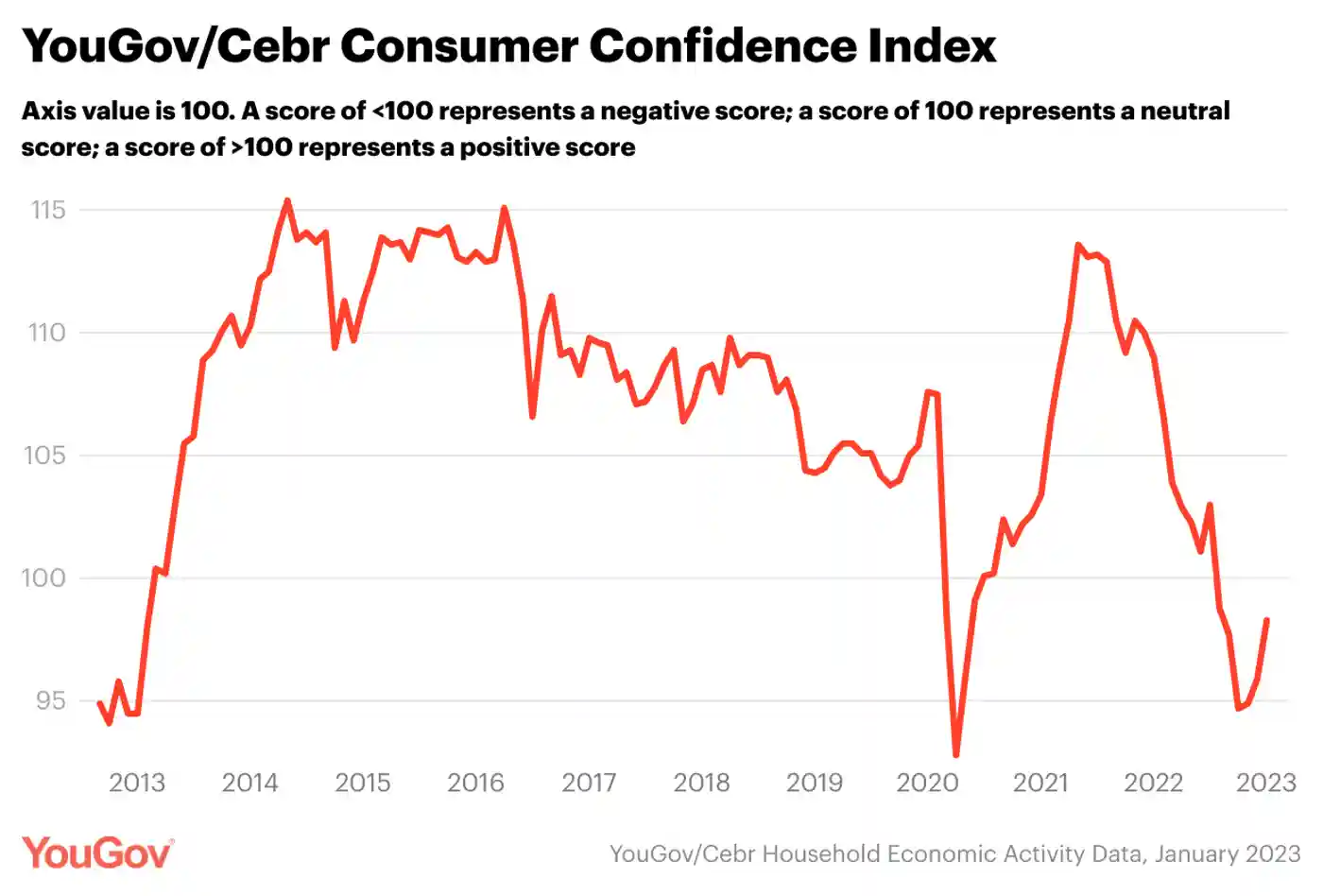
House value measures for the past 30 days (+3.7) and next 12 months (+5.8) also trended upwards but business activity measures for the past 30 days fell by -2.2 points to 106.6, the lowest since February 2021.
Confidence in job security also fell further by 0.7 points.
FTSE 100 has extended its losses, now at 7,858.88, down 52.27 points, or 0.66%.
10.55am: FAB/Standard rumours unlikely to go away
Although Standard Chartered PLC's (LSE:STAN) shares have slipped back after the FAB bid denial, Shore Capital’s banking analyst Gary Greenwood said “this feels like a rumour that is not going to go away easily.”
He remains a fan of the FTSE 100 listed lender and believes it to be “fundamentally cheap, with a standalone fair value of 900p.”
“Speculation that FAB may offer north of £29bn for the group would imply a takeout valuation north of 1,000p,” he calculated.
Unsurprisngly, Greenwood reiterated a 'buy' rating on the stock.
Shares in Standard Chartered have given up some of yesterday's gains, down 4.4%, while the FTSE 100 is currently at 7,875.78, down 35.37 points, or 0.45%.
10.00am: Glencore falls as UBS downgrades
Shares in Glencore PLC (LSE:GLEN) fell 1.2% on Friday as UBS downgraded its rating to 'neutral' from 'buy' although it still prefers the firm to sector peers Rio Tinto Ltd, BHP and Anglo American PLC (LSE:AAL) which are all on the 'sell' list.
The bank kept its target for Glencore at 560p but pointed out that since the start of 2022 the stock is up around 50%, outperforming the diversified miners by around 20%.
“We believe the risk/ reward is now balanced with the weaker near-term thermal coal & cobalt price outlook only part offset by the strength in base metals,” analysts at UBS said.
The Swiss bank's analysts still look favourably on Glencore’s commodity mix medium-term, its restructuring & organic growth options as well as its strong near-term FCF generation/ good capital discipline.
But they remain cautious overall on the mining sector as “we do not expect a material boost to commodity demand from China's reopening due to the structural challenges with China property.”
Shares in Rio Tinto were down 1%, Anglo American fell 0.7% and BHP slipped by 1.1%.
Overall the FTSE 100 is now at its worst levels for the day at 7,880.48, down 30.67, or 0.39%.
9.35am: Solvency II rules could be fast-tracked - reports
The Government is understood to be in talks to speed up the introduction of insurance reforms that would release £100bn for investment after months of clashes over the slow pace of the changes.
The Treasury is in active discussions with the Prudential Regulation Authority and insurers to find ways to quicken the process, sources told the Financial Times.
Officials could look to implement the reforms to the EU's Solvency II rules in two stages, it said.
It would see insurers soon allowed to swap the need to hold bonds for assets such as green technology or housing, with other changes such as reporting requirements implemented more slowly.
Shares in life insurers Aviva PLC (LSE:AV.) and Legal & General PLC were lower in early exchanges reflecting the weaker market mood while the FTSE 100 is now at 7,894.78, down 16.37 points, or 0.21%.
9.30am: Gains in oil majors limit FTSE falls
The FTSE100 is still on the wrong side of the line but index heavyweights, BP PLC (LSE:BP.) and Shell PLC (LSE:SHEL, NYSE:SHEL), are limiting the downside taking the top two positions in the risers in the lead index, up 2.7% and 1.5% respectively.
The gains came as Brent crude futures jumped on Friday after Russia announced its plans to cut output by 500,000 barrels a day in March.
The comments came from Russia’s deputy prime minister Alexander Novak who said the country will cut output by 500,000 barrels from March to boost a “recovery in market relations”.
The unexpected move is a retaliation against the European ban on seaborne imports and price caps for Russian oil products, causing a wave of volatility in oil markets.
The international oil benchmark is now up almost 8% this week, as concerns about tight global supplies come at a time when demand is likely to rebound.
Earlier this week, a crucial oil terminal in Turkey suspended operations due to the recent earthquake, while a key oil field in Norway unexpectedly shut down.
Brent crude is currently up 2.5% at $86.56/barrel with the FTSE 100 now at 7,896.03, down 15.12 points, or 0.19%.
9.00am: FTSE down, but off lows
The Footsie remains in negative territory, but off earlier lows, now at 7,899.15, down 12.00, points, or 0.15% following the UK GDP numbers with Standard Chartered PLC (LSE:STAN) top of the fallers as FAB said it is not evaluating a bid for the London-listed lender.
The Asian-focused bank was also hit by falls in the Hang Seng, which dropped 2%, after a rise in inflation in China unsettled the markets.
Victoria Scholar, head of investment, interactive investor said: “China’s inflation rate jumped to a 3-month high of 2.1% in January versus 1.8% in December but shy of analysts’ expectations for 2.2%.”
She noted “The easing of its Covid restrictions and Lunar New Year celebrations boosted demand and provided a tailwind to prices of both food and non-food items.”
But the 'will they, won’t they' story surrounding FAB was the main driver behind the share price move.
Susannah Streeter, head of money and markets, Hargreaves Lansdown noted FAB has large exposure to commercial real estate debt in China, with related impairment charges chipping away at profit's full potential which may “be part of the reason why FAB is for now steering clear.”
She also suggested “it’s also likely to be down to takeover rules," noting: "After FAB first announced in January it was stepping away from any offer, a six-month cooling off period kicked in, which means it is not meant to do any more deal work.”
There is “clearly is a great deal of speculation that First Abu Dhabi may move again, once the cooling off period ends in July,” Streeter added.
Elsewhere and Saga PLC (LSE:SAGA) rose 3.4% after it confirmed exclusive discussions with Open Insurance Technologies over the sale of its Acromas Insurance business following recent media coverage.
The firm, which offers cruises, package holidays, insurance, and financial services to the over-50s, is looking to pay down its debt pile.
But news of a new CFO at ASOS PLC (LSE:ASC) failed to impress investors and shares in the fashion retailer lost around 2.8%.
Another share on the way down was JD Sports Fashion PLC (LSE:JD.) which dipped 1.2% after Germany's Adidas flagged that it expects a high single-digit decline in sales this year. Analysts had expected a rise of 4% in 2023.
The sports retailer said it is discontinuing the sales of its existing Yeezy stock which could result in a €1.2bn hit this year and a reduction in operating profit of around €500mln.
8.35am: Industrial production improves in December
Industrial production in the UK improved slightly at the end of 2022, data on Friday showed, while manufacturing output stalled, according to the Office for National Statistics (ONS).
According to the ONS, industrial production saw a month-on-month improvement, rising 0.3% in December, after a revised 0.1% increase in November.
"The monthly increase in output resulted from growth in two of the four production sectors, with electricity and gas rising by 5.2% and water supply and sewerage by 0.7%; this was partially offset by mining and quarrying, which fell by 4.6%," the ONS said.
From a year before, industrial production was down 4.0% in December, easing slightly from a revised fall of 4.3% the month before.
Manufacturing production was flat on a monthly basis in December, having fallen 0.6% in November.
The manufacture of food products, beverages and tobacco fell 0.12 percentage points but this was offset by a positive contribution of 0.13 percentage points from the manufacture of basic pharmaceutical products and pharmaceutical preparations.
8.15am: FTSE heads lower at the open
The FTSE 100 opened lower on Friday as the latest figures from the Office for National Statistics showed the UK economy stalled in the fourth quarter with no growth in GDP between October and December although this meant it narrowly avoided going into recession.
At 8.15am, London's blue-chip index was at 7,886.10, down 25.05 points, or 0.32%, while the FTSE 250 was down 83.54 points, or 0.41%, at 20,193.80.
Laura Suter, head of personal finance at AJ Bell, commented: “The UK has avoided a recession by the narrowest of margins. The final three months of 2022 brought no growth but no contraction, meaning the UK has dodged the technical definition of a recession by a hair’s breadth.
“But while we can’t slap the badge of ‘recession’ on the economy, it’s clear the UK is struggling and everyone is feeling the effect of the malaise in the country’s economy. This economic no-man’s land of no contraction or no growth won’t have people celebrating in the street, particularly considering GDP is 0.8% below its pre-pandemic level.”
“December was a gloomy month for the UK’s economy, with Christmas failing to bring the economic boost it usually delivers. The economy contracted by 0.5% in the month, a sharp fall from November’s relatively rosy result of rising by 0.1%. If the UK economy can’t get off the floor in the biggest spending month of the year, January’s figures are likely to paint a pretty bleak picture,” she suggested.
Samuel Tombs, chief UK economist at Pantheon Macroeconomics pointed out that the UK is still “the only G7 country in which GDP has not recovered fully yet to its pre-Covid Q4 2019 level.”
“Looking ahead, we continue to expect GDP to decline by almost 1% between Q4 2022 and Q2 2023, in response to the simultaneous tightening of both monetary and fiscal policy, which will squeeze households’ real disposable incomes further, spur businesses to cut employment and investment, and trigger a sharp decline in residential investment,” he added.
Standard Chartered PLC (LSE:STAN) switched from top of the risers to top of the fallers in the FTSE 100 after First Abu Dhabi Bank denied a report on Bloomberg yesterday that it was set to bid for the Asian-focused lender.
In a statement, FAB reiterated that it “is not evaluating a possible offer for Standard Chartered.” Shares fell 5.9% to 722.40p.
7.55am: UK dodges a recession for now - contraction seen in Q1
A poor December GDP figure makes a first-quarter contraction in output look fairly inevitable, according to ING economist, James Smith.
The figures released earlier by the Office for National Statistics showed the UK economy saw no growth between October and December although Smith said “in truth it’s a quarter where the underlying picture was particularly noisy.”
He explained December’s 0.5% contraction in monthly GDP, which was worse than expected, can be largely blamed on either strikes or, more bizarrely, a lack of Premier League football games in December due to the World Cup.
“That was enough to drive the recreation/entertainment category down almost 8%, though admittedly this is a volatile series,” he pointed out.
So Smith felt that following a couple of months of distortion surrounding the Queen’s funeral last September, it’s hard to discern “the true underlying trend in the economy from this data.”
“The reality is probably a very gradual deterioration in activity levels,” he suggested.
But as the fourth quarter’s weakness was heavily concentrated in December it means the starting point for the first quarter is pretty low, and means we’ll almost certainly get a contraction in the first quarter, Smith predicted.
“Following this data, we’re pencilling in a 0.3-0.4% decline in GDP over that period, and this will probably be followed by a very modest hit in the second quarter too,” he said.
“That suggests recession, or at least a technical one, remains the base case, especially if we include the contraction in the third quarter of last year. But this looks like it is going to be very mild by historical standards, helped of course by the collapse in wholesale gas prices,” Smith thought.
Smith didn’t feel the data would impact policymakers at the Bank of England with more emphasis likely to be placed on the wage and price data next week.
7.35am: ASOS names new interim CFO
ASOS PLC (LSE:ASC) has bolstered its finance team by naming Sean Glithero as interim chief finance officer.
Glithero, who has already joined the business, will take over from Katy Mecklenburgh who leaves in May, until a permanent CFO is appointed.
The retailer said Glithero was a highly experienced CFO with a track record of delivery across a range of digital and fashion businesses.
“During his 28-year finance career, including ten years as a CFO, Sean has led large finance functions at businesses including Auto Trader Group, Funding Circle Holdings and, most recently, MatchesFashion,” the FTSE 250 listed firm said.
ASOS said a reinforced leadership and refreshed culture are core enablers of the company's strategy.
Over the last four months, ASOS has taken action to simplify the decision-making processes within the organisation while also building a stronger new Leadership Team with greater depth in critical areas, it said.
This 12-person team will be focused on the delivery of the Driving Change initiatives with 75% of these roles now filled.
7.20am: First Abu Dhabi Bank denies Standard Chartered bid reports
First Abu Dhabi Bank (FAB) has denied reports that it is set to bid for FTSE 100-listed lender Standard Chartered PLC (LSE:STAN).
The bank reiterated “that it is not evaluating a possible offer” for the Asian-focused bank after a report on Bloomberg yesterday said FAB, which is worth about twice as much as Standard Chartered, was exploring an all-cash bid of in the range of US$30bn to US$35bn, citing sources.
Bloomberg reported: “Under the code name Silver-Foxtrot, officials at the Abu Dhabi bank are working under the radar on a possible bid once a cooling off period required by UK takeover rules elapses, according to people familiar with the matter."
But in a statement to the London Stock Exchange FAB denied this was the case.
In January, shares in Standard Chartered soared, and then fell in a matter of minutes, as FAB said it had been considering a move for the bank but had decided not to proceed at that time.
7.05am: UK narrowly avoids recession but economy stalls in fourth quarter
The UK avoided a technical recession in the fourth quarter but a 0.5% fall in December meant there was no growth between October and December, according to figures from the Office for National Statistics (ONS).
GDP was flat (0.0% growth) in Quarter 4 (Oct to Dec) 2022:
▪️ services saw 0.0% growth
▪️ production fell 0.2%
▪️ construction saw 0.3% growth
— Office for National Statistics (ONS) (@ONS) February 10, 2023
November’s figure was unrevised at growth of 0.1%. The economy had shrunk by 0.3% between July and September.
A recession is typically defined as when the economy shrinks for two consecutive quarters.
In output terms, the services sector slowed to flat output on the quarter driven by falls in the education, and transport and storage sub-sectors.
Elsewhere, growth of 0.3% in construction was offset by a 0.2% fall in the production sector in the quarter.
In expenditure terms, growth in real household expenditure, government expenditure and gross fixed capital formation was offset by a fall in international trade flows.
Compared with the same quarter a year ago, the implied GDP deflator rose by 6.6%, primarily reflecting higher cost pressures faced by households.
The level of quarterly GDP in the quarter is now 0.8% below its pre-coronavirus (COVID-19) level, the ONS said.
6.55am: FTSE set to open lower, GDP figures awaited
The FTSE 100 is expected to open Friday on the back foot after the record-breaking exploits of yesterday with the big question being will the UK avoid a technical recession.
Spread betting companies are calling the lead index down by around 26 points ahead of the latest GDP figures which will show whether the UK economy contracted for a second quarter in a row.
Michael Hewson chief market analyst at CMC Markets UK said: “Whatever the outcome of today’s GDP numbers it’s likely to be a close-run thing, but with the September decline of -0.8% set to drop out of the rolling 3-month numbers the UK might avoid a technical recession, depending on how the economy performs in December, with monthly GDP expected to contract by -0.3%.”
“What we do know is that any growth is likely to be anaemic, and 2023 is still likely to be very challenging,” he added.
In the US, the Dow Jones Industrial Average closed Thursday down 249 points, 0.7%, at 33,670, the Nasdaq Composite lost 121 points, 1%, to 11,790 and the S&P 500 dropped 36 points, 0.9%, to 4,082. The benchmarks all ended lower after starting the session in the green.
In Asia on Friday, the Nikkei 225 index closed up 0.3%, while the Shanghai Composite index was down 0.3% and the Hang Seng in Hong Kong shed 2.0%. The S&P/ASX 200 in Sydney closed down 0.8%.
On the corporate front, a trading statement from speciality chemicals firm Victrex and annual results from insurer Lancashire Holdings are in the diary.