
Global oil demand is set to rise by 1.9 million barrels a day (mb/d) in 2023 to a record 101.7 mb/d, with nearly half the gain from China following the lifting of its COVID restrictions, according to International Energy Agency’s (IEA) latest oil market report.
Jet fuel remains the largest source of growth, up 840,000 b/d while OECD oil demand slumped by 900,000 b/d in 4Q22 as weak industrial activity and weather effects lowered use.
But despite the probability of recessions in Europe and the US, China's expected reopening is set to fuel rebounds in nearby Asian economies.
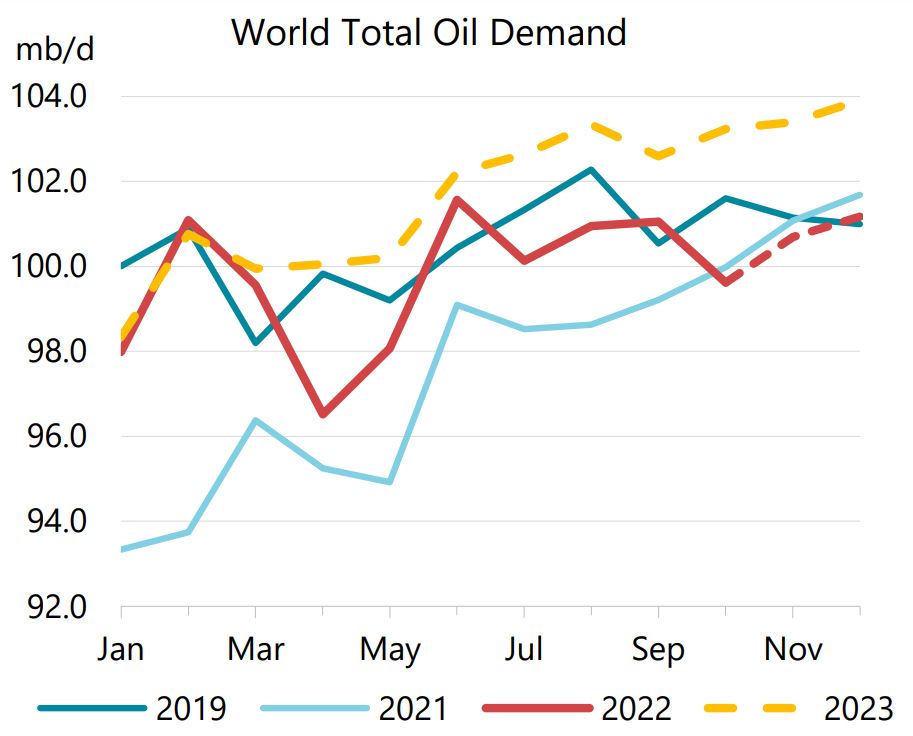
Source: IEA Oil Market Report - January 2023.
The Paris-based energy watchdog noted: "Two wild cards dominate the 2023 oil market outlook: Russia and China.
"Russian supply slows under the full impact of sanctions (while) China will drive nearly half this global demand growth even as the shape and speed of its reopening remain uncertain."
Source: IEA Oil Market Report - January 2023.
In this article:
- Brent crude could top US$100
- US natural gas price forecast lowered
- US crude oil outlook
- Risks of supply crunch could support higher prices
Brent crude could top US$100
Goldman Sachs (NYSE:GS) commodities analyst Jeff Currie recently predicted that crude oil could surpass US$100 per barrel by the end of 2023.
Factors contributing to this potential increase in prices include Russian export sanctions and increased demand in China, according to Currie.
As a result, OPEC may choose to end the production limits placed on its member states in 2022 in an effort to raise oil prices.
Currie noted that the industry was not spending enough to secure future production and that spare capacity globally was declining.
This could tip the oil market into a serious supply problem next year, but the price for a barrel of Brent could top US$100 before then.
US natural gas price forecast lowered
The US Energy Information Administration (EIA) has lowered its 2023 natural gas Henry Hub price estimate by 30.5% to $3.40 per MMBtu in its latest Short Term Energy Outlook (STEO), down from its previous prediction of $4.90 per MMBtu.
This is a significant decrease from the price of $6.42 per MMBtu last year.
EIA said that it revised its outlook for Henry Hub prices “as a result of significantly warmer-than-normal weather in January that led to less-than-normal consumption of natural gas for space heating and pushed inventories above the five-year average”.
US crude oil outlook
EIA’s outlook for 2023 US crude oil production has been revised upward to 12.5 million barrels per day (bpd), from the previous estimate of 12.4 million bpd.
For comparison, crude oil production in the US in 2022 averaged 11.9 million bpd with 2021 production coming in at 11.25 million bpd.
The EIA’s Brent crude oil price forecast for 2023 is US$83.63 per barrel.
Risks of supply crunch could support higher prices
Wael Makarem, senior market strategist – MENA at Exness noted that oil prices had been hit by the interest rate hikes in the US and Europe and other economic data in the US.
The US could see a softer decline in economic activity while the Federal Reserve continued to reduce the pace of its interest rate hikes.
At the same time, a stronger-than-expected job market could help support energy demand in the US while also giving more leeway for the central bank to keep interest rates higher for longer which could end up affecting the economy significantly.
Overall, supply growth is expected to continue to slow down while OPEC maintains its production quotas unchanged and Russian oil supplies continue to be squeezed by sanctions.
Over the longer term, risks of a supply crunch could rise under current market conditions, which could support higher oil prices.
On the demand side, China is forecast to account for the majority of demand growth thanks to the removal of COVID restrictions earlier this year.
However, the unpredictable pace of recovery in Chinese demand could remain a risk factor and could add to the current uncertainty.