
Microsoft has overhauled its Bing search engine and Edge browser with OpenAI’s ChatGPT technology, augmenting the applications to generate human-like responses to queries and automate mundane tasks.
The news comes a day after Google unveiled its own experimental conversational artificial intelligence (AI) service called Bard, which is set to rival Open AI’s ChatGPT.
“The race starts today, and we’re going to move and move fast,” said Microsoft Boss Satya Nadella
In order to disrupt the dominance of Google in the search engine space, Microsoft invested billions into OpenAI in a multi-year deal that will see the software giant become OpenAI’s exclusive cloud provider.
The new Bing search engine will be live right away to all in a limited capacity, with an option to sign-up to a waitlist for unrestricted access.
Interestingly, the Microsoft unveiling was held a day before Google’s event on search and AI, scheduled to be held today, February 8, 2023.
Today we previewed the new Bing and Edge powered by AI. @SatyaNadella shares why and how we’re innovating in AI, starting with the largest software category – search. pic.twitter.com/sN4zbHHa6X
— Microsoft (@Microsoft) February 7, 2023
AI will fundamentally change software
In a blogpost, Microsoft CEO and chairman Satya Nadella said: “AI will fundamentally change every software category, starting with the largest category of all – search.
“Today, we’re launching Bing and Edge powered by AI copilot and chat, to help people get more from search and the web.”
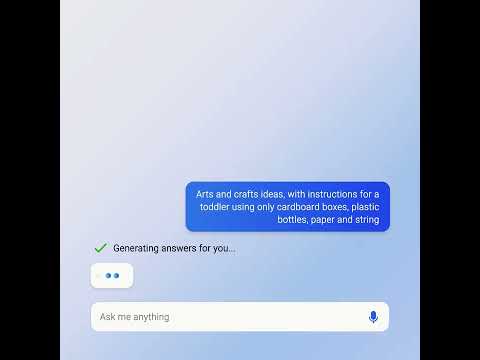
New features for Edge
In addition to the new Bing, Microsoft is launching two new AI-enhanced features for its Edge browser: 'chat' and 'compose'.
The chat function lets the user summarise the webpage or document they’re looking at and ask questions about its contents,
Meanwhile, the compose feature offers writing assistance, helping to generate text, from emails to social media posts, based on a few starting prompts.
What is ChatGPT
ChatGPT is an AI-powered chatbot from OpenAI which can simulate a cognitive dialogue with a user, similar to that you would have with a human.
The dialogue format makes it possible for ChatGPT to answer follow-up questions, admit its mistakes, challenge incorrect premises and reject inappropriate requests.
Besides ChatGPT, OpenAI is also the maker of Dall-E, which generates images in response to simple text instructions, and GitHub Copilot, a system which uses AI to help write computer code.
Here is an example of a ChatGPT interaction:
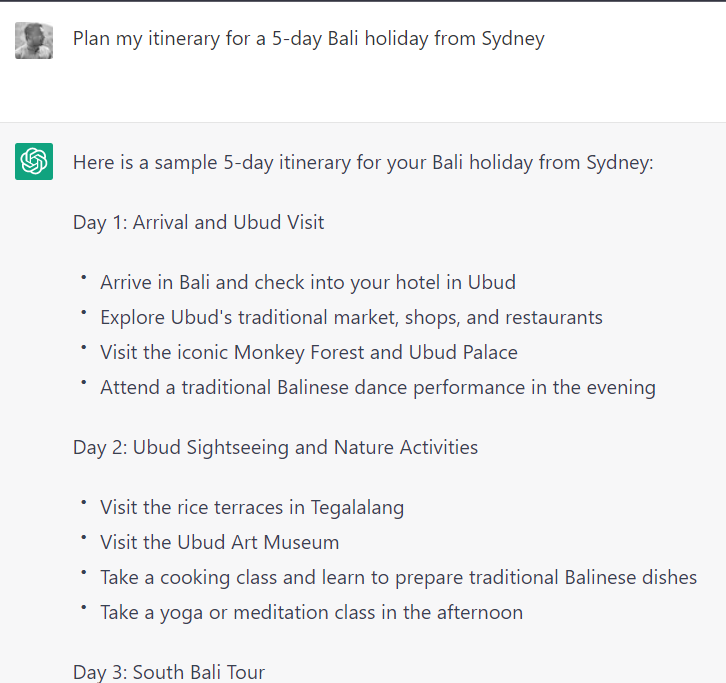
Example of ChatGPT interaction itinerary for a holiday in Bali.
Now, the interaction doesn't stop there, as it's a chat engine, I can further my dialogue with the AI-bot.
In this instance, I am interested in knowing the travel options in Ubud, hence I ask:
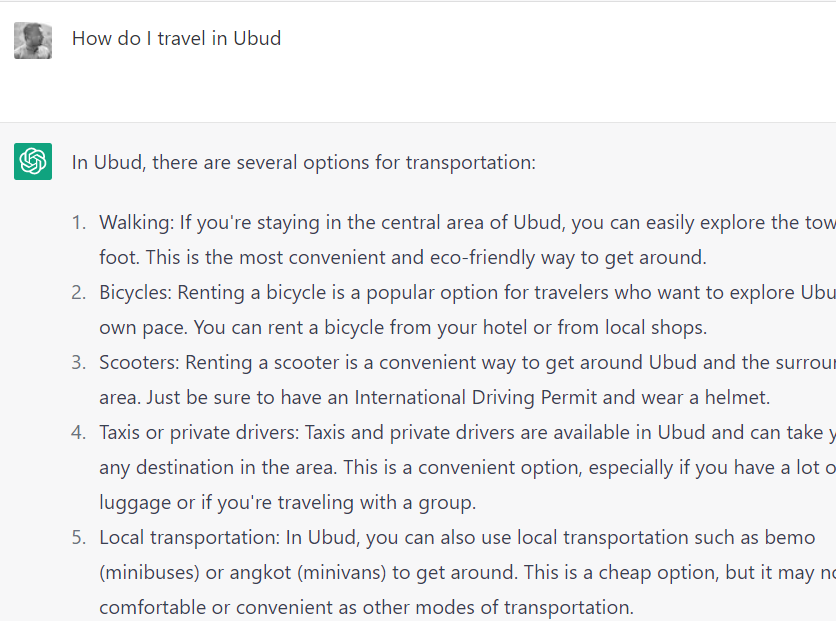
Dialogue with ChatGPT.
At the moment, ChatGPT uses data which was scraped from 2021, which means some of the data may be outdated or could even be factually incorrect in rare instances.