
Usha Resources Ltd (TSX-V:USHA) revealed that it has successfully completed hole JP22-1 at its Jackpot Lake Lithium Brine property, located 35 kilometers northeast of Las Vegas, which confirmed the presence of lithium in shallow soils and a higher-porosity sand-conglomerate zone at the basin bottom.
The North American mineral acquisition and exploration company focused on the development of battery and precious metal properties, said it will now proceed with drilling its second hole and sampling JP22–1.
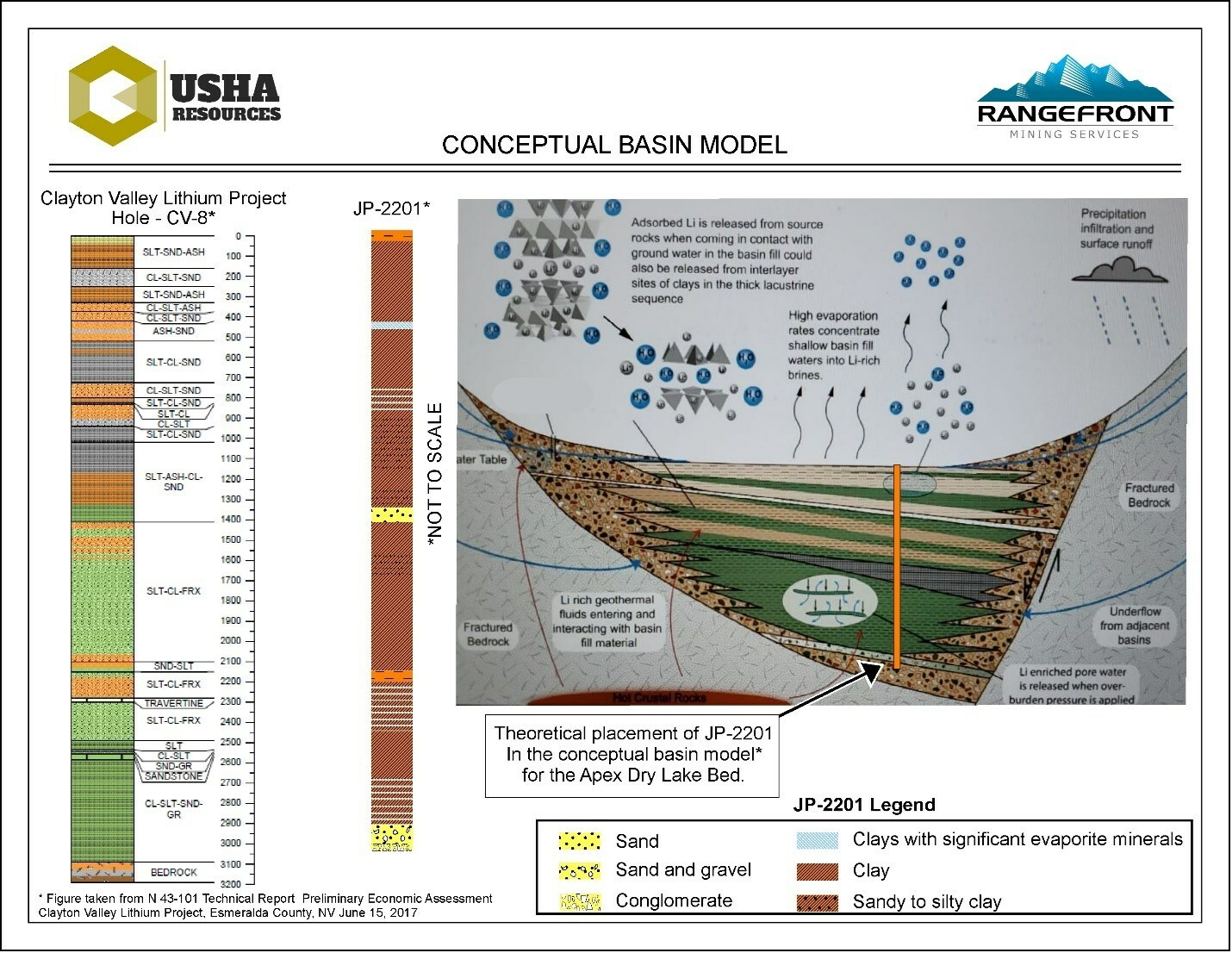
Usha’s 2023 drill program marks the first drill testing of the Jackpot Lake project in Nevada, which is hosted within a basin, estimated to be 10,900 acres and 625 metres (m) deep. JP22-1 was completed to a total depth of 525m below ground.
The Vancouver-based company said the exercise confirmed the following:
- Support for a similar geologic setting to that of Clayton Valley, hosting Albemarle's Silver Peak Nevada Lithium Mine, the only producing lithium mine in North America which has operated since 1966.
- Lithium is present in JP22-1 at a grade of up to 300 parts per million (ppm) in 10 samples taken from shallow surface soils (<442 feet).
- Evaporitic crystallization, indicative of a brine-forming environment, extends to the top of the basal conglomerate, with interbedding, veining and inclusions increasing significantly beginning at a depth of 381m. Interbedded zones included up to 90% evaporites.
- A higher porosity zone comprised of sand with evaporite crystallization was identified starting at 1,629 feet that continued to the bottom of the hole at 525m.
- Static water was present at 146 feet and the water column is anticipated to be greater than 481m.
Significantly, Usha said the hole terminated in a “higher porosity zone” of sand and conglomerate. The firm explained that reaching the sand-conglomerate zone was a “high priority” as it should contain the greatest porosity within the basin aquifer, and “serve as a pumpable zone” into which the fluids can drain.
According to a Preliminary Economic Assessment done by Pure Energy Minerals for their Clayton Valley project, their sand and conglomerate zone was identified to contain a large volume of brine with superior grades.
"The significance of evidence supporting the geologic setting coupled with the geological similarities and notable proximity to the sole domestic producer of lithium in the US bodes well for Usha’s future potential," Usha Resources CEO Deepak Varshney said in a statement.
"We’ve been very pleased with our maiden drilling program findings and it's great seeing the core beginning to come out of the ground. Shallow basins with the characteristics of Jackpot are uncommon. To be able to validate our thesis for the project on the first drill hole is very exciting. We are now moving on to hole number two as sampling of JP22-1 gets underway.”
Varshney pointed out that brine projects have the ability to move towards production “much quicker” than their counterparts in the hard rock space.
“Identification of heavily crystallized layers overlaying permeable pumpable sands and conglomerate, along with confirmed lithium in soil samples, shows that Jackpot has the potential to produce and help meet demand," noted Varshney.
Usha said it will proceed with sampling and the well will be allowed to recover and equilibrate after an airlift development. After completing well development activities, samples will be collected using HydraSleeve and Snap Sampler technology. The samples will then be sent to a lab and analyzed for lithium, boron, and other minerals typical of lithium-enriched brine systems, it added.
Contact the author Uttara Choudhury at uttara@proactiveinvestors.com
Follow her on Twitter: @UttaraProactive