
Future Metals NL (ASX:FME, AIM:FME) has identified broad zones of disseminated nickel-copper sulphides outside the existing high-grade platinum group elements (PGE) reef system at Panton Project in the East Kimberley Region of Western Australia.
Standout assays include:
- 53 metres at 0.12 g/t PGE, 0.18% nickel, 158 ppm cobalt and 0.10% copper from 32 metres;
- 83 metres at 0.49 g/t PGE, 0.25% nickel, 136 ppm cobalt and 0.04% copper from 53 metres; and
- 19 metres at 0.23 g/t PGE, 0.26% nickel, 158 ppm cobalt and 0.09% copper from 240 metres.
These results confirm that Panton hosts multiple styles of mineralisation, providing for the potential discovery of a nickel-copper sulphide deposit within the same intrusion as the existing high-grade chromitite PGE reefs.
During the program, FME confirmed an untested ‘embayment’ target prospective for the accumulation of shallow sulphide mineralisation identified on Panton North tenements, adjacent to sulphide-rich drill intersections and coincident with geochemical and geophysical anomalies.
Moving forward, the company will conduct follow-up drilling to test this embayment and any conductors identified in downhole electromagnetic (DHEM), which is scheduled to kick off following the wet season.
FME recently strengthened its geology and exploration team with the appointment of Barbara Duggan as principal geologist.

Multiple styles of mineralisation
FME managing director Jardee Kininmonth said: “The purpose of the 2022 reconnaissance drill program was to determine whether Panton could host a nickel-copper-(PGE) sulphide orebody outside of the known chromite mineralisation that the existing JORC resource relates to and to determine where there may be a large accumulation of these sulphides.
“These latest drill results demonstrate that the Panton intrusion hosts multiple styles of mineralisation, including magmatic sulphides which host nickel-copper-(PGE) sulphide mineralisation.
“The results are extremely encouraging as they show the potential for a further high-grade discovery to be made, potentially with similar style geology to the nearby Savannah nickel-copper deposit, which was emplaced later than the Panton intrusion, or a contact-style deposit such as the Flatreef.
“Of particular interest is the identification of a potential embayment feature which is coincident with the structures hosting anomalous sulphide mineralisation, a large magnetic anomaly, and nickel-copper anomalous stream sediment samples.
“This feature is also heavily weathered relative to the surrounding rocks, further suggesting the presence of increased sulphides.
“The company looks forward to further working up this exciting feature during the 2023 drill season.
"Aiding us with our exploration efforts is our new appointee Barbara Duggan, who brings significant experience in mafic-ultramafic intrusive geology and exploring for magmatic nickel sulphides.”
Geology experience
Duggan is a geologist with 20 years of experience in mineral exploration from project generation to advanced project stage, encompassing targeting studies, project management and evaluation.
She has extensive experience in Australia and Canada with a focus on nickel sulphide and magmatic-hydrothermal mineral systems.
Duggan specialises in integrated mineral systems targeting at a district-to-deposit scale.
She previously worked for Peak Minerals and has held positions at CSA, Panoramic Resources, Emmerson Resources, BHP Ni West and Inco Exploration.
Drill program
FME has received assays for seven drill holes as part of its exploration drilling program testing for the occurrence of magmatic nickel-copper-PGE sulphide mineralisation.
Drilling demonstrates a sulphide association within the high-grade reef mineralisation with potential positive implications for resource growth and metallurgy.
Importantly these drill results, in conjunction with analysis of geophysics, soil samples (MAGLAG), stream sediments and ground observations show a potential embayment feature (sulphide trap) that sits under cover on the Panton North permit adjacent to the existing JORC resource of 6.9 million ounces palladium equivalent.
Drilling and historical analysis have demonstrated that there is a sulphide association within sections of reef mineralisation previously thought to be primarily chromite-hosted.
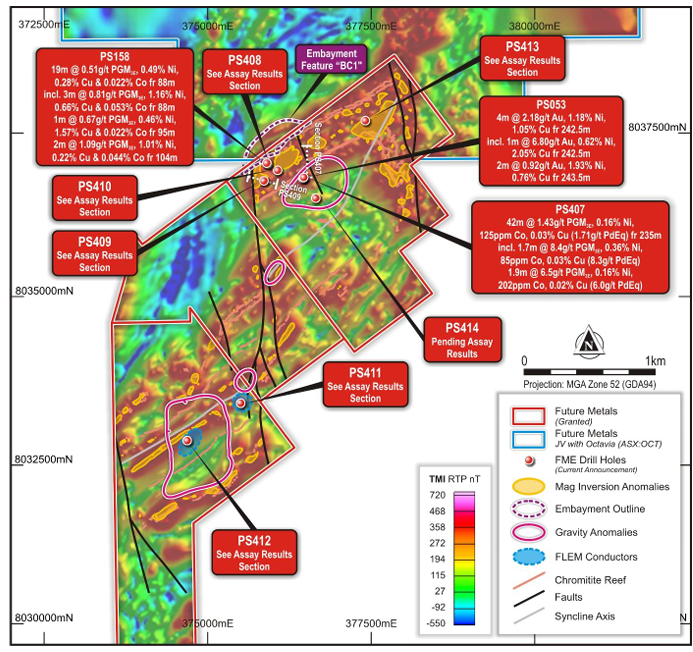
Plan view showing drill holes completed / pending results.
Forward plan
During the program, a deep diamond hole (PS414) was drilled through the entire stratigraphy of the Panton intrusion.
Assay results from this hole remain outstanding and will further inform this analysis, with potentially positive implications for resource growth and metallurgy.
Drilling was completed in mid-January and recent flooding in the West Kimberley region has delayed the ability to get DHEM contractors to the site, however, this work is due to begin shortly.
Furthermore, FME will update on the metallurgical process and scoping study.