
Natural Resources
Comment
31 January 2023
Ides of March.
On March 8th the EU is due to reveal its Critical Raw Materials Act, intended to bolster its supply chain of these materials critical to the energy transition.
Several reports from Davos last week highlighted that European industry has been calling on the EU to catch up with the US‘s support of the critical minerals supply chain vital for the energy transition or risk losing out on the economic opportunity to North America and Asia.
The US’s $370bn Inflation Reduction Act support and subsidies package, announced in August 2022, has bolstered expectations of greater “green” investment in the US, coming as it does with significant limits on where source materials are produced, with a heavy weighting to supply from US domestic sources and allied countries.
Europe doesn’t feature strongly in the “top 10” lists of any critical mineral production. The notable exception is Lithium where Portugal features in a distant 8th place, but with rapidly expanding production elsewhere that surely won’t last.
Europe’s dependence on metal imports has only been underlined by the consequences of Russia’s invasion of Ukraine and an increasing number of energy intensive industries looking to move production out of the bloc.
The quandary for European consumers of critical metals is that on one hand there is a lack of local production (partly because of local opposition, permitting hell or lack of an economic case) and on the other, securing supplies from jurisdictions with low environmental and social standards or a high embedded carbon footprint from long distance transport essentially negates the whole point of sourcing these materials in the first place.
Investors are all-in for the energy transition, except…
Negative publicity about the veracity of their green credentials hit ESG fund inflows during 2022 Nevertheless, Morningstar estimates that sustainable funds attracted $22.5bn of net new money in Q3 2022 vs $198bn outflows of the broader market. 54% of EU fund assets are now classified as “light green” or “dark green” under the EU’s Sustainable Finance Disclosure.
Whilst the reality of the “greenness” of those funds is yet to be fully tested, the ongoing flood of money into ESG funds demonstrates the appetite of investors for sustainability and the energy transition.
It seems to be a fairly widely accepted fact that without new production growth in the mining industry there won’t be much of an energy transition at all. Yet, if the message is that the decarbonisation agenda is getting whole-hearted support from wider society and that critical metals demand is indeed coming, it doesn’t seem yet to be translating into shareholder and management support for a strategic growth shift on (in) the ground.
Nothing to see here…
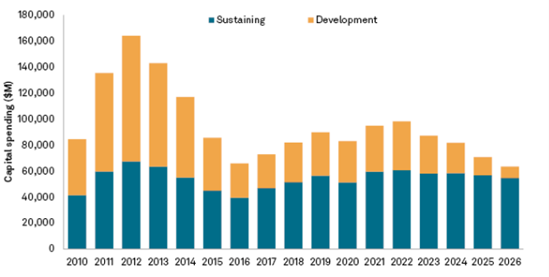
Metal Mining Activity 2022 – Source S&P Global Market Intelligence, January 2023
Many commentators have indicated that an additional $100bnpa of capex needs to be invested above the longer term run rate of ~ U$80bnpa, to ensure the energy transition demand can be fulfilled. On current projections that looks woefully over-optimistic.
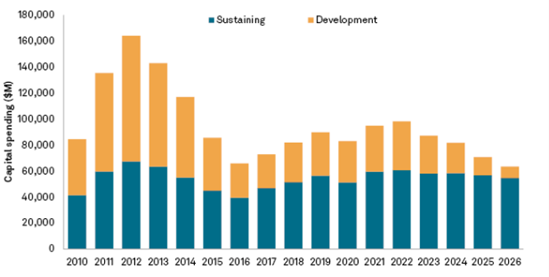
Metal Mining Industry Planned Capital Spending - Source: S&P Global Market Intelligence
Zero in on copper, which is perhaps the most important of the energy transition metals, and the picture looks even worse, with planned development capital declining precipitously in the coming years.
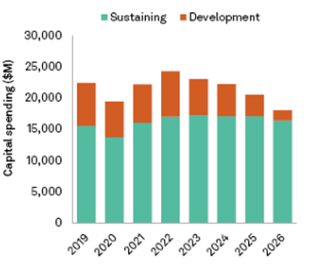
Copper Industry Planned Capital Spending - Source: S&P Global Market Intelligence
Leaving aside whether EU industry support and competition with the US will ultimately veer to the wrong side of protectionism, let’s hope the March 8th announcement from the EU helps to focus a few minds and galvanises some action on all sides.
Charlie Cryer
Head of RFC Ambrian London
+44 (0)20 3440 6834
charlie.cryer@rfcambrian.com
Copyright © 2022 RFC Ambrian Limited, All rights reserved.
This document has been approved under section 21(1) of the FMSA 2000 by RFC Ambrian Limited ("RFC Ambrian") for communication only to eligible counterparties and professional clients as those terms are defined by the rules of Financial Conduct Authority. Its contents are not directed at retail clients as RFC Ambrian does not provide investment advisory services to retail clients.
RFC Ambrian publishes this document as non-independent research which is a marketing communication under the Conduct of Business rules. It has not been prepared in accordance with the regulatory rules relating to independent research, nor is it subject to the prohibition on dealing ahead of the dissemination of investment research. It does not constitute a personal recommendation and does not constitute an offer or a solicitation to buy or sell any security. Neither RFC Ambrian nor any of its directors, officers, employees or agents shall have any liability, howsoever arising, for any error or incompleteness of fact or opinion in it or lack of care in its preparation or publication; provided that this shall not exclude liability to the extent that this is impermissible under the law relating to financial services. All statements and opinions are made as of the date on the face of this document and are not held out as applicable thereafter. This document is intended for distribution only in those jurisdictions where RFC Ambrian is permitted to distribute its research. In particular, it is not intended for distribution in and is not directed as persons in the United States.
On the date of this document, RFC Ambrian, RFC Ambrian's holding company, persons connected with it and their respective directors may have a long or short position in any of the investments mentioned in this document. RFC Ambrian is a member of the London Stock Exchange and is regulated and authorised by the Financial Conduct Authority. RFC Ambrian is registered in England and Wales no. 4236075. Its registered office is at Octagon Point, 5 Cheapside, London EC2V 6AA.
NOTICE: The information in this e-mail message is confidential and may also be privileged. It is only intended for the above-named addressee/s. If you are not a named addressee, you must not disclose, copy or take any action in reliance on this e-mail and should delete it from your system. If you have received this e-mail in error, please contact the sender by return e-mail or by telephone +44 (0)20 3440 6800. We believe, but do not warrant that this e-mail and any attachments are virus free. You should take full responsibility for virus checking.