
Auric Mining Ltd (ASX:AWJ) has received positive final results from recently completed drilling at the Chalice West Project near Higginsville-Widgiemooltha, Western Australia.
AWJ completed the program on November 22, 2022, with 227 aircore holes drilled for 7,227 metres.
The program has confirmed widespread gold mineralisation extending over 5 kilometres and potentially analogous with the Chalice gold deposit along with nickel.
Gold results include:
- 4 metres at 168 parts per billion (ppb); and
- 4 metres at 94 ppb.
Nickel results include:
- 9 metres at 3,636 ppm, including 2 metres at 6,663 ppm (0.67%).
Results also identified potential komatiite-hosted sulphide nickel mineralisation.
Auric was established to explore for and develop gold and other mineral deposits in the Widgiemooltha-Norseman area, of Western Australia.
The Chalice West Project is adjacent to the Chalice Mine, a mine that produced almost 700,000 ounces of gold and combines three tenements. It covers 408 square kilometres, including geology mirroring the Chalice Mine and is about 50 kilometres northwest of Norseman.
The company is now planning its 2023 program including RC drilling in early February 2023 that will test:
- beneath newly defined near-continuous gold anomalism in basalt; and
- for nickel sulphides in fresh rock beneath strongly anomalous nickel results from aircore drilling, including 2 metres at 0.67% nickel in AAC0279.
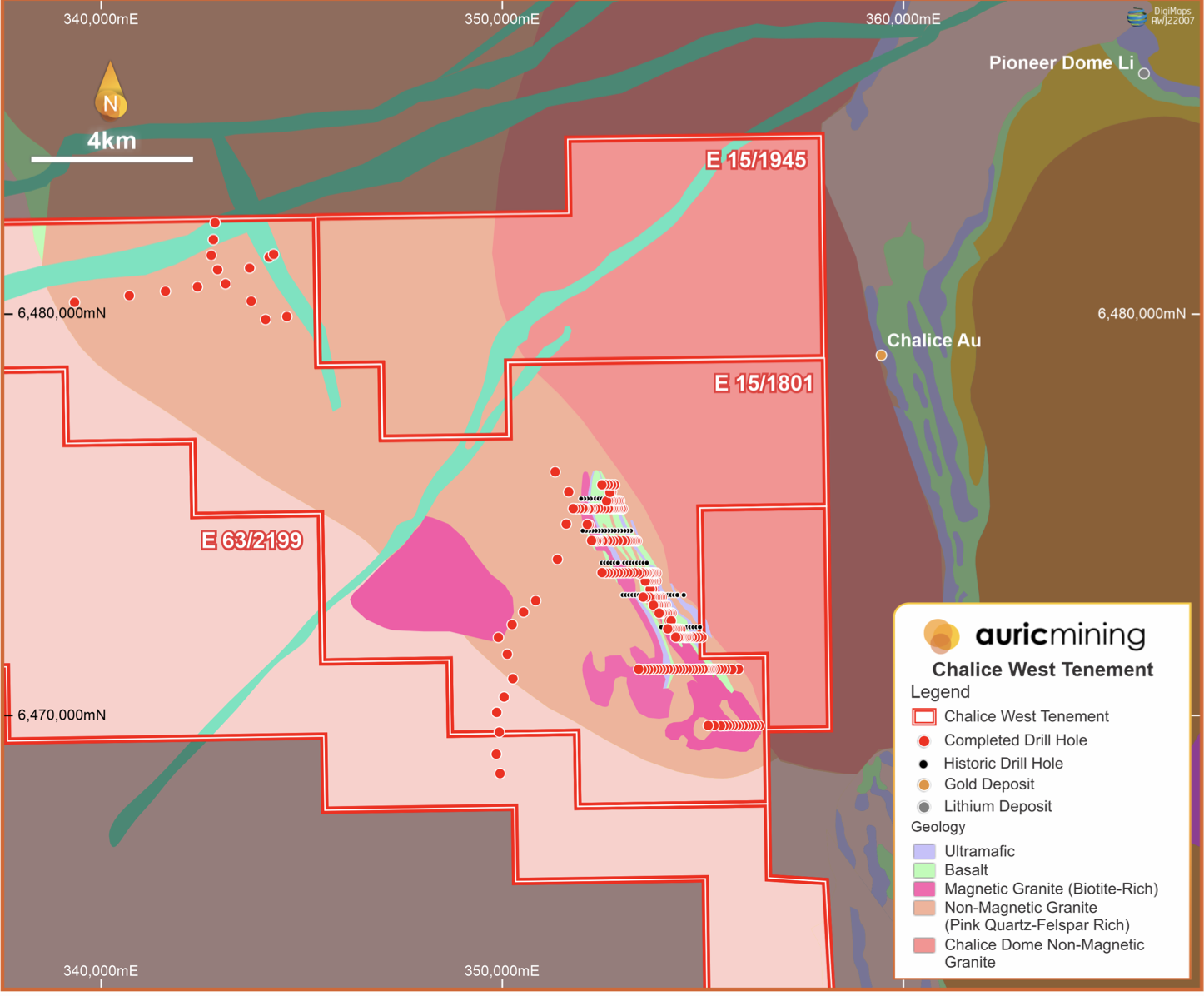
Chalice West aircore drill holes at completion of program.
Gold and nickel results
Gold results have been received for all the 1,961 composite samples submitted and multi-element results including nickel and rare earth elements (REE) received for all bottom-of-hole (BOH) composite samples and for the 363 selectively sampled 1-metre samples.
Note that final results for REE will be reported separately from the gold and nickel results.
The latest results included another five holes with anomalous gold values defined at a 10 ppb cut-off. The company also reaffirmed the interpreted continuation of rocks hosting the Chalice gold deposit into the project area.
Anomalous nickel intercepts were returned for another five drill holes in the latest results, including 4 metres at 1231 ppm nickel from 20 metres in AAC0240.
These intercepts together with eight anomalous drill holes reported on December 22, 2022, occur within two weathered ultramafic units that likely represent komatiites and are prospective for komatiite-hosted sulphide nickel deposits.
Several RC drill holes will be drilled in early February 2023 beneath near continuous gold anomalism hosted within basalt 800 metres to the south of historic drilling together with two holes to test fresh ultramafic rock beneath nickel anomalism on the same traverse.
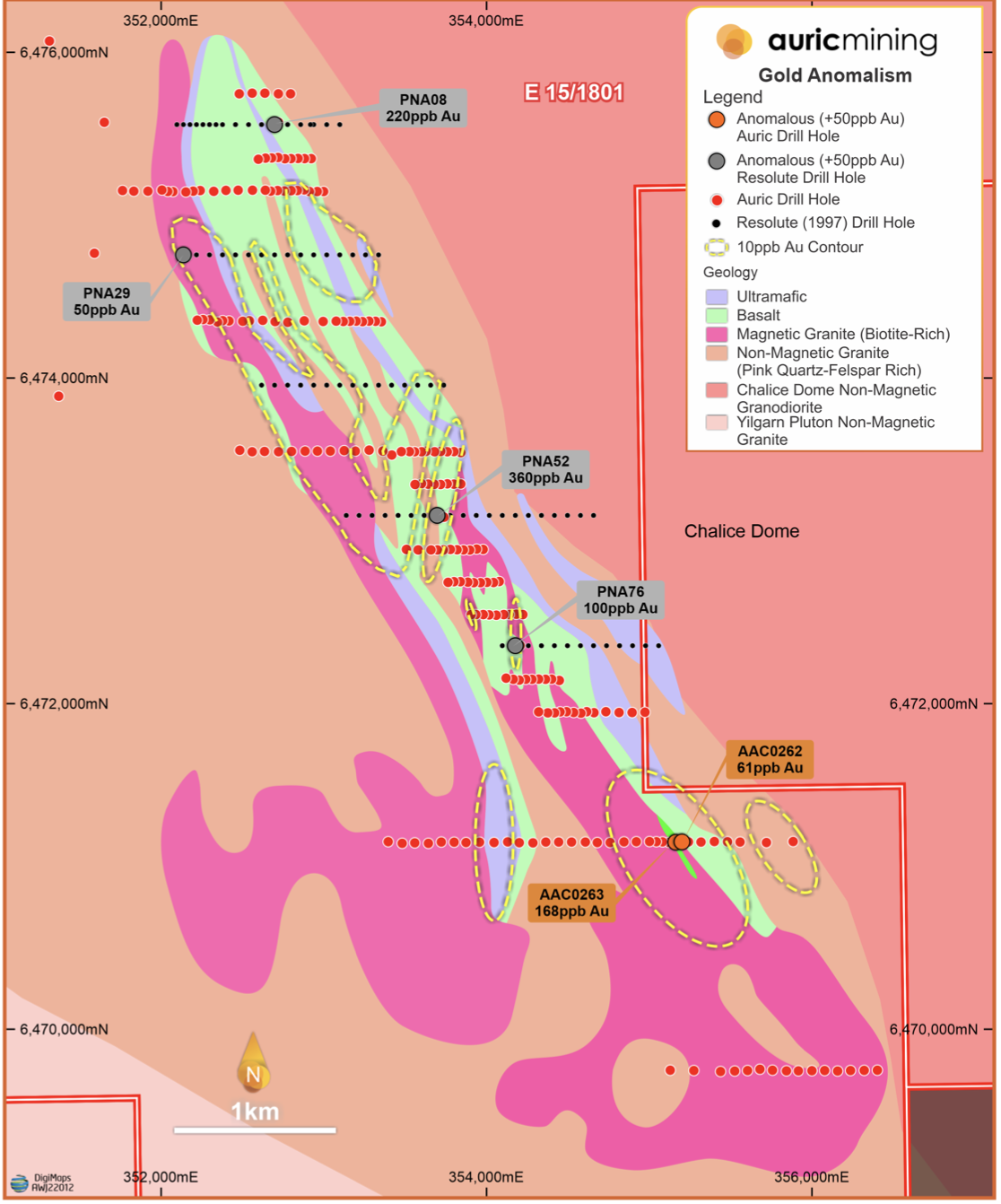
Chalice West Prospect – gold anomalies for all drill holes at 10ppb cut-off.
Aircore program illustrates potential
The aircore program design recognised the potential for gold, nickel, lithium and REE in the project area but focused on known gold anomalism associated with ultramafic and mafic units intersected by Resolute Limited in a 1997 aircore drilling program.
Prior to the drill program, Auric interpreted the geology intersected in the Resolute drill holes to mirror that hosting the Chalice Gold Mine about 8 kilometres to the northeast, separated by a granodiorite dome which Auric refers to as the Chalice Dome.
A total of 227 aircore holes were drilled between October 17, 2022, and November 22, 2022, by Kalgoorlie-based Kennedy Drilling. 197 of the holes were drilled along a series of 13 traverses that tested the mirrored Chalice stratigraphy. The remainder were drilled at wide spacings to define geology over the broader tenement.
Holes were mostly drilled to ‘blade-refusal’ ie, to the limit of penetration using a bladed drill bit, and depths ranged from 1 to 98 metres. The extensive transported cover ranged from 0 to 96 metres thickness, averaging 15 metres.
All samples were submitted as 4-metre composites for gold analyses and BOH composite samples also submitted for multi-element analyses. Onsite pXRF testing for nickel and proxies for lithium and rare earths was used as an objective basis for selection of 363 1-metre samples and associated multi-element laboratory analyses.
Drill holes were logged by a geologist at 1-metre intervals and the lithologies, particularly in the clay-weathered sequence compared with pXRF results for Cr, Ti and Zr to better constrain the clay-weathered protoliths.
Assay results have defined widespread gold anomalism in the residual profile (ie, below transported cover) that complements and extends the anomalism defined in the Resolute aircore drill holes.
The highest gold value returned from Auric’s drilling is a 4-metre composite at 168 ppb gold in AAC0263 with the hole distinctly anomalous over most composite intervals. Three angled RC holes will be drilled on this section in early February to traverse the basalt units and intervening granite hosting the anomalous gold, beneath the aircore holes.
Nickel anomalism defined at a 1000 ppm cut-off has now been returned for 13 holes, representing two of the three ultramafic stratigraphic units defined in this area.
The best intersection, as reported on December 22, 2022, is 9 metres at 3,636ppm (0.36%) nickel including 2 metres at 6,663 ppm (0.67%) in AAC0279.
Two RC holes will be drilled in early February to test the ultramafic unit in fresh rock below AAC0279.
Justified
AWJ’s exploration model for Chalice West (based on analogy with the Chalice gold deposit) has been justified by the lithologies encountered in drilling and the widespread gold anomalism encountered to date.
The latest drilling has extended the known gold anomalism 1.2 kilometres south of the earlier Resolute gold anomalism with the drill holes on that traverse (6471150N) 800 metres south and 1,400 metres north from the nearest traverses.
Furthermore, the anomalism along 6471150N shows a clear association with two mafic units and is more pervasive than in traverses to the north. Three RC holes are planned in the first instance to test the mafic units in fresh rock below the gold anomalism.
These holes will be drilled in early February.
Anomalous nickel intercepts including a 2-metre interval grading 0.67% were returned from two of the three ultramafic units identified by drilling.
Two RC holes will be drilled in the February program.