
- FTSE 100 finishes 24 points lower
- Dow Jones rallies to be almost flat after US PMI data
- UK composite PMI hit 24-month low but expectations improve
4.40pm: FTSE in the red
At the close of trading Tuesday, the FTSE 100 had fallen 24 points to 7,757 for a 0.4% loss on the day.
Markets across Europe experienced a bit of a pullback after some mixed flash PMI numbers painted a patchy outlook for certain parts of the economy in the UK and Europe, CMC's Michael Hewson noted.
"In Germany services pushed into expansion territory, while France disappointed. Manufacturing on the other hand was weak in Germany, while it rebounded in France, whereas in the UK manufacturing showed a modest improvement, while services disappointed," Hewson said.
3.55pm: Premium bonds boosted
National Savings and Investments (NS&I) has said it will increase the Premium Bonds prize fund rate to 3.15% from the next prize draw in February.
The latest increase takes the fund rate to a 14-year high and comes after NS&I added £80 million to its prize fund last month.
Notably, there are three more prizes of £100,000 and six more prizes at £50,000. Meanwhile, there will be over 121,000 more £50 and £100 prizes each to be won.
Despite this rate rise, the odds of winning some sort of prize remain unchanged at 24,000 to one. This is partly due to fewer £25 winnings on offer, with NS&I set to cull these prizes by nearly 242,000 next month.
3.15pm: US flash PMI touch better than feared
Private sector firms in the US registered a further decline in output at the start of 2023, according to the latest ‘flash’ purchasing managers index (PMI) data from S&P Global.
The fall in business activity softened to the slowest in three months, however, as manufacturers and service providers signalled moderations in their respective downturns.
The headline flash US PMI composite output index registered 46.6 in January, up from 45.0 at the end of 2022. A reading below 50 represents a contraction in activity but while the contraction was solid overall, it was the slowest since last October.
Goods producers and service providers recorded similar rates of decline, with service sector firms indicating a notable slowdown in the pace of decrease since December. Nonetheless, US companies continued to highlight subdued customer demand and the impact of high inflation on client spending.
In reaction to the slightly better-than-expected data, the US blue-chip index eased off opening lows, with the Dow Jones Industrial Average off 0.3% at 33,515. But the S&P 500 stayed 0.4% lower at 4,002, and the tech-heavy Nasdaq Composite also shed 0.4% at 11,327.
In London, at 3.15pm, the FTSE 100 index was down 38 points, or 0.5% at 7,746.
2.45pm: US stocks retreat
The FTSE 100 index remained lower midafternoon as Wall Street fell at the open on Tuesday following back-to-back daily gains, as investors continued to weigh a slew of corporate earnings, with Microsoft due to report after the US close.
Just after the New York market open, the Dow Jones Industrial Average was down 166 points to 33,463, while the S&P 500 eased 27 points at 3,993, and the tech-heavy Nasdaq Composite lost 45 points to 11,320. The Russell 2000 small-cap index, though, climbed more than 1.2%.
Notable stock movers included Verizon Communications, which jumped more than 7% despite posting mixed results for its fourth quarter of 2022.
“We do not see much scope for markets to rally in the near term, especially given our outlook for continued pressure on corporate profit growth,” UBS Global Wealth Management chief investment officer Mark Haefele said in a note to clients.
In London, at 2.45pm, the FTSE 100 index was down 34 points, or 0.4% at 7,750.
2.35pm: Power down
National Grid has said its Demand Flexibility Service will be offered for a second time to eligible households between 4.30pm and 6.00pm GMT on Tuesday.
Those who have signed up get discounts on their bills if they do things like delay using their oven. The scheme ran for the first time on Monday from 5.00pm to 6.00pm GMT.
According to National Grid's electricity system operator, more than a million households and businesses in England, Scotland and Wales have signed up to take part, the BBC News website reported.
The scheme - which is only available to homes with smart meters - was introduced last year and is scheduled to run until March this year.
2.20pm: Running on fumes
"Oil prices are marginally higher again", noted Craig Erlam, senior market analyst, UK & EMEA, OANDA, "continuing the good run they've been on since early in the year, but momentum is starting the fade.
"The China reopening trade has boosted oil prices considerably but we perhaps need more data to justify a continuation of that."
Erlam added: "Reports suggest that OPEC+ delegates expect the panel to recommend no changes to output when they meet next week which indicates they believe the market is fairly balanced at the moment. Of course, there's considerable uncertainty in the global outlook and the China transition so that remains subject to change."
1.32pm: London's movers
A quick look at some of today’s fallers and risers in London.
Fallers
Oxford BioDynamics- down 2% to 14.95p
Operating losses for the biotechnology company fell to £8.6mln in the year-ended 30 September compared to £7.5mln the year earlier. It blamed this on increased staff, general and administration costs, as well as depreciation.
Velocity Composites- down 7% to 59.5p
The supplier of material kits to the aerospace sector said inflationary pressures weighed on gross margins, which slipped to 23% from 26% for the full year to 31 October.
Smiths News- down 6.5% to 51.8p
Trading was in line with expectations for the current financial year, with the newsgroup stating it continues to manage inflation.
Risers
Norman Broadbent- up 31% to 4.5p.
The AIM-quoted recruiter and management firm flagged a 29% rise in net fee income (NFI) in the three months ended 31 December 2022, reporting a £7.32mln for the full year, a 21% improvement on 2021.
Senior- up 10% to 149p
Aerospace and defence components maker Senior took off after telling investors it expects results for 2022 to beat expectations. Adjusted pre-tax profits for the year ended 31 December will be ahead of the “top-end” consensus.
Pebble Beach- up 3% to 8.2p
An upbeat second-half trading update was enough to send shares in software company Pebble Beach higher. Revenue for the year ended 31 December is expected to be around £11.2mln, up from the £10.6mln reported in 2021.
12.55pm: Aviva reportedly set to back Arcadia pension funding deal
Thousands of pensioners left facing an uncertain retirement by the collapse of Sir Philip Green's high street empire are on the verge of a funding deal backed by one of Britain's biggest insurers, Aviva PLC (LSE:AV.).
A report from Sky News said that the trustees of the Arcadia Group pension scheme are close to striking a binding deal with Aviva to guarantee its members' incomes.
Citing City sources the report said a formal agreement was likely within weeks, with Aviva understood to have seen off competition from rival insurance companies.
If concluded, it would bring to an end negotiations about one of the UK's most contentious corporate pension schemes.
The fate of Arcadia's pensioners, comprising employees of prominent chains including Burton, Dorothy Perkins and Topshop, has been in the balance since Sir Philip was forced to put the group into administration in the autumn of 2020, Sky pointed out.
12.31pm: Weak PMI figures puts "R" word back on the agenda
The weak PMI figures have put the talk of will and when the UK enter recession firmly back on the agenda.
There is a chance that the UK economy could enter a technical recession – defined as two consecutive quarters of negative growth – when the GDP figures for December are released.
But after a surprise rise in November’s figure the Office for National Statistics estimated that it would need a fall of 0.6% in economic growth in December for the fourth quarter to post a fall after the decline in the third quarter.
Possible given the bounce in November’s figure reflected a jump in the services sector from the World Cup whilst December saw waves of industrial action and disruption from the cold weather.
Nevertheless, what is clear is that the economy is slowing, the picture is far from rosy and most, not all, economists expect the UK to enter a recession at some stage.
Today’s fall in the PMI figure to a 24-month low highlighted the risks that this could happen in the first half of the year, if not before.
Chris Williamson, chief business economist at S&P Global Market Intelligence, said the data “underscore the risk of the UK slipping into recession.”
“Industrial disputes, staff shortages, export losses, the rising cost of living and higher interest rates all meant the rate of economic decline gathered pace again at the start of the year” he noted.
Pantheon Macroeconomics, senior UK economist, Gabriella Dickens said the figures suggested GDP is still “on a downward trend, as real incomes continue to fall” adding the fall in the composite PMI was consistent with a 0.2% quarter-on-quarter contraction in real GDP in quarter one, if it holds steady for the rest of the quarter.
She estimated the figures appeared “to be broadly consistent with our forecast that GDP will fall by 0.3% quarter-on-quarter in quarter one and by a further 0.6% in quarter two.”
"At best, the UK economy will stagnate this year. Realistically we're likely to see a recession at some point," said Simon Harvey, head of FX analysis at Monex Europe.
"As we start to see the economic reality coming through, this will likely lead to sterling underperforming over the coming months," Harvey added.
This was also seen today with the pound falling back against the US dollar, easing 0.4% to $1.233.
But there was also hope. At Pantheon, Gabriella Dickens said the silver lining to the survey was that it strengthens the case for the Monetary Policy Committee to stop hiking Bank Rate soon.
The EY ITEM Club agreed, it expects the “rate raising cycle will soon come to an end, with Bank Rate peaking at 4% early this year.”
JPMorgan economist Allan Monks had an even brighter take on the figures highlighting the broader resilience in the detail.
He said “the current level of the PMI is not empirically consistent with a recession – which typically sees the survey drop to around 46 or below.”
Moreover, the details of the report were some way better than the headline, he noted.
He highlighted a rise in new orders, a jump in the employment reading and a leap in the year-ahead future output number.
“This should help to further allay fears that the UK is entering a job shedding episode and full recession scenario in the near term, especially with gas prices falling and inflation heading lower” he stated.
12.07pm: US markets set to open lower
Wall Street is set for a lower opening as traders mark time ahead of quarterly results from the likes of Microsoft and fourth quarter GDP and Personal Consumption Expenditures data later in the week that will help to inform the Federal Reserve’s next move on interest rates.
Futures for the Dow Jones Industrial Average fell 0.3% in Tuesday pre-market trading, while those for the broader S&P 500 index also retreated 0.3% and contracts for the Nasdaq-100 declined 0.5%.
The Nasdaq led US stocks higher on Monday as the markets started a busy week of earnings and economic data on the front foot.
At the close, the DJIA was up 0.8% at 33,630 points, the S&P 500 added 1.2% to reach 4,020 and the Nasdaq gained the most to close at 11,364 points.
“Wall Street kicked off the week sharply higher on Monday with the risk-on tech-heavy Nasdaq leading the charge to log a gain of more than 2%,” Victoria Scholar, head of investment at interactive investor commented.
“Focus this week is on US GDP figures which are out on Thursday for clues into the strength of the US economy,” she added. “Microsoft gets set to deliver earnings after the bell having added to the chorus of job cuts facing Big Tech just last week, providing a boost to the sector.
Netflix set the bar high last week with its earnings release, sharply outpacing expectations in terms of its subscriber numbers.”
Ahead of Microsoft’s results, General Electric (NYSE:GE) (General Electric (NYSE:GE)) and Johnson & Johnson (NYSE:JNJ) (Johnson & Johnson (NYSE:JNJ)) will report their December quarter earnings early Tuesday.
Tesla and Boeing report back on Wednesday in a week that sees an estimated quarter of the S&P 500 reporting.
“The US data slate is also dominated by PMI data due later today,” added TickMill Group’s market analyst Patrick Munnelly.
“With both readings believed to remain in contractionary territory, key for US investors will be whether next week’s ISM data confirms the PMI prints as the ISM releases tend to be tracked more closely by US investors.”
11.23am: CBI survey shows cost pressures are easing
Cost and pricing pressures in UK manufacturing remain high, but shows signs of easing, according to the CBI’s latest Industrial Trends survey.
In the quarter to January, average unit costs grew at the slowest pace since April 2021, while domestic selling price inflation was the slowest since July 2021. But both remained far above their long-run averages.
Manufacturers reported stable output volumes in the quarter to January, following a modest decline in the quarter to December, the survey showed.
New orders were flat, while the volume of total order books fell further below normal, suggesting that output has been supported in part by manufacturers tackling backlogs of work.
Looking ahead, manufacturers expect new orders and output volumes to increase in the next quarter, but the share of firms reporting that orders or sales would constrain output nonetheless reached its highest since April 2021.
The survey, based on the responses of 321 manufacturing firms, found that business sentiment fell for the fifth consecutive quarter, but at a much slower rate than in the three months to October (balance of -5%, from -48%).
Anna Leach, CBI deputy chief economist, said: “Mixed conditions are apparent in the manufacturing sector this month.”
“Global supply chain pressures, labour shortages and energy costs are easing, enabling unit cost growth to ease back from record highs.”
“But there are signs that demand is easing too, with order books weakening sharply, spare capacity in the manufacturing sector rising and the share of firms citing the strength of sales or orders as a potential constraint on output rising to its highest in almost two years.”
11.00am: Borrowing numbers not as bad as they look - economists
The rise in government borrowing to a record high in December may have covered up some more hopeful signs in the outlook for the UK’s finances, according to economists.
Figures from the Office for National Statistics (ONS) showed public sector net borrowing came in at £27.4bn in December, £16.7bn higher than a year earlier, and a record total for December.
But Samuel Tombs, chief UK economist at Pantheon Macroeconomics, suggested that “initial impressions deceive; the trend is still better than the OBR anticipated.”
He said most of the difference between the ONS’ first estimate and the OBR’s forecast, can be explained by the treatment of student loans.
Even despite this public borrowing totalled £128.1bn between April and December, £2.7bn below the OBR’s forecast and Tombs thinks public borrowing in the final three months of 2022/23 also will come in below the OBR’s expectations, given that interest rates look set to rise to a lower peak than markets had expected.
Accordingly, he predicted a full-year borrowing figure of about £160bn, below the OBR’s £177bn forecast.
Tombs also estimated that lower rates suggest that debt interest payments in 2023/24 will be about £10bn lower than the OBR forecast made in November while the recent fall in wholesale natural gas prices means that the Energy Price Guarantee will cost the government only a tiny fraction of the £13bn assumed previously.
Ruth Gregory, senior UK economist at Capital Economics, agreed that the data wasn’t quite as bad as initially appeared noting the impact of the student loans in the calculation, higher tax revenues and a reduction in the estimate of 2021/22 and 2022/23 fiscal year borrowing forecasts.
“So while December's worse-than-expected public finances figures further limits the chance of big giveaways in the Budget on 15th March, we suspect that by March 2024 borrowing will be lower than projected and the chancellor will be in a position to cut taxes/raise spending ahead of the next general election” she suggested.
Over at Citi and economists were also highlighting how lower gas prices could create more “fiscal space.”
“Falling gas prices do not just lower inflation and boost growth prospects” they said.
“Where governments capped households’ and firms’ energy prices, spending will be much lower than assumed, 0.3-0.9% of GDP per year according to our estimates” economists wrote.
“Other support measures such as indirect tax cuts or tax credits could be phased out earlier, creating even more fiscal space.”
“Lower public borrowing needs could create space for accelerated central bank balance sheet unwind as well” they concluded.
For the UK, the fall in energy futures prices over the past few weeks is unlikely to make much difference to the government finances over the remaining three months of this fiscal year according to the EY ITEM Club.
But its chief economic adviser, Martin Beck, said that, if sustained, “it appears likely to ensure that borrowing is significantly lower than the £140bn that the OBR expects for 2023-2024.”
He doesn’t think it has any implications for March’s Budget.
9.54am: Eurozone PMI shows growth in January
Better news over in Europe though.
S&P Global's flash PMI rose to 50.2 in January, better than the 49.8 reading predicted by economists and the first time since June that the gauge was above the 50 threshold that separates expansion from contraction.
The #eurozone crept back into growth territory in January, according to preliminary #PMI data (50.2; Dec: 49.3), as services firms signalled a modest recovery in business activity and the downturn in manufacturing eased. Read more: https://t.co/fLNwNvVghO pic.twitter.com/GEys9mgKhu
— S&P Global PMI™ (@SPGlobalPMI) January 24, 2023
A variety of factors including slowing inflation, a warmer-than-usual winter in energy-strapped Europe and an easing of supply-chain constraints are fanning optimism in the 20-member currency zone.
Chris Williamson, chief business economist at S&P Global Market Intelligence said that while the steadying of the economy adds to evidence the region might escape a recession, "the region is by no means out of the woods yet".
ING Economics said the figures indicate that the economy is performing better than expected.
“Businesses are experiencing fewer cost pressures than before, but selling prices remain high. For the ECB, this should seal the deal for a 50 basis point hike next week” it suggested.
ING added whether “this is a recession or not is almost semantics at this point.”
9.44am: UK composite PMI hits 24-month low
Not much optimism in the latest UK PMI figures although there was one crumb of comfort.
The headline seasonally adjusted S&P Global/CIPS flash UK PMI composite output index registered 47.8 in January, down from 49.0 in December, and below the neutral 50.0 threshold for the sixth consecutive month – a 24-month low.
????????#UK’s private sector faced the strongest downturn in 2-years as high interest rates and low consumer confidence continue to squeeze household spending. The headline flash #PMI index dropped to 47.8 (Dec: 49.0) @cipsnews. Read more: https://t.co/Jdz8ZhSTP2 pic.twitter.com/gzivPCBgjH
— S&P Global PMI™ (@SPGlobalPMI) January 24, 2023
A faster overall drop in private sector output mostly reflected a weaker service sector performance, with business activity falling at the steepest pace for two years (index at 48.0, down from 49.9 in December).
Manufacturing production meanwhile decreased considerably in January (index at 46.6), but the rate of contraction was the least marked since July 2022.
Commenting on data, Chris Williamson, chief business economist at S&P Global Market Intelligence said: “Weaker than expected PMI numbers in January underscore the risk of the UK slipping into recession.”
“Industrial disputes, staff shortages, export losses, the rising cost of living and higher interest rates all meant the rate of economic decline gathered pace again at the start of the year.”
“Jobs also continued to be lost as firms tightened their belts in the face of these headwinds, though many other firms reported being constrained by an ongoing lack of available labour.”
In an otherwise downbeat survey one positive sign was an improvement in business expectations which continued to rebound following the low point seen in October 2022, with the latest reading pointing to the strongest degree of optimism for eight months.
The improving global economic backdrop and falling inflationary pressures were the main drivers behind the improvement.
9.20am: Deutsche and Liberum lift airline price targets
Airlines were flying high in early exchanges as analysts at Liberum and Deutsche Bank raised price targets across the sector with shares in International Consolidated Airlines Group SA (LSE:IAG), the owner of British Airways, Wizz Air Holdings PLC (AIM:WIZZ) (Wizz Air Holdings PLC (AIM:WIZZ)) and easyJet PLC all higher.
"The airline industry is in the early stages of recovery from the pandemic" according to Liberum.
Positives are relatively careful capacity growth plans, stabilising jet fuel prices and encouraging forward booking commentary, it said.
Despite the deteriorating macro picture Liberum sees headroom for the demand/supply balance to remain favourable with capacity mostly still below 2019 levels.
"We increase our target prices on easyJet (500p from 430p), IAG (220p from 145p) and Ryanair (€17 from €16) and retain our 'buy' recommendations" the broker said.
Over at Deutsche Bank and analysts have also updated their price targets.
In a sector review Deutsche analysts said the key changes have been “higher fares near term.”
Updating its targets the bank said it has assumed the strong pricing environment that was in evidence in the September quarter of 2022 persists throughout quarter four and the first half of 2023.
It also assumed ticket yields that are flat year-on-year for the low cost carriers and -5% year-on-year for the Network Airlines.
The target for easyJet has been hiked to 410p from 330p although it remained a ‘sell’, for IAG (hold) to 180p from 155p and for Wizz Air (hold) to 3,150p from 2,550p.
Shares in IAG advanced 1.5%, easyJet rose 1.9% and Wizz Air jumped 0.5%.
9.05am: Record December borrowing unsettles Footsie
FTSE 100 continued its downbeat start to the day, underperforming its European peers, as a record December UK borrowing number triggered fresh concerns as to the health of the UK’s finances.
Public sector borrowing in December was £27.4bn, ahead of City expectations, and a record number for the month reflecting the cost the energy support package and rising debt interest payments.
Flash PMI figures are also being digested with the UK ‘s latest data due at 9.30am.
Victoria Scholar, head of investment, interactive investor noted: “So far, the French manufacturing flash PMI for January pushed back above the key 50 boom-bust divide to hit 50.8 versus 49.2 in the previous month.”
“However, services fell back to 49.2 hitting a 22-month low from 49.5 in December.”
“Conversely in Germany, services improved from 49.2 to 50.4 surpassing the 50 threshold, while manufacturing slipped back slightly from 47.1 to 47” she pointed out.
Falls in pharmaceuticals weighed on the blue-chip index with AstraZeneca PLC (LSE:AZN) top of the FTSE 100 fallers and GSK PLC (LSE:GSK, NYSE:GSK) and Haleon PLC (LSE:HLN, NYSE:HLN) also lower, while oil majors and index heavyweights, BP PLC (LSE:BP.) and Shell PLC (LSE:SHEL, NYSE:SHEL) also declined in early exchanges.
Associated British Foods remained lower, down 0.7%, despite a strong trading update.
Shares in the Primark owner rose yesterday ahead of the update and analysts at Shore Capital described it as a “sound and moderately encouraging trading statement.”
Elsewhere, shares in Senior PLC (LSE:SNR) (Senior PLC (LSE:SNR)) jumped some 10% in Tuesday’s early deals in London after the aerospace and defense components maker told investors that it expects results for 2022 will beat expectations.
Another company on the up was Yü Group PLC (AIM:YU.) which rose more than 10% in Tuesday’s early deals after the corporate energy supplier reported a "record-breaking" performance for 2022, against a backdrop of soaring prices.
The company in a trading update following the close of the year said that its fiscal 2022 had surpassed market expectations.
8.43am: Government borrowing hits record December high
Public sector borrowing (PSNB ex) in December 2022 was £27.4bn, the highest December figure since monthly records began in January 1993, according to figures from the Office for National Statistics (ONS).
The rise which was above City expectations was largely because of a sharp rise in spending on energy support schemes and an increase in debt interest the ONS said.
%20December%202019%20.png)
December’s borrowing was £16.7bn higher than December 2021 and £9.8bn higher than the latest official forecast published by the Office for Budget Responsibility (OBR); largely because of student loans assumptions made by the OBR, the ONS said.
Central government debt interest payable was £17.3bn in December, the highest December figure since monthly records began; the increase largely reflecting the effect of Retail Prices Index changes on index-linked gilts.
In the financial year-to-December 2022, the public sector borrowed £128.1bn, £5.1bn more than that borrowed in the same period last year, but £2.7bn less than forecast by the OBR.
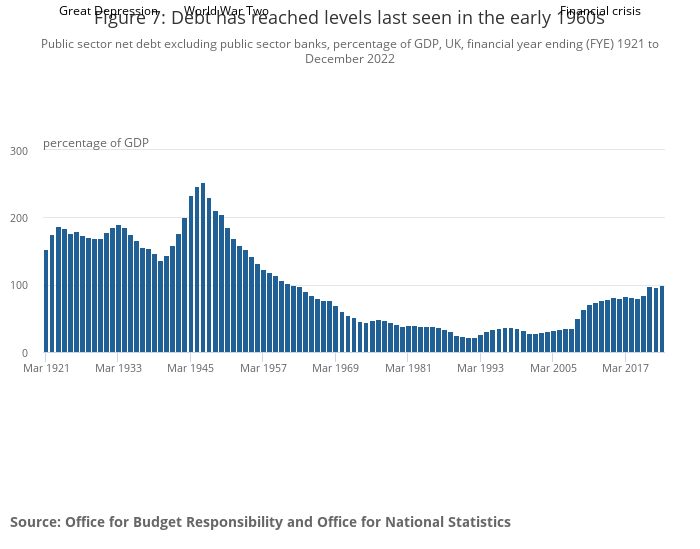
Public sector debt at the end of December 2022 was £2,503.6bn or around 99.5% of GDP with the debt to GDP ratio at levels last seen in the early 1960s.
Susannah Streeter senior investment and markets analyst, Hargreaves Lansdown said: “The government was forced to borrow £27.4 billion in December, the highest figure for the month since records began in 1993. Excruciatingly high debt interest is also taking its toll because index-linked gilts are pegged to scorchingly high RPI inflation.”
“It’s the third month in a row that borrowing has exceeded expectations, and faced with this deteriorating deficit, it will leave the government with no wriggle room for any quick tax giveaways in the March Budget and it’s likely that a very tight grip will be kept on spending.”
8.17am: FTSE 100 dips at the open
The FTSE 100 took a turn for the worse, after a rise in UK borrowing figures, and as investors nervously awaited the latest PMI prints across the globe.
At 8.15am the lead index was down 33 points at 7,752 while the FTSE 250 was up 20 points at 19,823.
Public sector borrowing (PSNB ex) in December 2022 was £27.4bn, the highest December figure since monthly records began in January 1993, largely because of a sharp rise in spending on energy support schemes and an increase in debt interest according to figures from the Office for National Statistics.
Ruth Gregory, senior UK economist at Capital Economics said: "December’s public finances figures provided more evidence that the government’s fiscal position is deteriorating fast."
"And high government spending in the early months of 2022/23 and the pressures from the weakening economy implies borrowing will come in at about £175bn, broadly in line with the OBR’s forecast of £177bn, but a huge £52bn above the 2021/22 total."
But analysts at the EY ITEM Club said although December's outturn for public sector net borrowing was much higher than a year earlier, “the fiscal deficit is running below the OBR's month-by-month forecast, particularly once differences around the treatment of student loans are factored in.”
It added: “The recent fall in energy futures prices is expected to mean that borrowing in 2023-24 is significantly lower than the OBR forecast.”
In company news Associated British Foods PLC (LSE:ABF) was little changed today, after rising yesterday, as it reported strong Christmas sales at Primark.
Richard Hunter, head of markets at interactive investor, said: “The group’s diversity continues to play its part, while Primark is back with a bang given changing shopping habits.”
He noted that as with so many other retailers, especially over the Christmas period, “there has been a marked return to physical shopping.”
Trading updates gave support to Saga PLC (LSE:SAGA) which extended yesterday’s gains, rising a further 1.5%, as it said profits would be in line with expectations as the cruise and travel industries continue to recover post-pandemic while investors raised a glass to Marston’s PLC (LSE:MARS) with shares up 5.8% as it reported strong Christmas trading.
Elsewhere and budget airline operators, easyJet PLC and WizzAir PLC, were flying high in the early exchanges as Deutsche Bank raised price targets for both.
7.57am: A merry Christmas at Marston's
Marstons PLC reported like-for-like sales for the 16-weeks to 21 January grew 12.9% compared to last year which was hit by the Omicron variant.
The pub operator said momentum improved throughout the period with sales up 6.8% in the first eight weeks followed by a 19.2% increase in the following eight weeks.
For the five key festive days like-for-like sales were up 26% on last year and 12.9% compared to 2019/20.
Total retail sales in the group's managed and franchised pubs were up 14.0% on last year with drink sales continuing to outperform food sales.
Electricity costs are now hedged for the entirety of fiscal year until the end of September 2023, with no change to earnings guidance, the company said.
Andrew Andrea, CEO, commented: “Our primary focus remains to meet our strategic goals of achieving £1bn sales and reducing our debt to below £1bn with all the subsequent benefits that both of those milestones will bring to our shareholders."
7.40am: AB Foods holds guidance, Saga rallies post-pandemic
A couple of bits of trading news.
Associated British Foods PLC (LSE:ABF), the owner of Primark, said group revenue for the 16 weeks to 7 January 2023 was £6,698mln, 16% higher at constant currency.
"We continue to encounter significant cost pressures but inflation has become less volatile and recently some commodity costs have declined" the company said, while "consumer spending has proven to be more resilient in this trading period than anticipated at the start of the financial year."
"To date, Primark trading has been good in all our markets and was ahead of expectation. We had a very strong Christmas period" the company added.
AB Foods said Primark sales were up 15% in the 16 weeks to 7 January.
As a result, the FTSE 100-listed group said full year expectations for the group is unchanged with a significant growth in sales, and adjusted operating profit and adjusted EPS lower than the previous financial year.
Saga PLC (LSE:SAGA) said the rebound in cruise and travel revenues, post-pandemic, has continued to drive revenue growth.
As a result, the company which specialises in products and services for people over 50, remains on track to report underlying pre-tax profits between £20mln and £30mln, in line with previous guidance.
In a trading update covering the period from 1 August 2022 to 23 January 2023, Saga said revenue is expected to be between 40% and 50% ahead of last year, driven by the cruise and travel recovery following the Covid crisis.
The company said its Ocean Cruise business achieved strong load factors and per diems in the second half of the year with an encouraging pipeline of bookings.
7.00am: Upbeat start
The FTSE 100 is expected to open slightly higher on Tuesday, after gains in the US and Tokyo and ahead of PMI readings for many of the world's major economies.
Spread betting companies are calling London’s blue chip index up by around 15 points.
In the US the Nasdaq led the charge higher on Monday as the markets looked to start off a busy week of earnings and economic data on a positive note.
At the close, the Dow was up 0.8% at 33,630 points, the S&P 500 gained 1.2% to reach 4,020 and the Nasdaq gained the most - 2% - to close at 11,364 points.
Meanwhile In Tokyo, the Nikkei 225 index rose 1.5%, as preliminary survey results showed the Japanese private sector returned to growth in January.
In London, a trading update from Primark owner Associated British Foods PLC (LSE:ABF) will be in focus while flash PMI figures are expected to show a slight improvement in the overall composite figure.
Michael Hewson, chief market analyst at CMC Markets said: “In the UK, manufacturing has struggled over the past three months and looks set to continue to do so, while services have been slightly more resilient.”
“As we head into 2023 the challenges for business will be whether we see new investment, and a pick-up in economic activity, after the rising pessimism seen at the end of last year. Manufacturing is expected to remain subdued at 45.5, while services could slip back from 49.9 to 49.5.”
Over in the US and results are due from tech giant Microsoft Corp.