
West Wits Mining Ltd (ASX:WWI) has returned “significant” gold intersections in a maiden reverse circulation (RC) drill program at the Mt Cecelia Project in the Paterson Province of Western Australia.
The program comprised four RC holes for 1,036 drill metres and was conducted by WWI’s farm-in partner Rio Tinto Exploration Pty Ltd.
Results for the two holes, confirming significant gold intervals, are:
- 82 metres at 0.51 g/t gold from 128 metres, including 24 metres at 0.95 g/t from 150 metres; and
- 56 metres at 0.55 g/t from 194 metres, including 20 metres at 0.93 g/t from 194 metres.
Assays for the remaining two RC holes are pending and are expected to be available in the coming weeks.
Extensive intersection
WWI chief executive officer Jac van Heerden said: “To hit significant mineralisation in the very first drill holes at Mt Cecelia is pleasing.
“The exploration program is following up on the electromagnetic (EM) anomaly previously identified from airborne and ground EM surveys.
“Such an extensive intersection of mineralisation at this early stage is encouraging.
“We look forward to receiving the results for the remaining two holes to guide the follow-up activities at Mt Cecelia.”
Drill summary
The first-pass drilling program targeted a moderate-strong EM anomaly identified from airborne and ground EM surveys previously undertaken by West Wits.
It consisted of two initial angled holes (WEWI0001 & WEWI0003) which, due to challenging unconsolidated cover conditions, failed to reach the planned 300-metre depth.
Two additional holes (WEWI0004 & WEWI0005) were drilled vertically to reduce the cover risks and achieved the target depth
Assays received for WEWI0001 and WEWI0004 contained relatively low levels of base metal anomalism (the initial target) but significantly elevated gold results.
These anomalies were initially interpreted as potential bedrock conductors that may represent base metal sulphide mineralisation.
The existence of elevated gold results at SGC-1 provides a basis for the exploration team to reassess initial interpretations of the remaining seven EM targets (SGC-2 to SGC-8).
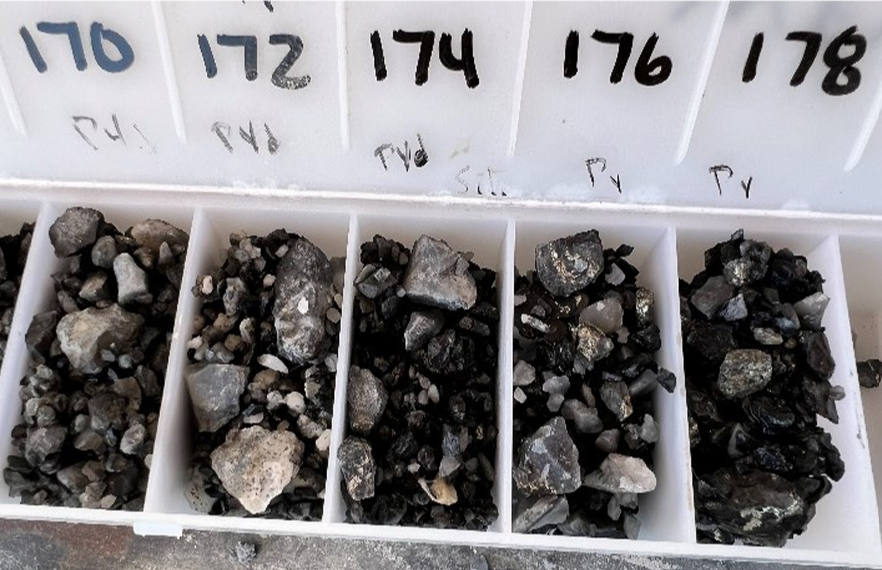
RC sample chip trays for WEW10001.
Underexplored region
The geological setting of the target area is relatively poorly understood, being proximal to the boundary of the Proterozoic Paterson Orogen and the Archean Pilbara Craton, much of which is concealed beneath the more recent sedimentary cover.
The major vines sault structure is intersected to run broadly NNE-SSW through the centre of E45/5045 towards the Nifty mine.
Limited relevant mineral exploration activity in the area of interest (at SGC-1) has previously been completed, and this has been restricted to broad-spaced geophysical surveys with the nearest drilling several kilometres away.
Maiden drill results for SGC-1, coupled with the historically underexplored nature of the region and recent major discoveries, demonstrate the Mt Cecelia Project’s potential for discovery.