
Kin Mining NL (ASX:KIN) is honing in on emerging high-grade gold thanks to reverse circulation (RC) and diamond drilling along the Cardinia Gold Project’s Eastern Corridor in WA.
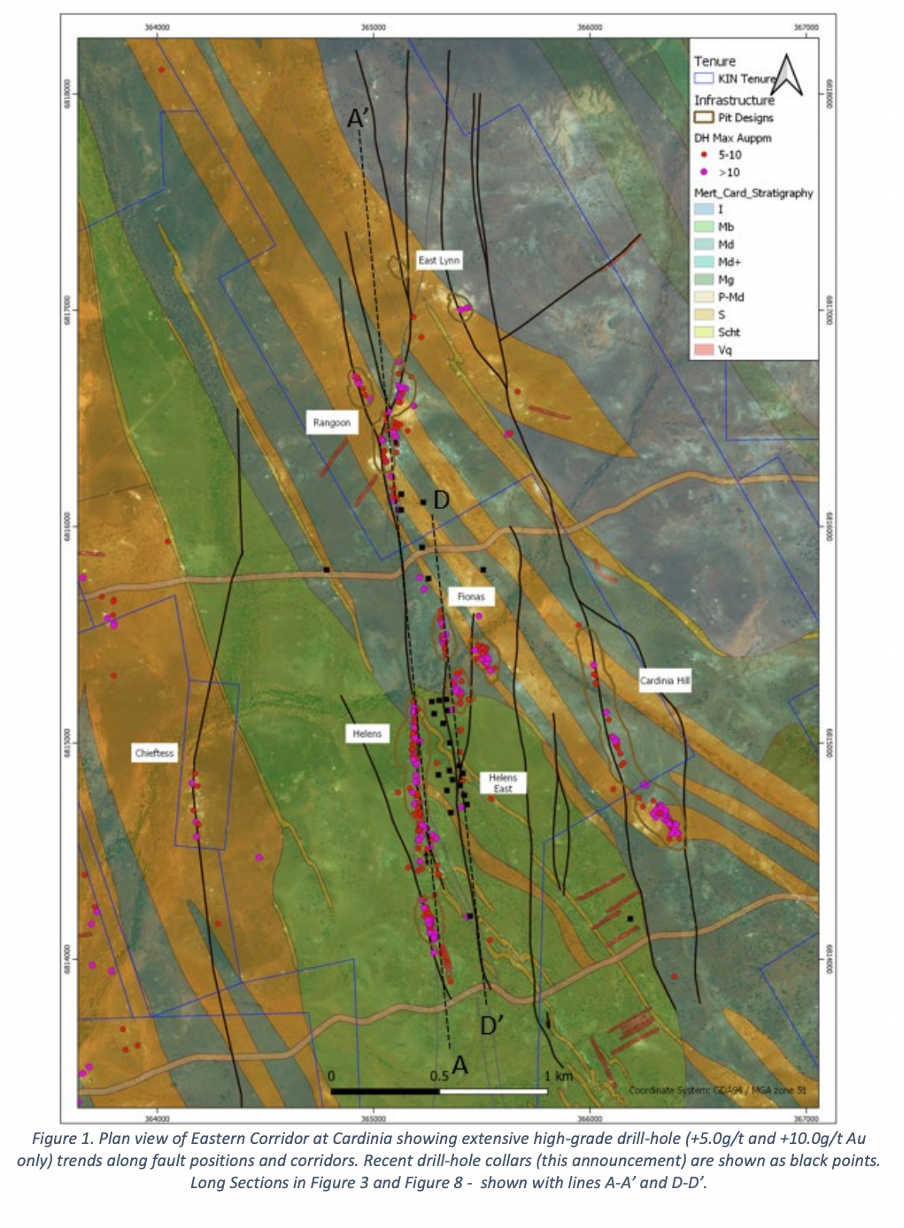
The precious metals explorer says drilling has demonstrated the potential for higher-grade, quartz-sulphide lode-style mineralisation below existing shallow resources at the corridor’s Helens-Rangoon and Helens East faults.
Results are pending for the southern half of the Helens East RC program, but some of the best new assays include:
- 2 metres at 24 g/t gold from 204 metres;
- 3 metres at 2.3 g/t from 153 metres; and
- 7 metres at 2.42 g/t from 93 metres.
In addition, diamond drilling at Helens-Rangoon has surfaced:
- 4.63 metres at 1.6 g/t from 215 metres; and
- 4.77 metres at 1.75 g/t from 214.5 metres.
What does it mean?
The newly identified vein-style mineralisation remains open in all directions along strike and down-dip. What’s more, there’s scope to define a major strike extent with further drilling.
Broadly speaking, the latest gold hits confirm the Eastern Corridor is a series of high-grade lodes, woven along an extensive inter-connected structural system with significant depth potential.
Kin plans to return to the soil in 2023 as it works to unlock the emerging gold opportunity at Cardinia.
“Strong proof-of-concept”
Managing director Andrew Munckton said the results provided strong proof-of-concept for an exciting new exploration opportunity.
“These results have shown, firstly, that the Helens East Fault is a significant structure, hosting high-grade gold mineralisation over a strike length of roughly 1 kilometre and to at least 200 metres below surface which runs parallel to the Helens-Rangoon Fault.
“Secondly, the drilling has shown us that the Helens-Rangoon Fault, which hosts the majority of the +5 g/t gold intersections in the Eastern Corridor, appears to be a zone of continuous mineralisation over its 3-kilometre strike length and remains open along strike.
“Thirdly, we now know that the Eastern Corridor hosts a number of significant structures including the Helens Rangoon Fault, Helens East Fault and the Cardinia Hill Fault, containing several yet-to-be drilled targets where narrow, high-grade quartz-sulphide lodes may persist to significant depths as part of a large mineralised system.
Next up
Kin plans to make further headway at Cardinia, with follow-up exploration along the Eastern Corridor pencilled in for this year.
In a nutshell, the campaigns will be designed to boost confidence in the extensions along the Helens East, Cardinia Hill and other mapped faults in the area.
This, in turn, will pave the way for future infill drilling programs to update and extend resource estimates across the Eastern Corridor.
Munckton continued: “Confirming the presence and continuity of high-grade mineralised zones opens up an important new avenue for our exploration team to target new, high-grade discoveries within the Eastern Corridor, complementing the shallower, bulk style resources which we have already defined.
“We are looking forward to receiving the rest of the results from this program and to refining our forward program of drilling for 2023, aimed at strategically targeting these high-grade sulphides lodes over a considerable strike extent and fully evaluating this exciting opportunity for our shareholders.”