
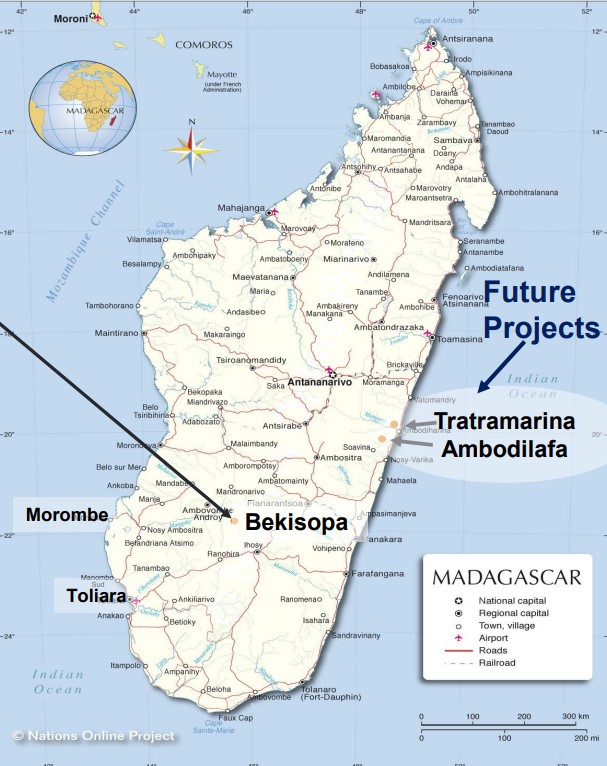
Akora Resources Ltd (ASX:AKO) is an emerging iron ore play in Madagascar advancing the Bekisopa (100% owned), Tratramarina (100%) and Ambodilafa (90%) iron ore projects.
The company’s flagship project is Bekisopa, for which Akora published mineral resource estimates in March and April 2022.
Akora also completed a promising scoping study for Bekisopa in November 2022 and aims to publish a pre-feasibility study (PFS) focusing on an initial direct shipping ore (DSO) operation in late 2023.
It is worth noting that Akora’s results to date demonstrate Bekisopa has the potential to produce clean, premium-grade iron concentrates suitable for DRI (direct reduced iron) pellet production.
As steel sector decarbonisation gathers pace, deposits that can meet DRI specifications such as Bekisopa are set to become of far greater importance.
In this article:
- Green steel future
- Readily upgradable iron mineralisation
- Scoping study scenarios
- Scoping study results
- Moving to prefeasibility study
- Potential to produce “clean” premium-grade iron
- Next steps
- Other projects with long-term potential
Green steel future
Cleaner steel-making technologies such as hydrogen-based DRI and a wholesale switch to electric arc furnaces (EAFs) will require higher quality iron ore feedstock.
Wood Mackenzie estimates the consumption of high-grade iron ore pellet feed will have to increase 5.5x to 750 million tonnes by 2050.
Akora looks well placed to feed the green steel future with its +67% high-grade iron feed, with low impurities, which is required by the iron and steel industry to achieve reduced carbon emissions.
It also seems likely that the ultimate market for Akora’s products will be in India and the Middle East as shipping distances to these markets are less than half the distance to China.
Although the iron ore sector is substantial with global production of more than 2.5 billion tonnes in 2021, it is largely dominated by a few large mining companies.
There are relatively few mid-tier independent producers in the sector which presents an opportunity with higher growth potential for Akora.
Readily upgradable iron mineralisation
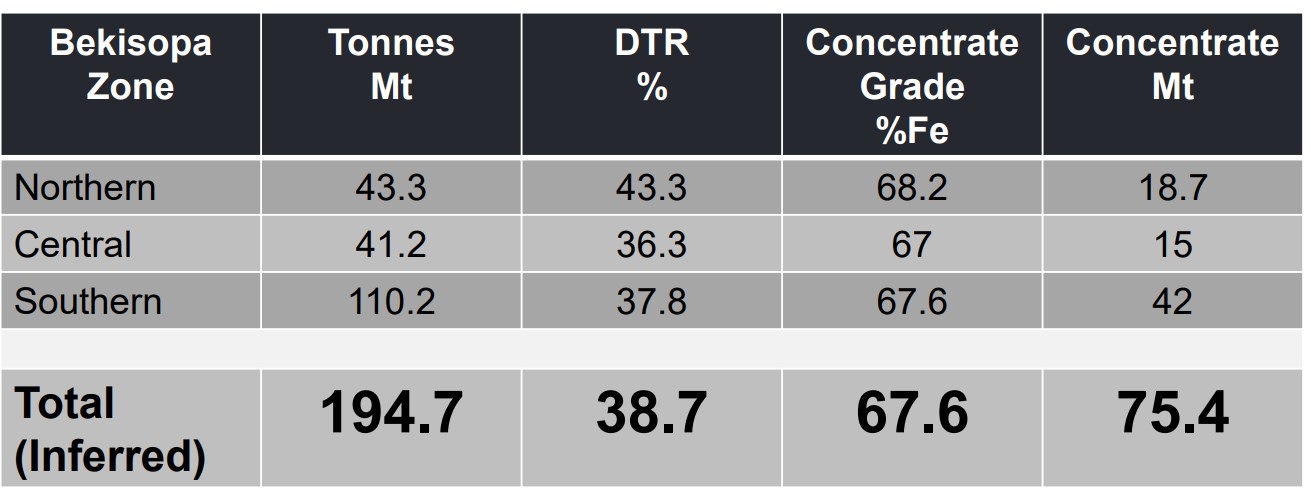
Akora’s maiden inferred resource, published last year, stands at 194.7 million tonnes at a head grade of 32% Fe (iron), for 75.4 million tonnes of iron concentrates at a grade of 67.6% Fe.
Davis Tube Tests (DTT), standard magnetic separation tests used in iron ore, demonstrate the iron mineralisation at Bekisopa is readily upgradable.
Concentrates grading 67.6% Fe can be achieved from a cut-off grade of 15% Fe and concentrates grading 69.7% Fe from a cut-off of 25-45% Fe, both at relatively coarse grain sizes of 75µm (microns).
Ore recoveries, measured by DTT, are also higher than at many Australian projects, meaning less material has to be processed to achieve the same volume of product.
Scoping study scenarios
Wardell Armstrong International (WAI) completed a scoping study in November 2022 to support the development of Bekisopa.
Three project scenarios were studied by WAI and are:
- Scenario 1. DSO mining and processing of known DSO mineralisation within the inferred mineral resource. This scenario is the starting phase for each of the other two scenarios.
- Scenario 2. DSO production, as described in Scenario 1, followed by the mining and producing a high-grade crushed 2mm fines product (DSO and fines).
- Scenario 3. DSO production, as described in Scenario 1, followed by mining and producing a premium grade concentrate at 75 microns (DSO and concentrates).
Scoping study results
The DSO scenario envisages annual production of 2Mtpa for the first 11 years.
Assuming a 64% Fe-content DSO selling price of US$130/t CFR China, and estimated cash operating costs of US$38/t, the project would be expected to generate annual EBITDA of US$187 million per annum at full production, at an EBITDA margin of 70%.
It is assumed that once the DSO material is exhausted, Akora will continue to produce and sell either iron fines (DSO and fines) or iron concentrates (DSO and concentrates) for 15 years commencing in 2036 (year 11 of the project).
The DSO and fines scenario boasts a post-tax NPV of US$554 million (A$792 million) and the DSO and concentrates scenario has an NPV of US$598 million (A$855 million).
Moving to pre-feasibility study
Akora is planning to progress to a pre-feasibility study this year for the DSO at Bekisopa.
This next phase of the study can be undertaken once the DSO in-fill drilling assay results have been received and incorporated into an updated mineral resource estimate, which is anticipated to define the DSO tonnage and grade in a better than inferred category.
This is expected to be completed in April 2023.
Akora managing director Paul Bibby said following the release of the scoping study: “We are very pleased to have completed the scoping study for Bekisopa.
“The study confirms viable pathways to production with robust project economics and provides knowledge that positions Akora to move to a pre-feasibility study, subject to funding, on the Bekisopa DSO in 2023.”
Akora’s recently completed in-fill drilling program at the Bekisopa Southern Zone aims to increase confidence in the resource.
All 85 shallow drill holes intersected mineralisation. Assay results and a resource update are expected in early 2023.
Potential to produce “clean” premium-grade iron
Iron and steel production accounts for more than a quarter of final industrial energy consumption and about a quarter of all industrial CO2 emissions.
Limiting the rise in global temperatures to 1.5°C in line with the Paris Agreement will require huge changes, including commercialising technologies such as hydrogen-based DRI.
In DRI, the iron ore is ‘reduced’ (oxygen is removed) without melting.
Akora’s results to date demonstrate Bekisopa has the potential to produce very clean, premium-grade iron concentrates suitable for DRI pellet production.
Next steps
Akora’s focus over the next 12 months or so will be on delivering a PFS.
This will be focused on the DSO material, and potentially will include either some fines or concentrates production depending on how much of the resource is in the Measured category.
A number of other studies including pit optimisation, geotechnical, hydrological, and weather cycle mapping will also need to be completed.
The company plans to undertake further crushing and screening trials aimed at better defining the metallurgical processing circuit for the DSO material.
Akora will also continue to study port and shipping options, including evaluating the suitability and cost of the existing port facilities, and the options around a conveyor system.
Other projects with long-term potential
In addition to the opportunity at and around Bekisopa, Akora owns the Tratramarina and Ambodilafa projects on the east coast of Madagascar.
The company conducted rock chip sampling and a 7-hole drilling program at Tratramarina in 2009-2012, returning solid results.
Management views the project as a priority exploration target with excellent potential for upgradable magnetite iron ore grading 25-35% Fe.
At Ambodilafa, an airborne magnetic survey conducted in the mid-2000s identified a strong north-south trending magnetic anomaly that suggests the presence of iron ore.
Sources: Akora Resources, Orior Capital