
November 2022 saw both Airbus and Rolls-Royce lay out ambitious plans to produce hydrogen fuelled aircraft, citing the zero-carbon fuel as a potential solution to the aviation industry’s ‘green’ problem.
Dubbing the fuel as “one of the most promising alternatives to power a zero-emission aircraft,” Airbus laid out plans to fly its hydrogen fuelled plane within the 2020s.
Meanwhile, Roll-Royce, alongside partner easyJet PLC, fired up its first ever hydrogen-powered jet engine, suggesting the tests were a “milestone” in reshaping the “future of flight”.
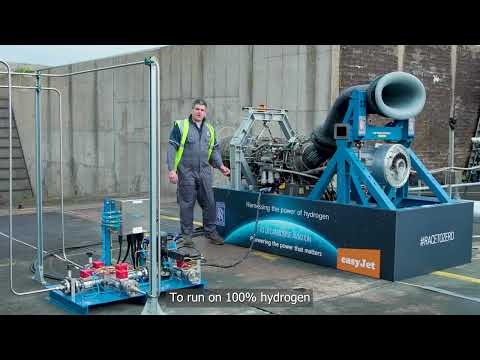
Rolls-Royce AE2100 Hydrogen Test at Boscombe Down. Source: Rolls-Royce
Business Secretary Grant Shapps even added that hydrogen could be the answer to the worlds much-needed “shift to guilt-free flying”.
Needless to say, hydrogen has become a much talked about topic in aviation, which, under the International Air Transport Association, is aiming for net-zero emissions by 2050.
But how viable is it really as a replacement to conventional fuel?
Hydrogen is produced by splitting water molecules, sometimes through electrolysis, but more often using gas, oil or coal.
This means that as a ‘low-carbon’ fuel, hydrogen can only really be as green as the method used for production, considering the emissions released during this process.
While the production of hydrogen gas is a relatively simple process, in order to be used in aircraft it would likely have to be liquified.
Energy intense production but ultimately less efficient
This is where issues begin to arise, given the energy intense process of cooling this to almost -253 degrees celcius.
Clean energy expert Michael Liebreich outlined that liquifying 7,500 tonnes of hydrogen per day to meet Heathrow’s fuel needs would require roughly 2.8GW of electricity, “similar to the output of Hinkley Point C”.
Hydrogen is also "highly volatile,” geopolitical analyst Irina Tsukerman said, and would have to be kept at extremely low temperatures in aircraft or risk evaporating and expanding.
Boiling point of hydrogen compared to kerosene (in degrees celcius).
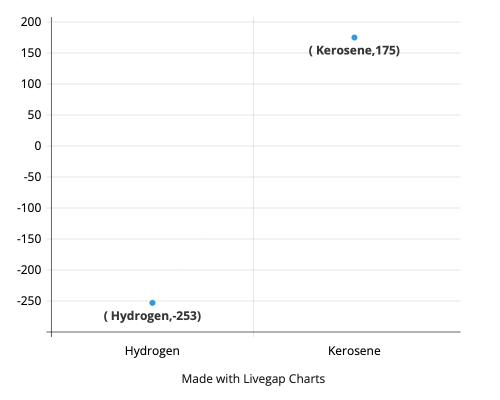
Data from International Labour Organisation.
Even this is not hydrogen’s biggest downside though.
While Airbus Group explained that by stacking hydrogen fuel cells “the megawatt levels of power – which are needed for an electric aircraft – are achievable,” experts tend to disagree, suggesting the amount of the fuel needed for aircraft would be excessive.
Hydrogen, while being “one of the hottest items in the long-term pursuit of renewables,” requires about four-times the volume of conventional jet fuel for the same amount of power, according to Tsukerman.
Drastic redesign of planes needed
This means “future aircraft might have to be redesigned completely to allow for the space issue and safe transportation,” she said.
Michael Liebreich added: “The difficult bit is that even for short haul, one third of your fuselage is liquid hydrogen at take off.”
“Longhaul is completely out,” he warned.
The UK has a lack of infrastructure to carry hydrogen between airports too.
Liebreich suggested that for Heathrow airport alone, “2,340 trucks” would be needed to deliver liquified hydrogen every day.
While hydrogen in aviation is indeed “fun to think about” and is gaining lots of public attention, in the words of Liebreich, it may well be “a dead end".
Some commentators have been less critical though, seeing past the storage and transport issues.
Only way to decarbonise flight?
Discussing recent breakthroughs in nuclear fushion, FuelCell Energy boss Tony Leo said: “We will be able to use it [nuclear fusion] to produce hydrogen which can be stored more easily and used to power a boat or plane."
Rinaldo Brutoco, chief executive of aerospace firm H2 Clipper, suggested hydrogen was the “only conceivable way” to replace fossil fuels in transport industries in the future, meanwhile.
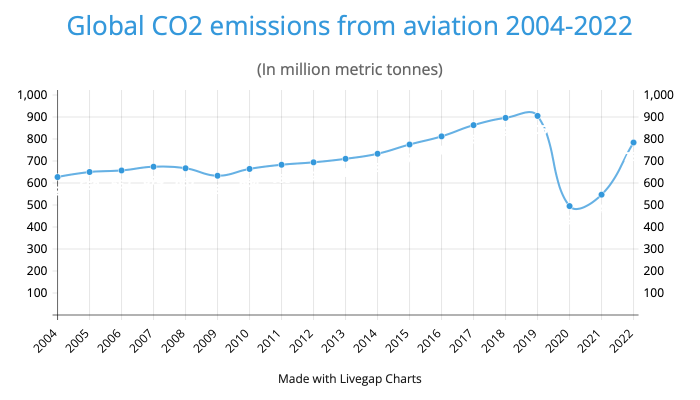
Data from International Energy Agency and Statista.
The fact remains though, that with current technology a Boeing 747 would require 1mln litres of hydrogen to deliver the same range as 0.25mln litres of conventional fuel, as pointed out by Liebreich and Tsukerman.
So, whether breakthroughs will see hydrogen lead the way in powering aircraft, or whether it is a non-starter remains to be seen.
Firms will have to tackle the huge storage and infrastructure hurdles if they wish to see it take this leading role, while also ensuring they source hydrogen from low-emissions fuels.
That's not to say that some progress hasn't been made on other low-carbon aviation technologies.
Indeed, Rolls-Royce Holdings PLC has developed a line of engines with improving efficiency, perhaps because of their more realistic prospects for powering green flight.
Its Ultrafan engine, due to be rolled out commercially by 2030, will run on sustainable aviation fuels made from waste.
These themselves are said to emit 80% less carbon dioxide than conventional fuel.
Create your own user feedback survey
Header image credit: Rolls-Royce