
City Index senior market analyst Matt Simpson discusses the latest outlook on crude oil for 2023, including the possibility of further volatility; the impact of a potential recession; China, Russia and other geopolitical factors; and an evaluation of where oil prices might head.
In this article
- The great pump n’ dump of oil prices in 2022
- Will it be less volatile in 2023
- China to fully open in 2023?
- Weak growth and potential recession/s
- The EU’s ban on Russian oil
- OPEC+ to the rescue (of oil prices)
- De-escalation of war
- ‘Weather’ or not…it depends.
- Higher oil prices seem more likely in 2023
- Oil to range between $60 - $110
- Conclusion
The great pump n’ dump of oil prices in 2022
Oil prices couldn’t wait to get out of the gates in 2022 with a cocktail of supply chain bottlenecks, increased demand from the great reopening and then Russia’s war in Ukraine catapulting prices sharply higher.
In fact, WTI prices rose around 75% from January’s low to the March high, which prompted the usual epic calls of $200 and even $300 oil prices (literally at the peak).
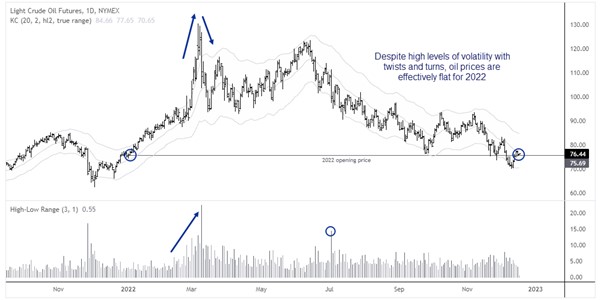
Yet Western sanctions on Russia prompted a sharp reversal of oil’s fortunes, sending prices -28.3% lower from the March high in just seven days and marking the peak for the year.
Whilst the rally tried to recover over the next two months, WTI has continued to trend lower since the June high around $124 and since handed back all the year’s early gains.
Of course, this is great news for inflation because the vast majority of inflationary inputs can be linked back to oil one way or another. And as inflation remains a key theme heading into 2023, expect oil prices to be watched as closely as ever.
Will it be less volatile in 2023?
With Russia more than willing to use energy as a weapon, the potential for further volatility is more than apparent.
However, one could argue that the element of surprise Russia wielded in Q1 is no longer present and, without a fresh catalyst, it seems less likely we’ll be subjected to similar level of volatility seen in early 2022.
Famous last words? Perhaps. But there is some logic to it.
Weighing up oil’s drivers
Weak growth and potential recession/s
The theme of weak growth in 2023 has been widely publicised, with IFM and central banks alike all forecasting a loss of momentum for the global economy.
Not many are forecasting a recession but that doesn’t mean we won’t get one.
In either case, it could dampen demand for oil and a recession would weaken that demand further.
China to fully reopen?
China is a great source of oil demand, given it is the second largest consumer of oil behind the US.
With Beijing continuing to roll back COVID restrictions and the ambassador to the US saying they look forward to international travellers “soon”, then it bodes well for demand – and therefore higher prices.
The EU’s ban on Russian oil
The EU and UK banned seaborne crude imports from Russia on December 5, having already banned coal imports.
Whilst we have already seen India and China step in to pick up Russia’s discounted oil, it has not been enough to plug the financial gap for Russia.
Regardless, this does impact the global supply of oil, which is likely supportive of prices.
OPEC+ to the rescue (of oil prices)
Rest assured that should demand suffer too much then OPEC+ will step in to reduce supply and support oil prices.
De-escalation of war
This is not a prediction but simply a scenario to consider.
Should Russia’s war on Ukraine de-escalate then it could open up supply lines and weigh on oil prices.
However, this seems to be an unlikely scenario at present – and if it happened at all in 2023 it is more likely to be in the second half or last quarter.
‘Weather’ or not…it depends
Unfortunately for Putin’s grand plan, Europe has not yet endured a deep freeze as the weather has not been as cold as expected. But we can’t assume every year will be like this, and cold weather increases demand for heating oil and therefore crude.
This is not something I’m willing to forecast so far out, but it is an unknown element that could impact oil prices later in the year, and therefore inflation.
Higher oil prices seem more likely in 2023
On balance, it seems oil prices are more likely to face upwards pressure in 2023. This should help it regain some of the losses sustained since the June high but without the white-knuckle ride or break to new highs and head for $200.
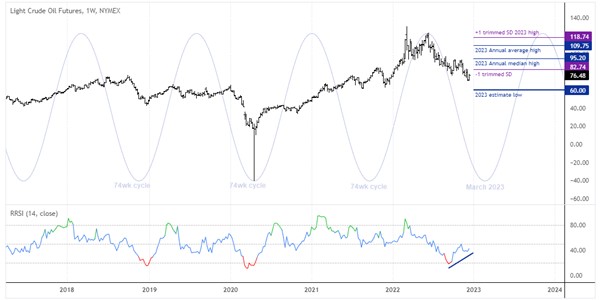
The Rapid RSI (developed by Ian Copsey) reached oversold in September and is now forming a bullish divergence. This could still allow for prices to create a new low, but it appears we have seen a cycle low in momentum.
Given the fundamentals mentioned above, we suspect that WTI will hold above $60 in 2023 and will therefore be used to project our high-low range estimates from.
We have an approximate 74-week cycle on WTI – although such cycles always need to be taken with a pinch of salt.
However, if the cycle holds it suggests a low for WTI around March and for it to turn higher until its peak around Q4.
Oil to range between $60 - $110
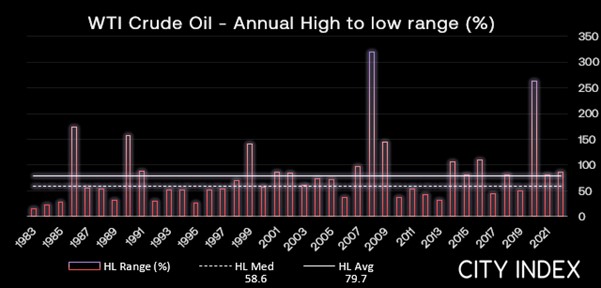
Looking back at annual data since 1983, oil prices have averaged a high to low annual range of 79.7%, whilst the median is 58.6%. For comparison, the current high-low range of 2022 is 86.2%, which means despite the perceived higher levels of volatility, the high-to-low range of 2022 is close to average.
The standard deviation of the entire set is quite high at 61.1% and projects a wide standard deviation band of 18.6% - 140.8%.
However, if we remove the three outliner years with a HL range above 150%, the ‘trimmed’ standard deviation band becomes 37.9% to 97.9%.
Assuming a 2023 low of $60 projects a 2023 high of $118.74 with +1 TSD or $82.74 with -1 TSD.
Conclusion
- We estimate oil to range between $60-$110 in 2023.
- Oil is more likely to close higher in 2023 than lower.
- China reopening, OPEC+ support and a soft landing should overpower the bearish factors. Higher oil prices will keep inflation in the mid-single digits.
- Central banks will be forced to keep interest rates higher for longer.