
Natural Resources
Comment
20 December 2022
Electric Dreams Are Still Yellow.
The old joke goes that Nuclear Fusion power, to many the holy grail of green energy, is always 30 years away but this week saw an announcement from the National Ignition Facility (NIF) in California that suggests that joke might finally be put to bed.
The scientists at the Livermore National Laboratory reported the breakthrough achievement of a net 50% energy gain from the latest fusion experiment, the first time more energy has been produced than was put in. The NIF test used a system called ‘inertial confinement’ which uses lasers to heat up the deuterium and tritium fuel unit to extreme temperatures (3m oC), causing it to implode and atomic fusion and energy release to occur.
The NIF announcement follows other recent promising news from ‘magnetic confinement’ experiments in China and Europe, which sustained fusion reactions for longer than achieved before (100 seconds and 53 respectively), though failed to produce an energy gain.
These groups, testing energy generation (as opposed to the NIF, which has mainly studied defence applications), use a tokamak machine to create the fusion reaction. The tokamak relies on heating the colourless deuterium and tritium fuel with an electric current to ~100m oC, turning it blue-green and into a plasma which allows fusion to take place. The plasma is controlled by super powerful magnets, hence ‘magnetic confinement’.
So, albeit through two different methods, we now have proof that we can generate more energy than we put in and we can sustain the reaction. The two fundamentally key factors required to produce a fusion power generation plant.
Job done? Not quite.
Although net energy gain and sustained reaction are two of the fundamental factors required to produce a fusion power station, scientists have pointed out there is a long way to go to achieve a commercial fusion reactor. Estimates of timing range from around 2035 to several decades.
The physics hurdles remain large. According to Scientific American, for a commercial power plant the energy gain needs to increase by at least two orders of magnitude and the reactions need to be self-sustaining. Something the European tokamak project doesn’t expect to achieve until 2035.
The engineering challenges, not least being able to actually extract the heat generated by the fusion reaction to generate power, are equally daunting.
So as astonishing a milestone as this is, nuclear fusion isn’t going to meet the energy challenges we face in the short and medium term.
Ready alternative
After last week’s announcement it may feel a bit old school, but it’s worth just reminding ourselves that we already have a zero-carbon nuclear solution – using yellow cake to power nuclear fission reactors.
According to the World Nuclear Association (WNA) today there are about 440 fission reactors operating in 32 countries, with 390 GW capacity supplying about 10% of the world’s electricity (2021).
The IEA’s 2022 World Energy Outlook suggests that the percentage contribution of nuclear to total electricity generation will shrink to about 9% by 2050, given the growth in overall electricity requirement. That still represents a ~ 50% expansion in nuclear generating capacity. The WNA calculates that 60 plants are currently under construction, a further 100 are on order or planned and more than 300 are proposed, mostly in Asia – China, India and Russia.
With current uranium demand at ~170mlbs pa, primary and secondary production has been running a supply deficit of some ~20mlbs to 30mlbs per annum since 2020. That is projected to continue until at least the middle of the decade. At the same time unfilled uranium requirements from existing US, European and Japanese nuclear plants are estimated to reach ~ 35 mlbs per year by 2026.
Uranium stocks have had almost as many false dawns as the fusion story but recently, the uranium price and equities moved off the lows.
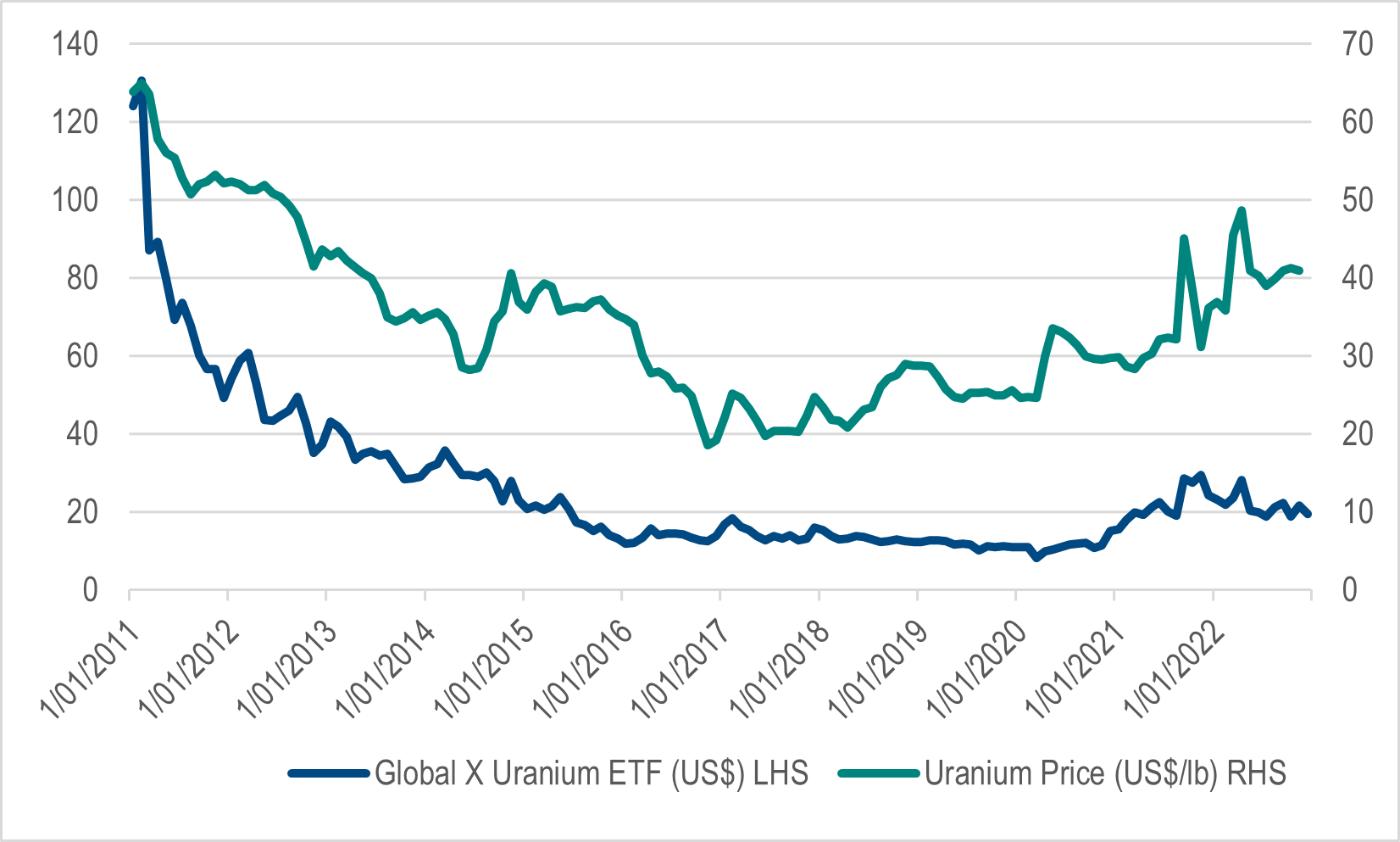
Global X Uranium ETF equity index and spot uranium price
The WNA estimates that a 1 GW plant requires ~450klbs of uranium per annum, and two or three times that to get it started. On a rough estimate if all the planned new plants come on stream, in addition to those currently being built, that equates to a 50% increase in uranium required. Add in those proposed and it jumps to over 230%.
If most of that additional demand is coming from Asia, who maybe won’t be so reluctant to take Russian material, the UK, US and France are doing their bit for more uranium demand in the west through leading the development of Small Modular Reactors (SMR’s). Though most designs won’t be commercially available before the mid-2030’s.
Generating 50Mw to 300Mw (vs UK’s newest Sizewell B at 1.2Gw or the in-construction Sizewell C at 3.2Gw) SMR’s are modular by design, essentially flat-pack power stations, with a smaller footprint, less cooling water required, delivering lower costs and construction risks – particularly important perhaps for western countries where nimbyism and permitting challenges make it very difficult, if not impossible, to install new large scale nuclear plants.
Perception of risk from accidents is of course the Achilles heel of nuclear fission power, driven by occasional catastrophic failures stretching back to the 1979 Three Mile Island. US Civil Nuclear commission policies from that date mean it’s nearly impossible to build a new large scale nuclear plant.
The headlines are always alarming, but the data doesn’t really back it up, certainly in comparison to the harm caused by other power generation sources. In the US nuclear industry for example 10 people have died since its inception, and none from radiation. However, concerns over waste disposal clearly remain a problem.
Even here there is technological progress. Newcleo are looking to build 200MW lead-cooled fast reactors in UK and France which use waste produced by conventional reactors. Don’t say it out loud, but that obviously means no need for newly mined uranium.
Last week’s announcement highlights the ingenuity of humans to find technological solutions to its problems and points to the future of the nuclear industry as a fusion one. But, before we get there, the answer is still yellow.
Charlie Cryer
Head of RFC Ambrian London
+44 (0)20 3440 6834
charlie.cryer@rfcambrian.com