
Auric Mining Ltd (ASX:AWJ)’s recently completed drilling at the Chalice West Project near Higginsville-Widgiemooltha, WA, has given the company plenty of food for thought as it pursues rare earths in the underexplored territory.
The drill program wrapped up on November 22 following 227 aircore drill holes covering 7,227 metres.
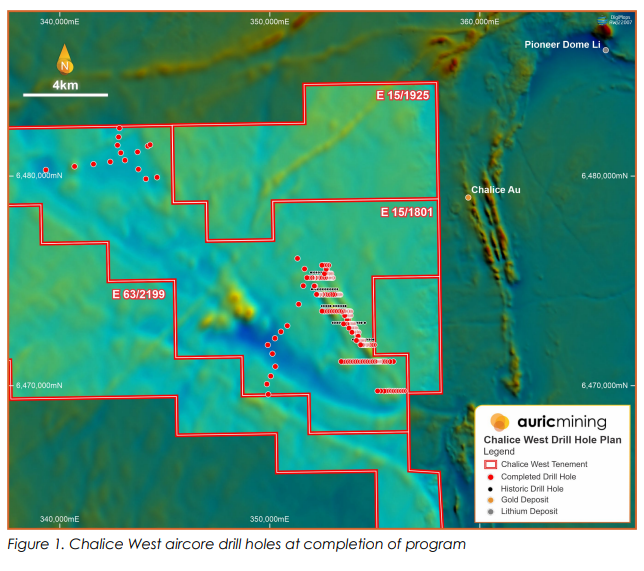
Highly anomalous regolith
The program uncovered a highly anomalous one-metre regolith interval at 1.1 wt.% total rare earth oxides (TREO) and 22% mixed rare earth oxides (MREO), with only 139 parts per million (ppm) phosphorous.
Of particular note was one 17-metre interval from 4 metres below surface, which registered 1,699 ppm TREO (21% MREO).
The magnetic granite from bottom-of-hole samples contains up to 1,595 ppm TREO (28% MREO).
Anomalous REE values coincide with a linear 7-kilometre-long NW-trending magnetic feature, which appears to be open in all directions.
Importantly, the REE mineralisation appears to be hosted in clay rather than granite.
Multi-element analysis
Auric has conducted on-site pXRF testing for nickel and proxies for lithium and rare earth elements (REE) and used this as an objective basis for selective (one-metre) sampling and associated multi-element laboratory analyses.
REE analyses have been returned for 95 bottom-of-hole (BOH) composite samples and 178 one-metre interval regolith samples for 19 holes.
Analyses are pending for a further 108 BOH samples and 193 one-metre interval samples.
Several distinctly anomalous intervals for REE have been returned in the results received to date. The current results reveal anomalous REE values from regolith and BOH samples with up to 1.1 wt.% TREO (total rare earth oxide).
All analyses were performed using four-acid-digest in order to include nickel, lithium, REE and other metals in the analysis.
This method also minimises the digestion of acid-resistant REE minerals such as monazite, that are unlikely to be recovered from REE clays.
Metallurgical tests and petrographic studies will determine the leachability and nature of the high-grade REE mineralisation.
The bottom-of-hole geochemistry data indicates that anomalous TREO concentrations coincide with magnetite-biotite-rich granite along a roughly 7-kilometre-long northwest-trending magnetic feature.
The company believes there are lots of positive results still to come from this drilling program.
Future work
Auric has its sights trained on the REE opportunity in this “virtually virgin” territory.
Rain has slowed some of the planned activities on site but some of the next steps include:
- interpreting data of pending assays;
- metallurgical test work using ionic solutions at different pH concentrations to quantify the leachability of the REEs in the clay horizon;
- reprocessing or flying aeromagnetic and radiometric over the magnetic features to obtain detailed outline of the anomalies identified in the GSWA dataset;
- petrography work to characterise the deportment of REEs in the clay horizon;
- drill postponed holes over the prominent magnetic high west of currently defined REE anomalies; and
- further drilling to test the REE clays if metallurgical results are favourable.